 The Game: Players assume the role of Susumu Kodai, a hot-headed young recruit unexpectedly thrust into a leadership role on a mission to cross the galaxy and procure a device that can restore planet Earth’s war-decimated ecosphere within a year. As if crossing the Milky Way and returning within a year wasn’t enough of a formidable task, the Space Battleship Yamato faces stiff opposition from an alien race, the Gamilas, determined to seal Earth’s fate by bringing the last-ditch rescue mission to a halt. Kodai and the Yamato’s ailing commander, Admiral Okita, must decide where to commit their forces for maximum effect. Large squarons of Cosmo Fighters can be dispatched to take the Gamilas on head-to-head on the on-screen grid, but Yamato herself can also be ordered into the thick of the action (a strategy that puts the entire mission in jeopardy if the battle is lost). Success means fighting through the Gamilas’ offensive front and reaching planet Iskandar. Failure means death for all humankind. Pick your battles wisely. (Interbec, 1992)
Memories: Space Battleship Yamato is, to this date, one of the best anime series that anyone in Japan has yet produced. First aired in 1974, its meaningful, carefully-paced tale of duty, honor, sacrifice, compassion and rapproachment is one that remains nearly unsurpassed. It’s like the best war movie ever, except animated. The series very carefully laid out the tactical stakes of its frequent battle scenes, and showed how both sides planned their next moves – it’s a fertile breeding ground for tactical action games. And yet, of the few video games based on Yamato, fewer still have done the action and adventure and drama of the series justice. In a nutshell: the games aren’t as fun to play as the show is to watch.

 The Game: As the commander of a sleek Solvalou fighter, you’re deep into enemy territory, shooting their disc-shaped fighters out of the sky, bombing ground installations and artillery nests, bombing tanks, and trying to destroy the mothership. As you progress further behind enemy lines, heavier aircraft and more versatile and Buy this gamedeadly ground-based defenses become the norm. Also look out for tumbling airborne mirrors – they’re impervious to your fire, but you’re toast if you fly right into them. (Nintendo [under license from Namco], 1986)
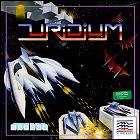 The Game: Destroy massive motherships while fighting waves of enemies and avoiding obstacles at breakneck speeds in this groundbreaking horizontal SHMUP. There’ll be time to rest when you’re dead. (Hewson, 1986)
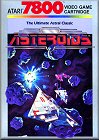 The Game: As the pilot of a lone space cruiser, you must try to clear the spaceways of a swarm of free-floating asteroids, but the job isn’t easy – Newton’s laws of motion must be obeyed, even by asteroids. When you blow a big rock into
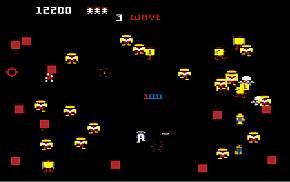 The Game: In the year 2084, all hell has broken loose on Earth. Robotic servants, created to perform dangerous tasks and defend their human creators, have decided they can do without their masters. The robots have evolved into new and terrifying varieties – the ever-multiplying Ground Roving UNit Terminators (GRUNTs), indestructible Hulks, self-replicating Quarks and Tanks, and most horrfying of all, the Brain robots, which capture humans and reprogram them into super-fast killing machines. And the only thing protecting the last remaining survivors of homo sapiens is your strength, endurance and cunning. (Atari, 1984 [released in 1987])
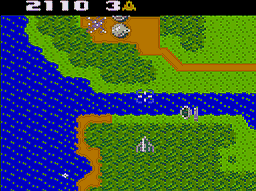 The Game: As the commander of a sleek Solvalou fighter, you’re deep into enemy territory, shooting their disc-shaped fighters out of the sky, bombing ground installations and artillery nests, bombing tanks, and trying to destroy the mothership. As you progress further behind enemy lines, heavier aircraft and more versatile and deadly ground-based defenses become the norm. Also look out for tumbling airborne mirrors – they’re impervious to your fire, but you’re toast if you fly right into them. (Atari, 1984; released circa 1987)
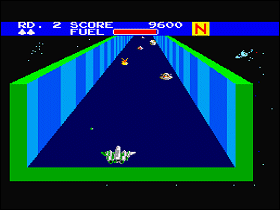 The Game: As the lone pilot daring enough to breach the defenses of Zaxxon’s space stronghold yet again, you take on a fleet of perimeter fighters, some of whom helpfully leave power-ups behind when destroyed. Then it’s into the space base once more, bristling with gun emplacements, fuel tanks that gas up your fighter when they’re shot (we haven’t quite worked that one out either), and walls that you can run face-first if you’re at just the wrong altitude. Just beyond the walls of the base lies the new and improved Zaxxon itself; if you survive that encounter, you begin again. (Sega, 1987)
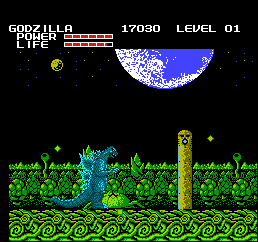 The Game: It is the year 2XXX (don’t worry, we couldn’t find it on our calendars either), and Planet X has declared war on Earth’s solar system, sending its finest kaiju into the fray. In this time of our most desperate need, Godzilla and Mothra step forward to defend the Earth and fight for humanity, taking out enemy installations, spacecraft and even those pesky enemy monsters. But even Godzilla and Mothra can only take so much damage… (Toho Studios/Nintendo, 1988)
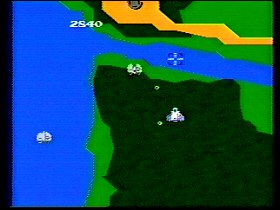 The Game: As the commander of a sleek Solvalou fighter, you’re deep into enemy territory, shooting their disc-shaped fighters out of the sky, bombing ground installations and artillery nests, bombing tanks, and trying to destroy the
 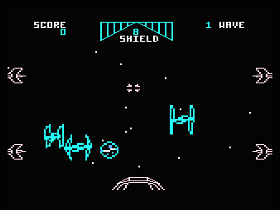 The Game: You’re an intrepid X-Wing pilot participating in the last-ditch Rebel attempt to destroy the Death Star – before it destroys the Rebel base on Yavin IV. TIE Fighters try to intercept you, but you can destroy them (as well as use your own lasers to blast their incoming fire out of the sky). Then you move in to attack the Death Star itself, with its incredibly hazardous system of gunnery towers and bunkers. Once you’ve gotten past the surface defenses, you dive into the trench that will lead you to an exhaust port which is the only means of destroying the Death Star – but there are defenses in the trench as well, and your deflector shields can only take so much… (Domark / Zeppelin Games Ltd., 1988)
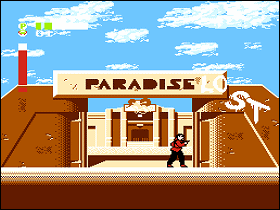 The Game: Sybok, a charismatic Vulcan cult leader, has tried to disrupt the peace process on the neutral planet Nimbus III. Players take control of one Enterprise crewman at a time to: retrieve the Nimbus III hostages (Sulu), save Kirk and Spock from a cell aboard the Enterprise (Scotty), pilot the Enterprise through asteroids and attacking Klingons (Sulu again?), and finally make a mad dash into the heart of the lair of the “god creature” (Kirk). Running out of life energy aborts the mission; fortunately, Dr. McCoy is standing by at all times and the mission can start from scratch. (Bandai, 1989 – unreleased)
 The Game: Players slide into the cockpit of Defender once again, defending the power generators on the surface of a human space colony from intruding aliens. As usual, the Defender is a versatile, fast-moving attack ship, but the aliens have an advantage in sheer numbers. Vaporizer bombs can clear the screen of attackers, but they’re in short supply. Eliminating all invaders clears the level and starts anew; running out of Defender craft means the aliens win. (Ensign Software, 1989)
 The Game: As a daring spy, you break into a top secret enemy facility, trying to grab vital secrets and evade or kill as many enemy agents as you can. Your only means of getting from floor to floor through most of the game is via the elevator – which gives you an advantage and also makes you vulnerable. (Taito, 1991)
 The Game: Captain Picard puts you in charge of a simulated mission aboard the Enterprise. With the helpful advice of Commander Riker, Data, Geordi, Worf and Chief O’Brien, you have to command the pride of the Federation fleet into a number of difficult situations, accomplish as much of the mission objectives as you can, and bring the Enterprise home in one piece. (Absolute, 1993)
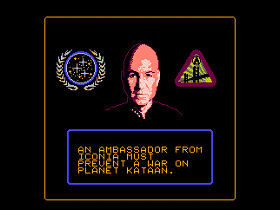 is that?) and having to go to their screens to kick in things like the shields, weapons and warp drive, when it comes right down to it, if you strip away these elements, it’s the same basic game: you’re blasting away at enemy ships and hoping to get more clean shots in at them then they get at you. He whose shields fail first gets blown out of the sky. In 11 years, the basic Star Trek game hadn’t evolved that much (but at least The Next Generation doesn’t get the torturously slow “story” scenes of Star Trek: 25th Anniversary).
 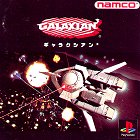 The Game: An alien war fleet is closing in on Earth, armed with a powerful weapon that can eradicate the entire planet. You (and, if you happen to have some fellow gunners, four others) man the artillery batteries of an armed-to-the-teeth ship on a mission to take the fight to the aliens before they can bring it to Earth. If you successfully complete that mission, you can also move on to a second mission to defend the planet Gourb from the Galaxian fleet. (Namco, 1995)
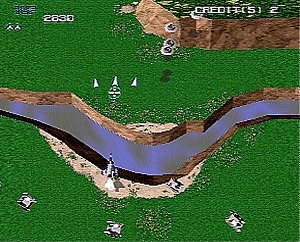
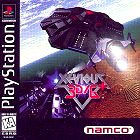 Memories: This somewhat obscure Namco title updates and revives their classic arcade title Xevious, which accumulated a cult following in 1983 when the game was released Stateside by Atari. Truth be told, Xevious 3D/G+ doesn’t rewrite the book or reinvent the wheel. For the most part, the game simply puts the original Xevious in a vaguely third-person 3-D perspective, adds some weapons and enemies (most notably the enormous and hard-to-kill Bosses), and kicks ass graphically. I liked this a lot. It has a great deal of respect and reverence for its source material.
 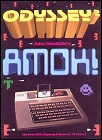 The Game: You’re alone in a maze filled with armed, hostile robots who only have one mission – to kill you. If you even so much as touch the walls, you’ll wind up dead. You’re a little bit faster than the robots, and you have human instinct on your side…but even that won’t help you when SmileyBot, a deceptively friendly and completely indestructible smiley face, appears to destroy you if you linger too long in any one part of the maze. The object of the game? Try to stay alive however long you can. (John Dondzila Classic Gaming Creations, 1998)
 The Game: In a first-person space shooter set in the Star Control universe, the player is charged with maintaining order in the spaceways, a job made a little more difficult by rival warlords trying to stake their claims on the interstellar shipping lanes. Your patrol ship is armed to the teeth, which is good – because so are their ships. (Accolade, 1998 – never released)


 The Game: Remember those BASIC programming how-to books in the 70s and 80s with the do-it-yourself minigames you could type in and run? They’re back. Daniel Bienvenu’s tribute to those classic games has a twist though: it’s running
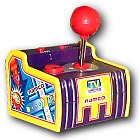 Memories: After I reviewed the dandy Techno Source Intellivision 25-in-1 TV Game, at least one e-mail suggested that I wasn’t being critical enough in my review. I praised that dandy self-contained gadget for capturing the flavor of those 25 classic Intellivision games, even if a lot of the finer details were left out. Those of you who thought I was going easy on that game should just stop reading this review now. Because I kinda dig this quintet of Namco goodness – with some significant reservations.