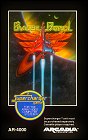
 The Game: The war between the humans and the spacefaring enemy Dracons isn’t going well, and you’ve enlisted to join the fight. In the cockpit of your space fighter, you toggle between your flight computer (where you can find and set a course for Dracon attack groups on the map, or helpful starbases where you can replenish and repair your ship) and the direct view ahead when you engage in combat. The Dracons throw a lot of firepower at you, but your own torpedoes have a longer “reach” than their ammo. Your ship can take a pounding in a firefight, gradually eliminating your shields, your targeting ability, and even your weapons. The game is over when you can’t withdraw for repairs and are destroyed by the Dracons. (Arcadia, 1982)
The Game: In 1982, an assemblage of former Atari programmers, along with a few hand-picked rookie programmers, started their own third-party video game venture. To be in that market at that time, however, one had to make games for the Atari 2600, and the Arcadia programmers’ game concepts outstripped that machine’s software. Not to be slowed down by that minor problem, Arcadia introduced a new piece of hardware along with its first game. The Supercharger more than doubled the 2600’s RAM, and had the beneficial side effect of allowing Arcadia to avoid the costly practice of having cartridge casings made; instead of cartridges, the Supercharger loaded its enhanced games from cassette tape, usually in under 30 seconds.

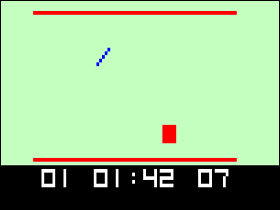 The Game: The first Channel F “Videocart” packs three games into one bright yellow package. Shooting Gallery is a straightforward target practice game in which players try to draw a bead on a moving target. Tic-Tac-Toe is the timeless game of strategy in small, enclosed spaces, and Quadradoodle is a simple paint program, long, long before its time. (Fairchild, 1976)

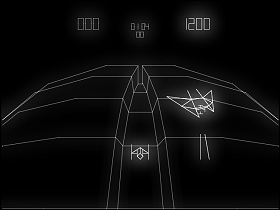 The Game: The player pilots a space fighter into an endless dogfight above a space station trench. Enemy ships attack from all directions, and even zip down the trench; and and all of these can be blasted into bits for points. Beware the fastest of these enemy fighters, which will appear with very little notice and fire directly at the player’s score, relieving it of points every time the fighter is successful with its attack! (Cinematronics, 1979)
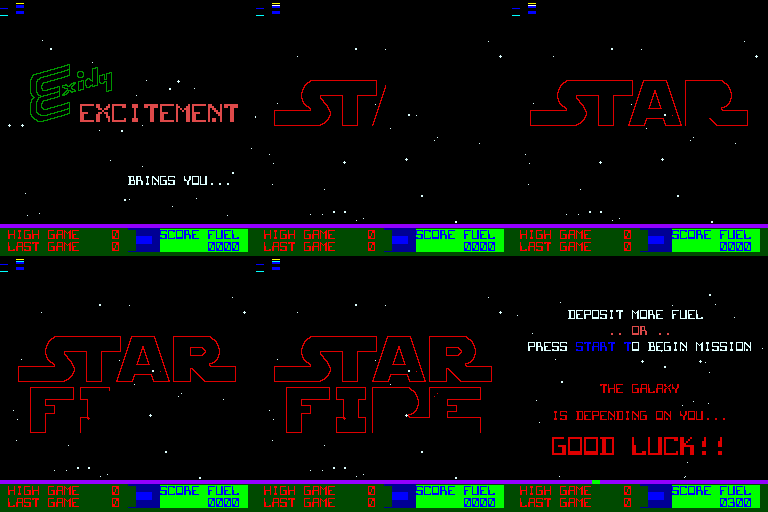 The Game: This may sound awfully familiar, but you’re the lone surviving pilot of a space squadron decimated by enemy attacks. The enemy’s bow-tie-shaped fighters are closing in on you from all sides, and you must keep an eye on your own fighter’s shields, weapon temperature (overheated lasers don’t like to fire anymore), and ammo, all while trying to draw a bead on those pesky enemy ships. You’re also very much on your own – nobody’s going to show up and tell you you’re all clear, kid. (Exidy, 1979)
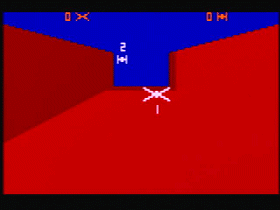 The Game: As a lone space pilot flying down a seemingly endless trench, your job is simple – blast or bomb all of the vaguely-bow-tie-shaped space fighters that you see. If your fighter is on the lower half of the screen, you’re blasting straight ahead/upward; if you move your fighter near the top of the screen, you can bomb any fighters below you. The game ends when you run out of ships; fortunately you never seem to run out of ammo. (Bally, 1979)
 The Game: Players are manning the defenses of a space station under a constant onslaught from all sides by alien attackers. The station’s laser cannons can take out the alien ships and intercept their incoming fire; when an entire wave of attackers is eliminated, a much more mobile fighter will attack, and destroying it will advance the game to the next level of difficulty. (Midway,1980)
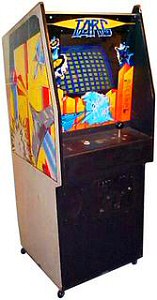 The Game: You’re trapped in a symmetrical maze with a bevy of robotic target vehicles – “Targs” – which are programmed to do just one thing: collide with your vehicle. You have one advantage on these decidedly mean streets, however – you can fire missiles ahead of your car (but the Targs are capable of dodging your projectiles too, so don’t get too cocky). Every once in a while, one of the impregnable blocks in the maze will disgorge a new enemy which is just a little bit faster and deadlier than the rest. Clearing the screen of Targs advances you to a new level with faster enemies – and eventually they’ll put the brakes on your attempts to survive. (Exidy, 1980)

 The Game: This is a very simple first-person space game in which you watch various and sundry harmless space freighters waft lazily past your screen, punctuated at regular intervals by TIE-fighter-like attackers which do pose a moderate threat to you (but not much of a moderate threat). (Magnavox, 1980)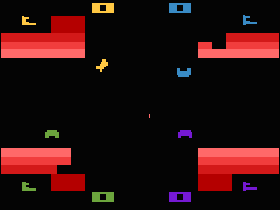
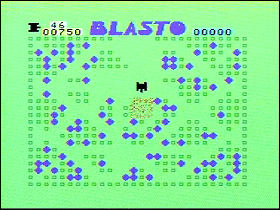 The Game: Piloting your mobile cannon around a cluttered playfield, you have but one task: clear the screen of mines, without blowing yourself up, in the time allotted. If you don’t clear the screen, or manage to detonate a mine so close to yourself that it takes you out, the game is over. If you do clear all the mines, you get a free chance to try it again. Two players can also try to clear the minefield simultaneously. (Texas Instruments, 1980)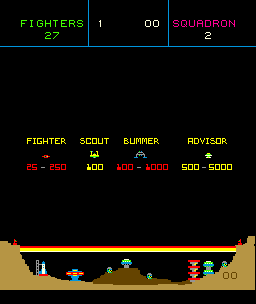
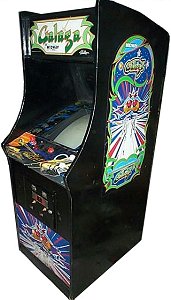
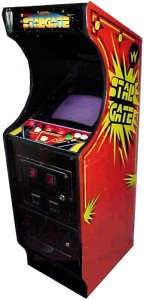
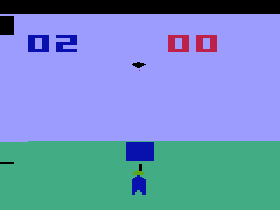 The Game: Line up moving targets in your sights and blast ’em away. The more targets you hit, the more points you get. Simple enough, eh? Just don’t expect everything to travel in a straight line – and keep in mind that something like 80% of the time you won’t have a chance of hitting anything at all due to where you’re positioned. (Games By Apollo, 1981)
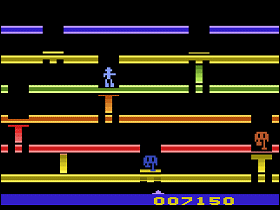 The Game: You’re trapped in a multi-story building with hostile forces all around. Your infiltration mission has gone from mere espionage to a battle for survival – a battle you’re probably not going to win. Board elevators to reach the opposite level of the screen to retrieve enemy secrets, all while avoiding enemy agents and trying to shoot them down. (This spy business would be a lot easier if the enemy couldn’t shoot back, but generally they’re better shots than you are.) Then a new prize appears at the opposite end of the screen, sending you on yet another dangerous mission. (Games By Apollo, 1981)
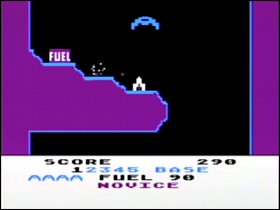 The Game: The enemy in an interplanetary war has gone underground, and you’re piloting the ship that’s taking the fight to him. But he hasn’t just hidden away in a hole; he’s hidden away in a very well-defended hole. As if it wasn’t already going to be enough of a tight squeeze navigating subterranean caverns on Mars, you’re now sharing that space with enemy ships and any number of other fatal obstacles. (Fortunately, the enemy also leaves copious numbers of helpful fuel depots for you too.) Once you fight your way to the bottom of the cave, you plant charges on the enemy mothership – meaning that now you have to escape the caverns again, and fast. (Atari, 1981)
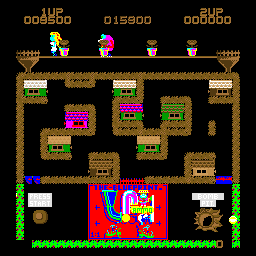 The Game: You are the intrepid, barbershop-quartet-suited J.J. (hey, it’s better than being O.J.!), out to save a damsel in distress from a pursuing monster. How does a guy in a little striped suit do this? By building a mobile, tennis-ball-launching contraption to dispatch said dastardly monster, naturally. The catch? The eight pieces of your mechanical creation are hidden somewhere among ten little houses in a maze – and those houses that don’t contain parts of your machine contain a bomb that must be dumped into the bomb pit immediately (else they’ll explode and kill J.J.). Critters also roam the maze to annoy you, including one pesky monster who will prematurely jump on the “start” button, rattling your still-unfinished machine to bits. If you don’t build your Rube Goldberg gizmo in time, the monster catches the damsel and you lose a life. (Bally/Midway, 1982)
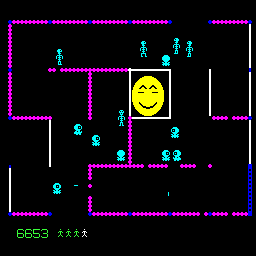 The Game: You’re back in the maze, but this time, the stakes are increased, the danger is increased, and your strategic options are only slightly increased. Touching the walls, the robots, the robots’ laser blasts, or even your own ricocheted lasers are deadly. And of course, the inevitable appearance by Evil Otto is also deadly. However, you can temporarily repel the smiley little bugger by blasting him until his grin turns into the frown – but he will reappear mere seconds later, moving much faster every time he must retreat and reappear – so you’re not doing yourself any favors. If you enter a generator room, you can halt all the robots in their tracks by penetrating the walls surrounding the generator and blasting it. “Beaded” walls can be eaten away, bit by bit, by laser fire from anyone who shoots it, while solid walls will ricochet lasers around until they hit something – which could mean a death trap for you. (Stern, 1982)
 The Game: Your ship is confined to a grid-like playing field, which isn’t all that bad until you take into account that armed ships are gliding along all four of the “walls” surrounding that grid, blasting away at you like a fish in a barrel. Your job is the clear the grid of the objects filling it, and wherever possible, to fire a well-timed shot at the ships trying to destroy you. Clearing the grid advances you to the next level. (Bally/Midway, 1982)
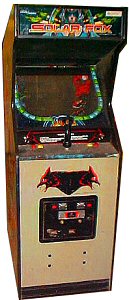
 The Game: Piloting a ship navigating a tunnel in space at breakneck speeds, your mission – aside from screaming down that tunnel way over the speed limit without getting too far off course- is to dispatch countless suspiciously bow-tie-shaped fighters before they get a clear shot at you. (Has anyone ever wondered what all these short-range fighters are doing out here? Bah, never mind. Probably got separated from a convoy or something.) If the enemy ships do manage to get a shot off, you have a narrow window of opportunity in which to intercept the incoming laser fire – very narrow, considering how fast everything is moving. Fire too much, and your lasers overheat and become temporarily useless. Stray too far off course, and your hull temperature shoots upward until your ship explodes. (Atari, 1979 – released by Centuri in 1982)
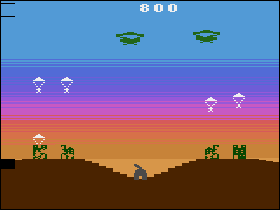 The Game: Helicopters and planes are dumping paratroopers directly over your land-locked cannon. Your job is to take out both aircraft and paratroopers before the enemy can land on and slowly destroy the rows of buildings on either side of the cannon. Once enemy paratroopers raze a building to the ground, they begin doing something even deadlier: digging tunnels toward your cannon so they can destroy it from below with a giant bomb, at which time your point defense career is over. (U.S. Games, 1982)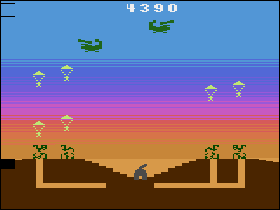
 Seasoned Missile Commanders looking for a new posting can do a lot worse than signing up to go Commando.
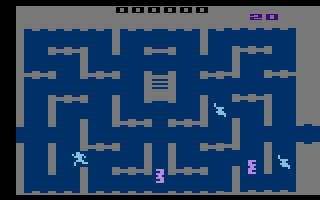 The Game: Robots, spiders and critters, oh my! You’re a lone human in a maze teeming with deadly robots, spiders and other nasties, and your trusty gun – which can dispatch any or all of the above – has only a limited amount of ammunition. You can obtain more ammo by walking over a briefly-occurring flashing gun symbol – but until then, if you’re out of ammo, you’re no longer the hunter, but the hunted. (M Network [Mattel], 1982)
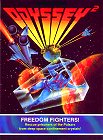 The Game: Using the left joystick, you control the movement of your ship within the confines of a screen filled with mines, alien aggressors, and occasional purple “confinement crystals” which you have to catch, because these contain human prisoners of war. The right joystick engages your hyperdrive, enabling you to go zipping along in true Defender style. (North American Philips, 1982)
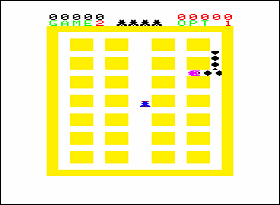 The Game: Players control a segmented, centipede-like creature as it wanders through an open maze inhabited by similar creatures. The player’s creature can shoot segments off of the opponent creatures, but the opponents can also turn around and eat their own segments to get out of a corner, which won’t score any points for the player. To clear a level, the player must eliminate the other creatures from the maze. (Emerson [under license from Konami], 1982)
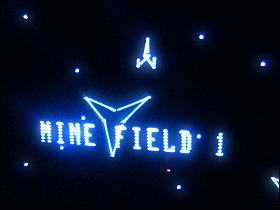 The Game: An alien ship zooms into view overhead, depositing a network of mines in deep space. Your job is to clear the spaceways, blasting each mine and then blasting the smaller mines that are released by each subsequent explosion; there are three different mine sizes, and blasting the smallest and fastest ones finally does away with them. In later stages, there are homing mines, mines that launch a missile in your direction when detonated, and other hazards. Smaller alien ships periodically zip through the screen, trying to blast you while also laying fresh mines. (GCE, 1982)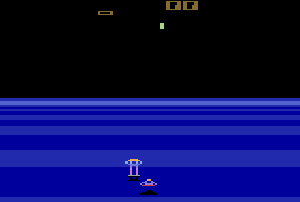
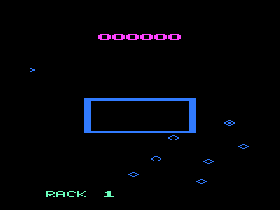 The Game: In an enclosed track in space, you pilot a sleek, lone space fighter up against an army of mine-laying opponents. In early rounds of the Omega Race, only a few minelayers activate at a time…but in later rounds, they all deploy their full arsenal at you at once, leaving you to dodge through a deadly maze in zero gravity while trying to turn to draw a bead on your opponents. You can bounce off of the walls of the track, but anything else is deadly to touch. (CBS Electronics, under license from Bally/Midway, 1982)
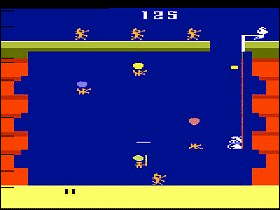 The Game: You’re a mama pig trying to prevent her adorable piglets from becoming a side of bacon for a pack of big bad wolves. First, you try to shoot down as many wolves as they try to parachute to safety with balloons, and then you have to prevent them from rising back up again, because if they do, they’re going to push a big rock right off a cliff and on top of you. (Konami, 1982)