
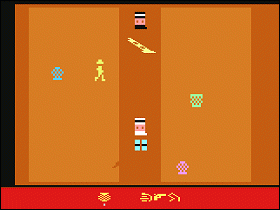
 The Game: You’re guiding a pixellated rendition of famed adventurer Indiana Jones as he embarks on his search for the Lost Ark of the Covenant. Meander through Middle Eastern marketplaces, obtain weapons and items of value, and watch out for snakes as you try to overcome a series of obstacles and hazardous environments, find the clues, and recover the Ark. (Atari, 1982)
Memories: One of the two movie licenses that landed on programmer Howard Scott Warshaw’s desk, the Atari 2600 game Raiders Of The Lost Ark is a near-perfect specimen of an adventure game on this console: it makes sense from reading the manual, but in practice, the way in which the game’s various settings and characters interlock and interact is almost abstract. Maybe this is one of those games where I’m just not getting the point, but I’ve always wondered why E.T. is held up as an example of what not to do with a 2600 game, and Raiders is held up as an example of a great game – to me, they’re almost identical.
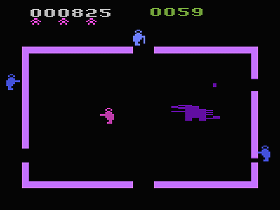 The Game: One man and one hideous mutant creature enter! A bunch of guys peek through holes in the walls and shoot at them! No one leaves! Room Of Doom turns the player into a gladiator, trapped in an enclosed arena with alien creatures. The rules are simple: kill or be killed. The only problem is that it’s always audience participation night: armed guards around the periphery of the arena will open doors at random and fire into the arena. With a well-timed shot before the doors slide shut, the player can do away with these extraneous attackers too. Only by eliminating all of the guards can the player advance to the next level. (Commavid, 1982)
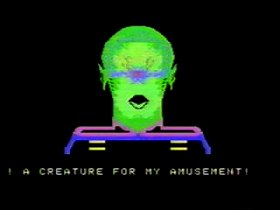 The Game: The Space Fury Commander – a big one-eyed dude with a veiny green cranium – challenges you to a duel. One slight problem: you’ve just got one ship and can only shoot in one direction at a time, and he has a whole battle fleet bent on your destruction. After surviving a round of his contest, you get the chance to dock with an enhancement module that will allow you to fire shots in several directions at once, or fire more powerful shots. The Commander always comes back to taunt you. When you lose all of your ships, the game is over, and one-eye gets to gloat. (Coleco [under license from Sega/Gremlin], 1982)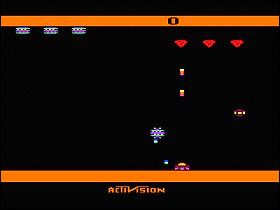

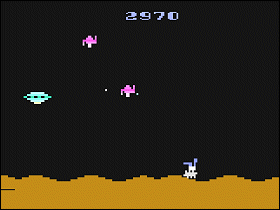 The Game: Space is a dangerous place, full of enemy fighters, hostile vehicles…and even enemy biplanes and enemy hot air balloons. Your job? Blow ’em all away. Your space fighter can hug the ground or zip into the stratosphere in a second, which is good because there are oncoming enemies at every altitude. If they take out all of your fighters, you might as well kiss the planet goodbye…which is kind of embarrassing if this means you’ve left the world open to invasion by balloon. (Vidtec [U.S. Games], 1982)
 The Game: You’re at the helm of the U.S.S. Enterprise – that’s the cool part. The not-so-cool part? You’re in disputed territory – and the Klingons are bringing the fight to you en masse, attacking both the Enterprise and local Starbases, which you have the defend (lest you be left with no place to refuel). Use your phasers, photon torpedoes and shields judiciously – and do whatever it takes to halt the Klingon advance before they overrun Federation space. (GCE, 1982)


 The Game: On a somewhat fantastic voyage into the human body, you’re in a tiny ship (presumably with Martin Short along for the ride) on a mission to blast diseased cells out of the bloodstream. Naturally, it’s not as easy a task as it sounds; the cells split into smaller cells when you zap them, and you have to clear even the tiniest remnants off the screen before advancing to the next treatment. (Arcadia, 1982)
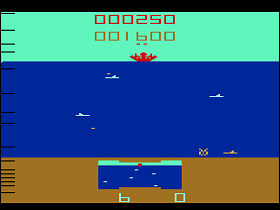 The Game: It’s a cold warrior’s nightmare! Enemy submarines glide silently through the seas below, but the only ordnance available isn’t of the guided variety. From a destroyer on the surface of the ocean, players have to carefully drop depth charges; taking out enemy subs will depend on timing and sheer luck. Failing to take out enemy subs – and wasting depth charges – will result in a deadly sinking feeling… (Sega, 1982)
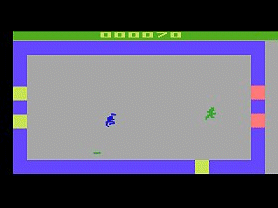 The Game: You are Tron, a lone video game warrior pitted against three other enemies with much greater armament. You can take a number of hits before you’re “de-rezzed” out of existence, but those hits can pile up pretty quickly. By throwing your disc at certain portions of the arena wall and changing them to the same color as your on-screen character, you can make tunnels for yourself – not unlike the side tunnels in Pac-Man – handy for escape or ambush. (M Network [Mattel], 1982)
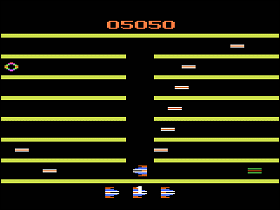 The Game: Players pilot a ship trapped in a maze of vertically stacked level, teeming with aliens who are all deadly to the touch. The good news is that the ship has an inexhaustible supply of ammo. The not-so-good news is that the bad guys have an inexhaustible supply of bad guys. Players have to keep the ship from colliding with the enemy, while shooting at the enemy and watching out for split-second opportunities to grab any bonus items that may make a fleeting appearance. Just one word of caution: the prizes turn into smart bombs if you wait too long to go pick them up. (20th Century Fox, 1982)
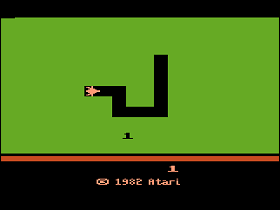 The Game: Your Vanguard space fighter has infiltrated a heavily-defended alien base. The enemy outnumbers you by six or seven to one at any given time (thank goodness for animated sprite limitations, or you’d be in real trouble!). You can fire above, below, ahead and behind your ship, which is an art you’ll need to master since enemy ships attack from all of these directions. You can’t run into any of the walls and expect to survive, but you can gain brief invincibility by flying through an Energy block, which supercharges your hull enough to ram your enemies (something which, at any other time, would mean certain death for you as well). At the end of your treacherous journey lies the alien in charge of the entire complex – but if you lose a life at that stage, you don’t get to come back for another shot! (Atari, 1982)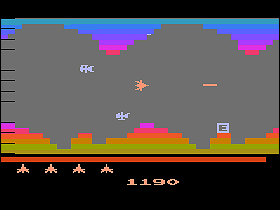
 The Game: As intrepid (and perpetually happy) adventurer Winky, armed only with a bow and arrow, you’re on a treasure hunt of the deadliest kind. HallMonsters try to stop you at every turn, and their minions guard the individual treasures that lie in the rooms of the maze. You can kill the smaller creatures (though their decomposing remains are still deadly to touch), but the HallMonsters are impervious to your arrows – and you’re lunch. (Coleco, 1982)
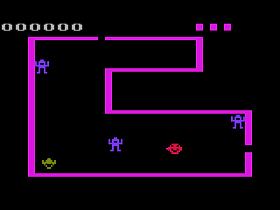 The Game: Trapped in a maze full of HallMonsters, you are adventurer Winky, on a mission to snatch incredible treasures from hazardous underground rooms inhabited by lesser beasts such as re-animated skeletons, goblins, serpents, and so on. Sometimes even the walls move, threatening to squish Winky or trap him, helpless to run from the HallMonsters. The deeper into the dungeons you go, the more treacherous the danger – and the greater the rewards. Just remember two things – the decomposing corpses of the smaller enemies are just as deadly as the live creatures. And there is no defense – and almost never any means of escape – from the HallMonsters. (Coleco, 1982)
 The Game: You’re the pilot of a lone fighter ship, screaming down the trench-like, heavily armed confines of a spaceborne fortress, on a mission to find and destroy the Zaxxon robot – the most heavily guarded of all – at the heart of the structure. (Coleco, 1982)
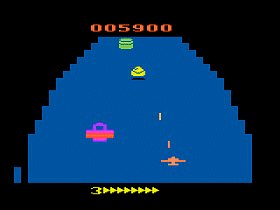 The Game: You’re the sole space fighter pilot penetrating a heavily-armed, mobile alien fortress. If you can survive wave after wave of fighters and ground defenses, you’ll have the opportunity to destroy the Zaxxon robot at the heart of the complex. (Coleco, 1982)
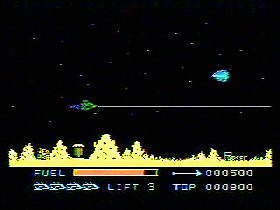 The Game: You control a space patrol fighter cruising over the surface of a planet. Alien attackers swarm on the right side of the screen and strafe you, and you must get out of the way of their laser fire and return some of your own; the more enemy ships you allow to safely leave the screen, the more you’ll have to deal with when they re-enter from the right side of the screen. Avoid their fire, avoid colliding with them, and avoid slamming into the ground, and you might just live long enough to repel the invasion. (Texas Instruments, 1982)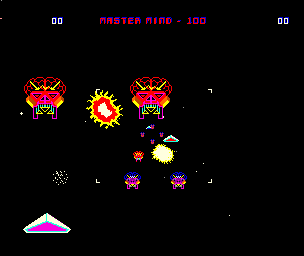
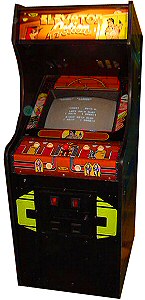 The Game: Love in an elevator, it’s not. As a daring spy, you break into a top secret enemy facility, trying to grab vital secrets and evade or kill as many enemy agents as you can. Your only means of getting from floor to floor through most of the game is via the elevator – which gives you an advantage and also makes you vulnerable. (Taito, 1983)
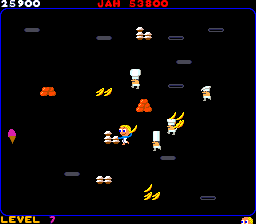 The Game: You are Charley – but you don’t have the Golden Ticket. Instead, what you have is a playfield littered with immobilizing potholes, lots of food, and four feisty chefs (is there a different word for the plural of “chef”?). Charley Chuck can pick up handfuls of food and fling them at any one of his opponents, but keep in mind that they can do the same. Charley’s ultimate goal? Reach the yummy ice cream cone at the opposite end of the screen without falling victim to any of the above. To do any less causes every piece of food on the screen to hurl itself at Charley. (Atari, 1983)
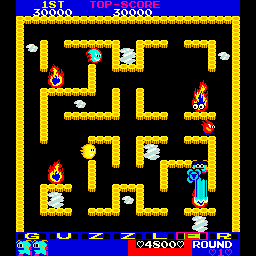 The Game: As a fluid little fellow, you zip around a maze flooded with flaming foes who’ll fry you with fire without fair warning. However, since water can put out fire, you can belch forth a mighty stream of water at your enemies, extinguishing them instantly. However, you’re only a little Guzzler, so you only contain a certain amount of water. You replenish yourself very slowly, but you can gobble up clouds full of moisture or drink from a fountain that occasionally appears at the center of the maze to refill yourself more quickly. And some fires are bigger than others, and putting them out will accordingly take more out of you. And you do eventually run out of clouds… (Tekhan, 1983)
 The Game: Just another day in the life of the rock group Journey, as you help Steve Perry, Neal Schon, Ross Valory, Jonathan Cain and Steve Smith evade alien “groupoids” intent on keeping them from reaching their next gig. (Bally/Midway, 1983)
 The Game: Marvin built a maze on two levels, with habitrail-style tunnels to take him from the first floor to the second and back again, and all was well until the Robonoids moved in and took over. Now they’re out to evict Marvin from his own turf! It’s up to you to guide Marvin through his maze, using cunning one-way bridges to escape from the Robonoids and find the power-ups he needs to zap them. Marvin moves on to the next maze (and the next level of difficulty) only by clearing this maze of power-ups and dots. (SNK, 1983)
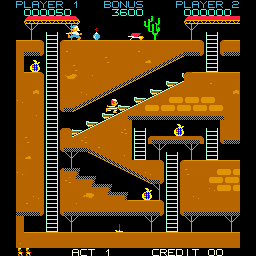 The Game: As in the original Bagman, you’re a crook trying to heist all the gold out of an underground mine as a bunch of pesky cops try to catch up with you. What’s different in this sequel? You can also find a loaded gun in the subterranean caverns and take out your pursuers…but this only intensifies their determination to find you. (Stern/Seeburg [under license from Valadon Automation], 1983)
 The Game: Hostile spacecraft are bombing the underwater paradise of Atlantis from above. Manning two cannons, you can knock the attacking ships out of the sky – or try to hit them at close range if they dive to bombing altitutde. When all of Atlantis’ landmarks have been wiped out, the game is over. (Imagic, 1983)
 The Game: You’re alone in a maze filled with armed, hostile robots who only have one mission – to kill you. If you even so much as touch the walls, you’ll wind up dead. You’re a little bit faster than the robots, and you have human instinct on your side…but even that won’t help you when Evil Otto, a deceptively friendly and completely indestructible smiley face, appears to destroy you if you linger too long in any one part of the maze. The object of the game? Try to stay alive however long you can. (Atari, 1983)
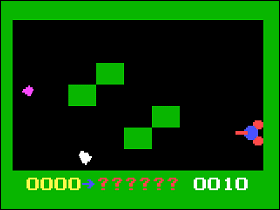 The Game: Amoeba-like monsters spawn and grow in an enclosed space with moving platforms. Players control a very mobile cannon, tasked with the mission of destroying these creatures, or at least trying to keep their population under control. The newly-spawned creatures pose no threat to the cannon – they’ll simply attach themselves to it, slowing it down unless it can shake them off. But the creatures rapidly grow in size and change colors; when a creature turns red, it is capable of destroying the cannon on contact. The cannon’s shots regress the creatures into earlier evolutionary stages; firing on a creature that has been regressed to its newly-spawned stage will destroy it. Both the cannon and the creatures can hitch a ride across the screen – either to safety or into the jaws of the enemy – aboard the platforms. (GST Video, 1983)
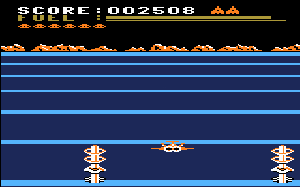 The Game: As space pilot Buck Rogers, you pilot an agile star fighter across a hazardous alien landscape, dodging buildings and destroying enemy vessels. (Sega, 1983)
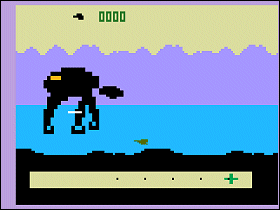 The Game: The Empire Strikes Back puts you in the cockpit of Luke Skywalkers’s snowspeeder in a desperate bid to beat back huge Imperial Walkers – also known as AT-ATs – from destroying the Rebel back on the ice planet of Hoth. The AT-ATs’ heavy artillery can seriously deplete your snowspeeder’s shielding with a single hit, though you must score numerous direct hits before you can even begin to have the same effect on the onslaught of Imperial Walkers, let alone destroy one. Occasionally, a weakness will be exposed in the “neck” region of the huge mechanical monsters, and you’ll have a few seconds in which you may take advantage of that and blow the machine away. (Parker Brothers, 1983)
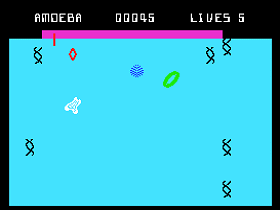 The Game: It can take billions of years for a microbe to evolve into a race of creatures crossing the stars, except in the confines of the