
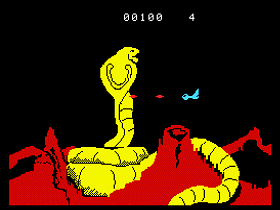
 The Game: As superhero Adam Power, you’re the pilot of a space sled on patrol around the explosive Volcan Rock, and what better cover for the bad guys? An enormous laser-eyed space serpent is coiled around the mountain, and you have to take it down single-handedly. Once you’ve baked the snake, you land your sled on the surface and have a shootout with Gryptogg, Raygoth and Arkus. Once you’ve beaten them back, you can explore the underground caverns, collecting their instruments of evil and exchanging fire with them again. When you escape from their maze, you advance to the next level and begin the fight anew. (North American Philips / Probe 2000, 1983 – unreleased)
Memories: This Colecovision adaptation of the Odyssey² game (now there’s a phrase you’re never going to see again), based on a less-than-blockbuster-successful series of comics and action figures, adds more depth to the game than the dear old Odyssey ever could’ve managed. But it’s hard to tell how much depth, as the game was never completed.
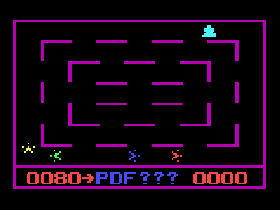 The Game: Four robotic tanks search methodically through a maze, trying to hunt you down. If you wind up in a straight line across or above/below the robot tanks, they will fire, even if a maze wall is in the way. Your job is to evade their fire, use the robots’ logic against them (i.e. try to get one tank to shoot another just because you’re in a straight line with them), or sneak up from behind and destroy them. Destroyed tanks leave a radioactive crater that you must avoid for the rest of that round; you advance to the next round by eliminating all of the tanks without being shot yourself. (Philips, 1983 – unreleased prototype)
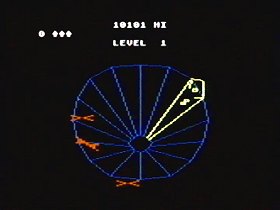 The Game: As a strangely crablike creature, you scuttle along the rim of an abstract, hollow geometric tube, zapping red bow-tie-ish critters and purple diamond-shaped things which carry them. There are also swirly green things which spin “spikes” like webs, and by the way, you should avoid spikes. (Atari, 1983)
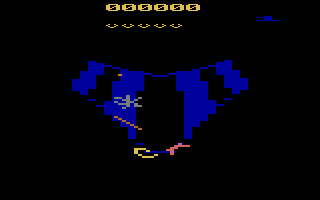 The Game: As a strangely crablike creature, you scuttle along the rim of an abstract, hollow geometric tube, zapping red bow-tie-ish critters and purple diamond-shaped things which carry them. There are also swirly green things (swirly thing alert!!) which spin “spikes” like webs, and by the way, you should avoid spikes. (Atari, 1983 – never released)
 The Game: As an intrepid, pith-helmeted explorer, you’re exploring King Tut’s catacombs, which are populated by a variety of killer bugs, birds, and other nasties. You’re capable of firing left and right, but not vertically – so any oncoming threats from above or below must be outrun or avoided. Warp portals will instantly whisk you away to other parts of the maze (though this doesn’t necessarily mean safer). Gathering all of the treasures and keys will allow you to open the vault at the end of each level…which leads to the next, and even more difficult level. It’s like The Mummy, only much more entertaining. (Parker Brothers, 1983 – unreleased prototype)
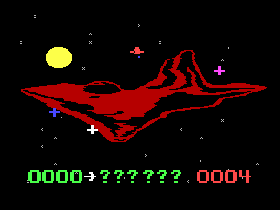 The Game: As the pilot of a lone space cruiser, you must try to clear the spaceways of a swarm of pesky and relatively harmless drone UFOs, but the job isn’t easy. You can ram the alien ships with your ship’s shields, destroying them (but forcing your shields offline for a few precious seconds during which anything could collide with your unprotected ship and destroy you), or shoot them (which also forces your shields down for a recharge). To that screenful of bite-sized chunks o’ death, add an unpredictable Killer UFO that likes to pop in and shoot at you, and suddenly being an interstellar traffic cop ain’t so easy. (Philips, 1983)
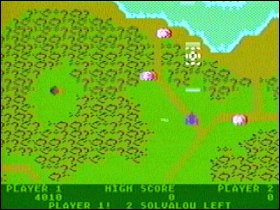 The Game: As the commander of a sleek Solvalou fighter, you’re deep into enemy territory, shooting their disc-shaped fighters out of the sky, bombing ground installations and artillery nests, bombing tanks, and trying to destroy the mothership. As you progress further behind enemy lines, heavier aircraft and more versatile and deadly ground-based defenses become the norm. Also look out for tumbling airborne mirrors – they’re impervious to your fire, but you’re toast if you fly right into them. (Atari, 1983)
 The Game: As everyone’s favorite pixellated clown since Bozo, you guide Mr. Do around a multi-level platform, pursued by multicolored killer critters. You have a magic power ball you can shoot at them, but if you score a hit, you’ll have to scramble around and pick up fruit and other items on the platforms until you have the strength to hurl another power ball. If, in the other hand, your power ball doesn’t score a direct hit, it will ricochet back and forth across the screen until you retrieve it, or it hits a monster that has wandered into that part of the screen. (You can only have one power ball bouncing around at a time.) (Universal, 1984)
 The Game: Pirates have boarded your ship, and it’s up to you to defend the whole boat. Evade the pirates in the twisty mazes of barrels and treasures in the cargo deck, or pick up one of those barrels and brain the nearest pirate with it. Be careful – some pirates hide inside the barrels, and it’s instant death to pick up an “occupied” barrel and not back off quickly. Some containers reveal a treasure when you pick them up, and you can go back and grab the treasures for bonus points. Clear the deck of pirates to advance to the next level and start again. (Capcom, 1984)
 The Game: You’re an adventurer with a bullwhip and a hat, and you hate snakes and love treasure – sound familiar? The bad news is that you’re surrounded by slippery snakes, scurrying scorpions and jumping spiders, all of whom can kill you instantly on contact. The only way you can eliminate these foes and claim the treasure is with a precisely-aimed crack of your whip…but if you’re surrounded, your treasure-hunting days are probably over. (Bally Sente, 1984)
 The Game: As the commander of a sleek Solvalou fighter, you’re deep into enemy territory, shooting their disc-shaped fighters out of the sky, bombing ground installations and artillery nests, bombing tanks, and trying to destroy the mothership. As you progress further behind enemy lines, heavier aircraft and more versatile and Buy this gamedeadly ground-based defenses become the norm. Also look out for tumbling airborne mirrors – they’re impervious to your fire, but you’re toast if you fly right into them. (Atari [under license from Namco], 1984)
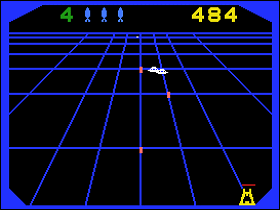 The Game: Alien ships are sliding toward you on a gridwork of energy; as the pilot of the Beamrider, your job is to destroy them before they get too close to home (i.e. the bottom of the screen). They can fire back, though, and while in some cases you can return fire and intercept their shots, it depends on what kind of weaponry they’re using. When you run out of Beamriders, the aliens take over. (Activision, 1984)
 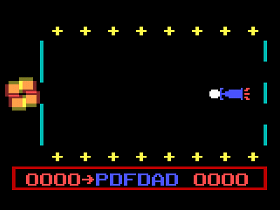 The Game: This is a tale of a futuristic society advanced almost beyond belief. A black hole has been trapped behind a force field, where its gravity won’t snag the chains of space outposts lining the top and bottom of the screen. That gravity will, however, attract stray asteroids, which naturally can do a number on the space stations. This is where you come in: as the captain of an interplanetary street-sweeper, it’s your job to grab the asteroids and deposit them in the maw of the black hole. It’s tricky, business: letting go of an asteroid too far away from the black hole will allow it to drift toward the space stations, but putting your own ship too close to the black hole will put you in harm’s way (and may still let the asteroid escape). The more asteroids you put in the black hole, the bigger and more powerful it becomes (did anyone really think through this method of disposing of the trash?), which will attract more asteroids and cause them to move faster. You can also shoot asteroids, but this will add no points to your score, and stray missiles could destroy space stations. If your ship plummets into the event horizon, or too many space stations are destroyed, there’s suddenly a vacancy for the most dangerous garbage disposal job in the universe. (GST Video, 1984)
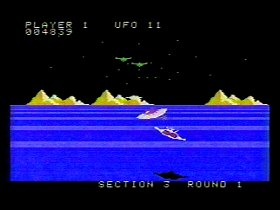 The Game: Zoom being the operative word here, your mission – as space hero Buck Rogers – is to fly in close quarters with all kinds of enemy ships, landers and structures, fending off their attacks, and generally staying alive as long as possible. Obligatory robot wisecracks and utterances of “beedy-beedy-beedy” not included. (Coleco [under license from Sega], 1984)
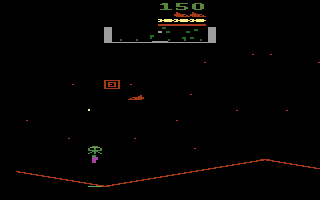 The Game: Once again, you’re piloting a sleek spacecraft, patrolling the airspace over a populated planet whose inhabitants are being harvested by alien Landers to create berzerker Mutants. If you shoot down a Lander in mid-air and its abductee falls toward the ground, you must catch the helpless kidnap victim and lower him to the ground safely. Other menaces await you in the sky, along with Stargates, which instantaneously transport you to other locations around the planet. (Atari, 1984)
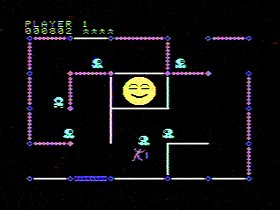 The Game: You’re back in the maze, but this time, the stakes are increased, the danger is increased, and your strategic options are only slightly increased. Touching the walls, the robots, the robots’ laser blasts, or even your own ricocheted lasers are deadly. And of course, the inevitable appearance by Evil Otto is also deadly. However, you can temporarily repel the smiley little bugger by blasting him until his grin turns into the frown – but he will reappear mere seconds later, moving much faster every time he must retreat and reappear – so you’re not doing yourself any favors. If you enter a generator room, you can halt all the robots in their tracks by penetrating the walls surrounding the generator and blasting it. “Beaded” walls can be eaten away, bit by bit, by laser fire from anyone who shoots it, while solid walls will ricochet lasers around until they hit something – which could mean a death trap for you. (Coleco, 1984)
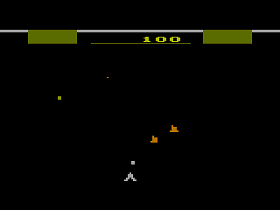 The Game: The aliens are taking their complaints to the home office! As the pilot of an agile space fighter, you have to blast your way through the alien forces from Pluto all the way back to Earth. Occasionally you can boost your ship’s firepower, but that’s the only help you’re going to get. The rest is up to your speed, your strategy, and your ability to nail those suckers in mid-dive. (Parker Brothers, 1984)
 The Game: You’re piloting a fighter jet on a canyon run through enemy territory. You can’t fly outside the canyon walls, so stay over the river and blast everything in sight. Well, almost everything – flying your plane on top of “FUEL” buoys instead of shooting them puts a little bit of gas in the tank, and if you run out of fuel, you might as well just swallow the next enemy bullet, because you’re goin’ down. (Activision, 1984)
 The Game: Your mission is to travel from sector to sector, eliminating Klingon incursions into Federation space without getting your ship and crew destroyed. Friendly starbases offer aid and allow you to make resupply stops so you can keep up the good fight – and you do have to keep a careful eye on your phaser, shield and warp power… (Sega, 1984)
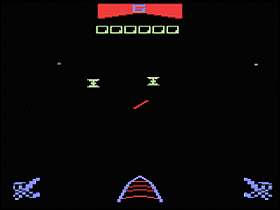 The Game: A long time ago in a galaxy far, far away…you mean to tell me there’s someone out there who doesn’t know this story?! You’re an intrepid X-Wing pilot participating in the last-ditch Rebel attempt to destroy the Death Star – before it destroys the Rebel base on Yavin III. TIE fighters try to intercept you, but you can destroy them (as well as use your own lasers to blast their incoming fire out of the sky). Then you move in to attack the Death Star itself, with its incredibly hazardous system of gunnery towers and bunkers. (Parker Brothers, 1984)
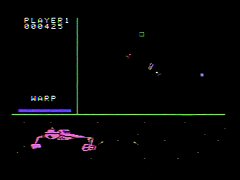 The Game: Welcome aboard, Captain. Your mission is to travel from sector to sector, eliminating Klingon incursions into Federation space without getting your Constitution-class starship and her crew destroyed. Friendly starbases offer aid and allow you to make resupply stops so you can keep up the good fight – and you do have to keep a careful eye on your phaser, shield and warp power. Periodically you’ll even have to navigate a minefield laid by the murderous Nomad probe while trying to catch a fleeting glimpse of Nomad itself so you can destroy it. (Coleco [under license from Sega], 1984)
 The Game: As the pilot of a lone fighter infiltrating a spaceborne fortress, your mission is simple – survive long enough to vanquish the evil Zaxxon robot hidden deep within the fortress, and take out as many of the defenses as you can in the meantime. (Sega, 1984)
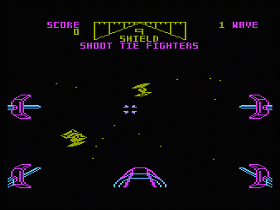 The Game: You’re an intrepid X-Wing pilot participating in the last-ditch Rebel attempt to destroy the Death Star – before it destroys the Rebel base on Yavin IV. TIE Fighters try to intercept you, but you can destroy them (as well as use your own lasers to blast their incoming fire out of the sky). Then you move in to attack the Death Star itself, with its incredibly hazardous system of gunnery towers and bunkers. Once you’ve gotten past the surface defenses, you dive into the trench that will lead you to an exhaust port which is the only means of destroying the Death Star – but there are defenses in the trench as well, and your deflector shields can only take so much… (Parker Brothers, 1984)
 The Game: They’re responsible for the deaths of countless Imperial officers in battle, and served as a vital ally to Luke, Han, Leia and the Rebel Alliance in their darkest hour. Surely every gamer wants to join their ranks and experience the battle of Endor from their perspective! That’s right, you’re an Ewok, flying a primitive hang-glider behind enemy lines, avoiding AT-ST fire and trying to take out as many Imperial troops as you can. Stormtroopers on speeder bikes are both tempting targets and formidable foes for you; if you can, try to fight your way to the Imperial bunker and clear the way
 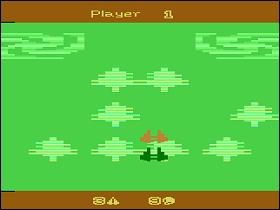 for your friends. Good timing can allow you to temporarily take over the Empire’s walking terrors and use them against their own forces. Face it: you’re a short, stubby teddy bear, armed with rocks, and the fate of the universe depends on you. (Parker Brothers, 1984 – never released)
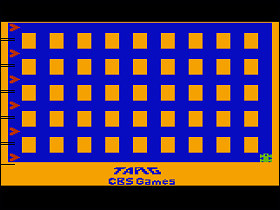 The Game: You’re trapped in a symmetrical maze with a bevy of robotic target vehicles – “Targs” – which are programmed to do just one thing: collide with your vehicle. You have one advantage on these decidedly mean streets, however – you can fire missiles ahead of your car (but the Targs are capable of dodging your projectiles too, so don’t get too cocky). Every once in a while, one of the impregnable blocks in the maze will disgorge a new enemy which is just a little bit faster and deadlier than the rest. Clearing the screen of Targs advances you to a new level with faster enemies – and eventually they’ll put the brakes on your attempts to survive. (CBS Video Games, 1984)


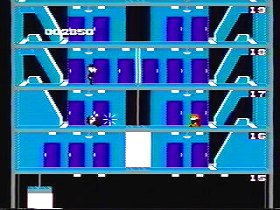 The Game: As a daring spy, you break into a top secret enemy facility, trying to grab vital secrets and evade or kill as many enemy agents as you can. Your only means of getting from floor to floor through most of the game is via the elevator – which gives you an advantage and also makes you vulnerable. (Taito, 1985)
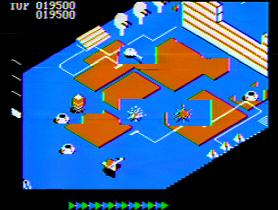 The Game: As the pilot of a lone fighter infiltrating a spaceborne fortress, your mission is simple – survive long enough to vanquish the evil Super Zaxxon robot hidden deep within the fortress, and take out as much of the defenses as you can in the meantime. (Sega, 1985)
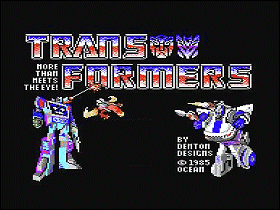 The Game: The raging battle between the Autobots and Decepticons continues in this exclusive title for the Commodore 64 computer. Take control of five different Transformers in the Autobots’ quest for Energon. (Ocean Software, 1985)