
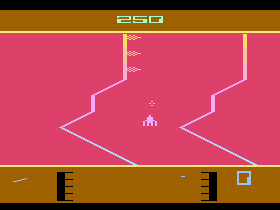
 The Game: Man a biological “spaceship” and get ready to shrink down to microscopic size – you’re going on a voyage through the human body! Blasting away viruses and disease cells, and leaving the body’s natural defenses intact, you’re going to give the immune system a little bit of a boost – at least until a disease cell takes out your micro-ship. Based on the 1966 movie of the same name. Raquel Welch not included. (20th Century Fox Video Games, 1983)
Memories: It’s a Vanguard clone. That’s really always been my first reaction to the very sight of Fantastic Voyage. Now, it’s not a bad idea for a game, nor is it even a bad license, but…it’s a Vanguard clone. And in any event, the save-the-patient-from-disease genre already had an all-time winner at the top of its list: Imagic’s Microsurgeon for the Intellivision. Now, to be fair, versions of that game were announced, but never released, for other platforms (with the exception of a rare version for the TI 99/4A computer) – this genre wasn’t exactly tapped out on the 2600. But I would’ve hoped for something more than a Vanguard clone.
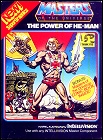 The Game: Don’t be too eager to say “By the power of Greyskull,” because there’s one problem: Skeletor has wrested the power of Castle Greyskull for himself, and seems none too keen on giving it back. As He-Man, the player is tasked with reaching the castle via a flying vehicle, shooting down fireballs (and, if possible, ensnaring Skeleton in traps from above) along the way; provided He-Man doesn’t use up all of his fuel in the aerial fight, he lands at Greyskull and must dodge Skeletor’s fiery projectiles in order to do battle with the ghastly one. Only one will win. (Mattel Electronics, 1983)
 The Game: You control a solitary swarm of “good” bees, trailed by a couple of handy ray guns on the same vertical axis. The game starts out with a bunch of dim-witted Beebots bumbling around the screen, which you can sting with your bee swarm until the ‘bots slow down and finally expire, marked by a rather grim little tombstone! This probably sounds easy enough, but there are killer bees from outer space emerging from hives around the edge of the play area, and when their swarms collide with your swarm, you lose bees. The only defense against the killer bees is a pair of ray guns, which have to recharge after every use. (North American Philips, 1983)
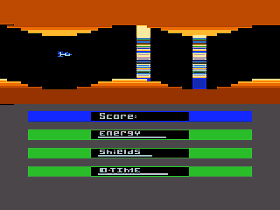 The Game: You’re piloting the Dante Dart through the innards of an enormous sentient computer. The computer was originally constructed to defend the galaxy, but now it’s gone haywire and is planning to destroy the galaxy instead. There’s only one problem with such a massive defense computer: its own internal defense mechanisms. Blast through densepack columns and laser gates as they try to fry your ship, and watch out for laser turrets, “byte bats” and other menaces which will pursue you. Your Energy meter is depleted by constant firing, so make every shot count. And your Shield meter drops as you take hits from enemy fire or crash through the defenses with your ship – something you don’t want to do too much of, lest your mission end prematurely and fatally. (Imagic, 1983)
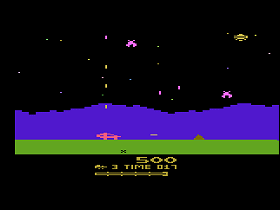 The Game: Driving an agile, armed moon buggy across the lunar surface, you must jump over craters and land mines, shoot large boulders (some occasionally mobile) out of your way, and try not to be on the receiving end of hostile fire from alien ships that try to strafe you. Some of the ships, which look very suspiciously like the triangle-of-spheres enemy ships from Gyruss, can even bomb the moon and make new craters for you to jump over – which may put you right into their line of fire.
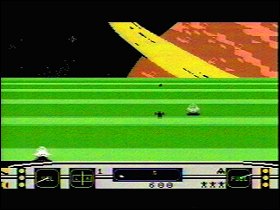 The Game: As the pilot of a super-fast intergalactic rescue ship (which is also armed to the teeth, which explains the absence of a red cross painted on the hull), you must navigate your way through hazardous comets and space debris, entering low orbit around various planets from which you must rescue a certain number of stranded civilians. But there’s a reason you’re armed – some alien thugs mean to keep those people stranded, and will do their best to blast you into dust. You can return the favor, and after you rescue the needed quota of people from the surface, you must align your ship with a series of launch rings to reach orbit again. (Imagic, 1983)
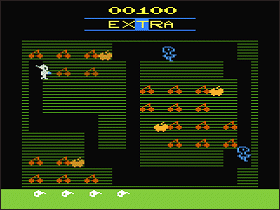 The Game: As an elfin dweller of a magic garden, you must avoid or do away with a bunch of nasty critters who are after you, while gobbling up as much yummy fruit as you can. (Coleco, 1983)
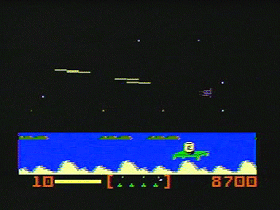 The Game: You’re the pilot of a fighter plane whose job is to patrol the sky at supersonic speeds and eliminate alien threats to the cities on the ground below You have a radar screen spanning the entire globe at your disposal, and endless arsenals of weaponry. If all of the cities are wiped out, your mission – and your life as you know it – are over. (Imagic, 1983)
 The Game: As superhero Adam Power, you’re the pilot of a space sled on patrol around the explosive Volcan Rock, an active volcano which frequently blows its top. And what better cover for the bad guys? Gryptogg, Raygoth and Arkus are perfecting their evil plans for a “gravitational ray” which basically amounts to a portable black hole – its gravity can alter the course of your space sled if you’re on a direct horizontal line-of-sight with it. Add to that meteors pummeling the ground from space and the enormous laser-eyed space serpent, and you’ve got your hands full just staying alive, let alone battling evil. (North American Philips, 1983)
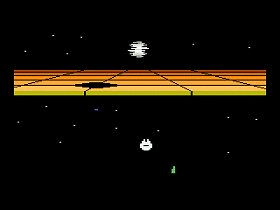 The Game: Presumably, you play the part of Lando Calrissian in this game, which seems to follow the events in the latter half of the film
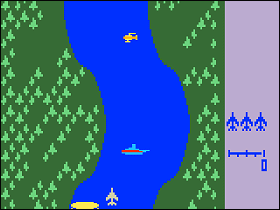 The Game: You’re piloting a fighter jet on a canyon run through enemy territory. You can’t fly outside the canyon walls, so stay over the river and blast everything in sight. Well, almost everything – flying your plane on top of “FUEL” buoys instead of shooting them puts a little bit of gas in the tank, and if you run out of fuel, you might as well just swallow the next enemy bullet, because you’re goin’ down. (Activision, 1983)
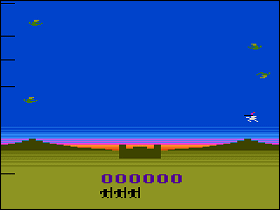 The Game: In Sir Lancelot, players assume the role of the legendary knight atop his flying steed (who knew that the Arthurian mythos could be mixed with the Greek legend of Pegasus?), battling a sky seething with dragons. Killing all the dragons on the screen will advance Lancelot to another level featuring a “boss” dragon and a damsel awaiting rescue.
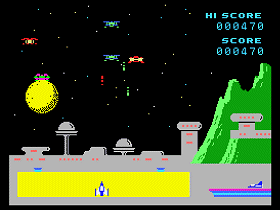 The Game: Aliens are closing in on your planetary base, and apparently you’re the only one on call to fend them off. Shields protect your ground-hugging mobile cannon, but they tend to be eroded away quickly by both incoming enemy fire and your own shots from the ground. If enemy ships infiltrate your protective bunker, you can find yourself in a very close-quarters firefight. When you eliminate a wave of alien ships, the next wave moves in to attack. (Spectravideo, 1983)
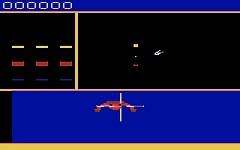 The Game: Welcome to the bridge. Your mission is to travel from sector to sector, eliminating Klingon incursions into Federation space without getting your ship and crew destroyed. Friendly starbases offer aid and allow you to make resupply stops so you can keep up the good fight – and you do have to keep a careful eye on your phaser, shield and warp power… (Sega, 1983)
 The Game: The alien abductors are back. Their henchbeings are back. And fortunately for the hapless humans on the planet’s surface, you’re back too, in a fully armed warship with a belly full of smart bombs. But the aliens have brought new and unusual reinforcements, and now the ultimate X-factor is seen visibly floating in the night sky – a stargate which could deposit your space fighter anywhere, delivering you to safety…or a rendezvous with a swarm of aliens. (Atari, 1983)
 The Game: You’re piloting a heavily armed helicopter straight into a heap o’ trouble. Ground and air defenses have been mounted in this enemy installation to stop you at any costs. Missiles, anti-aircraft turrets, and even other vehicles will do anything to knock you out of the sky – and given the chunky terrain, the odds are in favor of the house. Your only saving grace is that you’re armed to the teeth. But, as you may have guessed by now, even that may not be enough to save you. (Supposedly, according to Konami, Super Cobra was their sequel to the minor arcade hit Scramble.) (Parker Brothers, 1983)
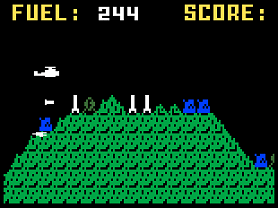 The Game: You’re piloting a heavily armed helicopter straight into a heap o’ trouble. Ground and air defenses have been mounted in this enemy installation to stop you at any costs. Missiles, anti-aircraft turrets, and even other vehicles will See the videodo anything to knock you out of the sky – and given the chunky terrain, the odds are in favor of the house. Your only saving grace is that you’re armed to the teeth. But, as you may have guessed by now, even that may not be enough to save you. (Parker Brothers, 1983)
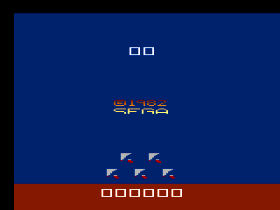 The Game: Commanding a fleet of ships, you use their combined firepower to wipe out an onslaught of alien ships (which, perhaps not at all surprisingly, are firing back at you). It only takes one hit to lose one of your own fleet, and when your fleet is completely wiped out, the game is over. Until then, do as much damage to the enemy armada as you can. (Sega, 1983)
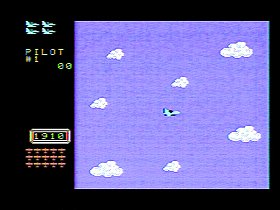 The Game: You’re flying solo through the fourth dimension! In what must be the least subtle time-traveling intervention since the last time there was a time travel episode on Star Trek: Voyager, you’re blasting your way through
 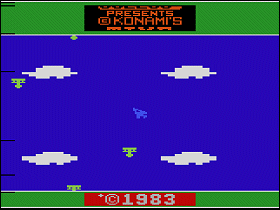 The Game: You’re flying solo through the fourth dimension! In what must be the least subtle time-traveling intervention since the last time there was a time travel episode on Star Trek: Voyager, you’re blasting your way through dozens of aircraft from 1940 through 1982. From WWII-era prop planes, to Vietnam-era helicopters, to 1982, where you confront jet fighters with the same maneuverability as your plane, you’re in for quite a wild ride. Rescue parachutists and complete the level by destroying “boss” craft such as heavy planes and dirigibles. (Coleco, 1983)
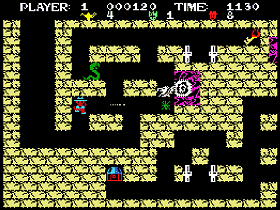 The Game: As an intrepid, pith-helmeted explorer, you’re exploring King Tut’s catacombs, which are populated by a variety of killer bugs, birds, and other nasties. You’re capable of firing left and right, but not vertically – so any oncoming threats from above or below must be outrun or avoided. Warp portals will instantly whisk you away to other parts of the maze (though this doesn’t necessarily mean safer). Gathering all of the treasures and keys will allow you to open the vault at the end of each level…which leads to the next, and even more difficult level. (Parker Brothers, 1983)
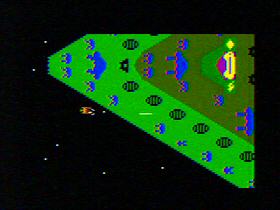 The Game: Piloting a series of solo space fighters, you’re humanity’s last hope against a fleet of gigantic, triangular wedge-shaped battle cruisers bearing down on Earth. Launching from a staging area equipped with a hyperspace gate to fling your fighters into the void at top speed, you must strafe these cruisers in your fighter, bombing and blasting their gun emplacements, engines, and an assortment of weak spots on their ship. The enemy cruisers also have defensive fighters that they’ll launch to keep you from getting the job done, and of course the cruisers themselves are bristling with enormous laser cannons. Hitting all of the guns, engines and other “soft targets” on a cruiser will destroy it, giving you a momentary reprieve until the next cruiser arrives. If you run out of ships or fail to stop the enemy, they’ll wipe out your planet – game over, indeed. (Activision, 1982)
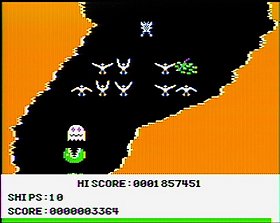 The Game: Why do mountain climbers climb mountains? Because they’re there. Why are you flying a spacecraft into a vast complex of subterranean caverns? Because they’re there, and apparently because you want to blast the multitudes of critters who lurk there. The bad news: there are a lot more of them than there are of you. The good news? Your ship’s cannons fire in four directions simultaneously. Given that fact, and your ship’s maneuverability, you might just survive this little bit of aerial spelunking. (Datamost [designed by Paul Lowrance], 1983)
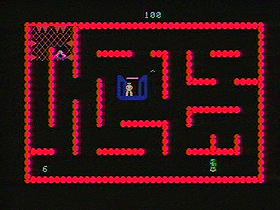 The Game: You’re alone, unarmed, in a maze full of bats, bugs and ‘bots, most of whom can kill you on contact (though the robots would happily shoot you rather than catching up with you). Loaded guns appear periodically, giving you a limited number of rounds with which to take out some of these creepy foes, though your shots are best reserved for the robots and spiders, who have a slightly more malicious intent toward you than the bats. If you shoot the bats, others will appear to take their place. If you shoot the ‘bots, the same thing happens, only a faster, sharper-shooting model rolls out every time. Your best bet is to stay on the move, stay armed, conserve your firepower – and don’t be afraid to head back to your safe room at the center of the screen. (Mattel Electronics, 1983)
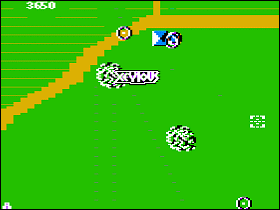 The Game: As the commander of a sleek Solvalou fighter, you’re deep into enemy territory, shooting their disc-shaped fighters out of the sky, bombing ground installations and artillery nests,bombing tanks, and trying to destroy the mothership. As you progress further behind enemy lines, heavier aircraft and more versatile and deadly ground-based defenses become the norm. (Mindscape, 1983)
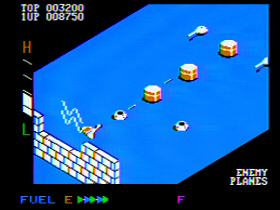 The Game: As the pilot of a lone fighter infiltrating a spaceborne fortress, your mission is simple – survive long enough to vanquish the evil Zaxxon robot hidden deep within the fortress, and take out as much of the defenses as you can in the meantime. (Datasoft, 1983)
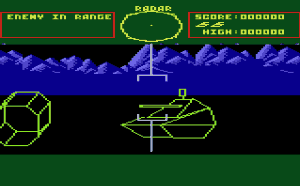 The Game: As the pilot of a heavy tank, you wander the desolate battlefield, trying to wipe out enemy tanks and landing vehicles. (Atari, 1983)
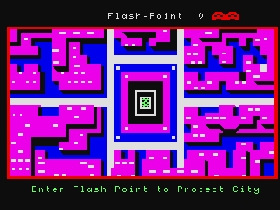 The Game: A zombie infestation has overrun the city. The player, in a mobile unit bristling with weapons, must venture into the infested areas and eliminate the zombies – or die. The center of the infestation screens features a green area surrounding the player’s vehicle; this must be preserved as much as possible while fighting off the zombies, as bonus points are awarded for guarding that space. If the player survives, it’s time to move on to the scene of the next zombie attack. (North American Philips, 1983 – unreleased prototype)
 The Game: What if you were out to perform daring, air-show-style aerial acrobatics, and someone was shooting at you at the same time? Wouldn’t that be dandy? Lucky you, that’s what you’re doing in this game. With a mandate to DESTROY TERMINAL, you set out to obliterate an airport terminal protected by armed hot air balloons. The closer you get to carrying out that mission, the more fiercely they defend their turf. When you do level the terminal to the ground, a door opens up, allowing you to fly your plane into a massive maze of pipes, and if you can navigate that labyrinth, you reach “the end” – where you must fend off more adversaries to touch down safely and start again. (Coleco, 1983 – unreleased / recovered and released by CGE Services, 2003)
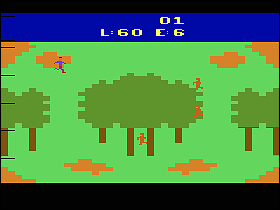 The Game: It’s not a good idea being a human on Earth of the future, in a world ruled ruthlessly by intelligent, verbose, violent apes. Or, in this case, persistent, pixellated apes. The player controls a hunted human trying to stay out of the apes’ damn dirty paws. If the human falls into the apes’ hands, an indelicate lobotomy is probably the best treatment he can expect. (20th Century Fox, 1983)