 Introduced in 1989 as a big, neutral-grey brick of a B&W portable game machine, the Nintendo Game Boy may have been considered instantly obsolete by some. It was powered by a Z80 chip, something which had fallen out of use with personal computer manufacturers halfway through that decade. Its display was monochrome and LCD, and in an age when late 80s arcade games had spoiled players with stereo sound, the only way to get stereo out of the Game Boy was with its headphones.
But the “killer app” of the Nintendo Game Boy was its portability. But hadn’t this been tried before, with the Milton-Bradley Microvision around 1982? Sure it had. But the Microvision didn’t  come packed with what was, at the time, the most popular game in the world: Tetris.
Nintendo and a few other manufacturers released a whole slew of Game Boy titles, and it seemed uncertain what genre of gaming would be the machine’s strength: puzzle games, like Tetris? Decent classic arcade adaptations such as Qix and Super Mario Bros.?
This confusion was intensified by the Super Game Boy, a module fitting into the Super NES cartridge slot, allowing the machine to play Game Boy games encoded with minimal color schemes.
It was 1997 before the next true compelling application of the Game Boy was discovered: a little Japanese creation which every child in America now knows as Pokèmon.
 The Game Boy Color was introduced in 1999, sprucing up the same basic machine with a non-backlit color LCD display, and with the arrival of the Game Boy Advance – a much more powerful but, very wisely on Nintendo’s part so as not to alienate a dozen years worth of loyal customers, backward-compatible color handheld – it seems as though this platform is joining the hallowed and rarified ranks of game consoles that can survive a decade. The Game Boy shares this distinction only with Atari 2600.
With the 2004 release of the Nintendo DS handheld system, however, Nintendo moved away from the Game Boy legacy. The DS included a secondary cartridge slot that allows it to play Game Boy Advance games, but this time backward compatibility only went so far – the ability to play the original monochrome Game Boy games or Game Boy Color titles was left behind. Software was produced for both systems for a while, but Nintendo eventually shifted all of its efforts to the DS system. It’s possible now, having reached the end of the Game Boy line, to look back and see the system for what it was – a trendsetting game machine which became nothing short of a cultural icon unto itself, and a machine that set a new benchmark for the longevity of a single family of hardware (at least 16 years). The Game Boy also boasted one of the most widely varied game libraries of any platform, ranging from the 80s arcade simplicity of its launch titles to the deeply immersive quest games of the Game Boy Advance’s heyday, with stops at nearly every gaming trend that has emerged along the way. It truly was the sole survivor of the classic 80s video game systems, coming to rest at a time when gamers were only beginning to wax nostalgic about its very first games.
[jwcatpostlist orderby=title order=asc includecats=251,252,253]
A note about screen shots in this section: At long last, the Game Boy section of Phosphor Dot Fossils has real live screen shots to accompany its game reviews. Games hailing from the monochrome Game Boy era have, for authenticity’s sake, been reduced to greyscale images and then tinted to a yellow approximating the background of the original Game Boy’s screen. Some of these games have color encoding intended for the SNES Super Game Boy module, but I’ve elected to take the greyscale-and-tint approach to preserve the flavor of the hardware of that time.

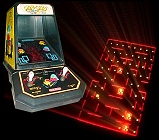 The Game: As a round yellow creature consisting of a mouth and nothing else, you maneuver around a relatively simple maze, gobbling small yellow dots and evading four monsters who can eat you on contact. In four corners of
  the screen, red power pellets enable you to turn the tables and eat the monsters for a brief period for an escalating score. The monsters, once eaten, return to their home base in ghost form and return to chase you anew. If cleared of dots, the maze refills and the game starts again, but just a little bit faster… (Coleco, 1981)
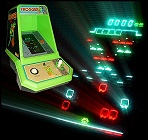 The Game: You are a frog. Your task is simple: hop across a busy highway, dodging cars and trucks, until you get the to the edge of a river, where you must keep yourself from drowning by crossing safely to your grotto at the top of the screen by leaping across the backs of turtles and logs. But watch out for snakes and alligators! (Coleco, 1982)
 The Game: Baseball returns to the small screen – the very small screen – on the Game Boy. Step up to the plate and take a swing; after three outs, take control of the pitcher, basemen and outfield, trying to keep the computer from scoring a run. (Nintendo, 1989)
 The Game: As intrepid plumber (and explorer) Mario, players have to jump through new environments and enemies to help Mario rescue Daisy. Egyptian pyramids guarded by fire-breathing Sphinxes, seaside platforms invaded by space aliens, and the usual Goombas and Koopas await Mario as he tries to reach the end of each level. As always, there are mushrooms, stars and fire flowers to help Mario power up, and helpful hidden chambers full of coins. (Nintendo, 1989)
 The Game: Cavernous rooms are loaded with gold, just ripe for the picking. But before you celebrate hitting the mother lode, look again – there are other gold-diggers homing in on the treasure. What do you have that they don’t? A drill gun that can blast a hole in the floors, into which your opponents will jump blindly. Eventually, the holes will reseal themselves, and that process will swallow your enemies (and you, if you happen to be clumsy enough to wander into the hole yourself). Grabbing all of the gold will reveal a passage to the next level of the game. (Bandai, 1989)
 The Game: You’re in charge of a getaway car loaded with crafty criminals. Your job is to sneak around the maze, avoid a bunch of cranky cops who are hot on your trail, and grab all the dough – and, of course, to escape so you can steal again another day. But the cops can trap you with a series of doors that can prevent you from getting away… (Data East, 1990)
 The Game: You are a marker, trying to claim as much of the playing field as you can by enclosing areas of it. Drawing your boundaries faster is safer, but yields fewer points. A slower draw, which leaves you vulnerable to attack from the Qix and the Sparx, gives you many more points upon the completion of an enclosed area. If the ever-shifting Qix touches your marker or an uncompleted boundary you are drawing, you lose a “life” and start again. And the Sparx, which travel only along the edges of the playing field and along the boundaries of areas of the screen you’ve already enclosed, can destroy you by touching your marker. And if you linger too long, a fuse will begin burning at the beginning of your unfinished boundary, and will eventually catch up with you. (Nintendo/Taito, 1990)
 The Game: As a daring spy, you break into a top secret enemy facility, trying to grab vital secrets and evade or kill as many enemy agents as you can. Your only means of getting from floor to floor through most of the game is via the elevator – which gives you an advantage and also makes you vulnerable. (Taito, 1991)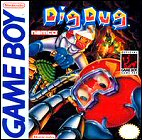
 The Game: You are Dig Dug, an intrepid gardener whose soil is infested with pesky Pookas and fire-breathing Fygars. You’re armed with your trusty pump, which you can use to inflate your enemies until, finally, they blow up. But both the Pookas and Fygars can crawl through the ground and can pop out into your tunnels, and if a Fygar sneaks up behind you, he can toast you if you’re not careful. In New Dig Dug, you guide Dig on a series of subterranean adventures, trying to unlock buried doors by finding some equally buried keys. Pookas and Fygars still stalk the underground tunnels in the new game, only each one that Dig dispatches is replaced by a new Pooka or Fygar from above. (Namco, 1992)
 The Game: Players assume the role of Susumu Kodai, a hot-headed young recruit unexpectedly thrust into a leadership role on a mission to cross the galaxy and procure a device that can restore planet Earth’s war-decimated ecosphere within a year. As if crossing the Milky Way and returning within a year wasn’t enough of a formidable task, the Space Battleship Yamato faces stiff opposition from an alien race, the Gamilas, determined to seal Earth’s fate by bringing the last-ditch rescue mission to a halt. Kodai and the Yamato’s ailing commander, Admiral Okita, must decide where to commit their forces for maximum effect. Large squarons of Cosmo Fighters can be dispatched to take the Gamilas on head-to-head on the on-screen grid, but Yamato herself can also be ordered into the thick of the action (a strategy that puts the entire mission in jeopardy if the battle is lost). Success means fighting through the Gamilas’ offensive front and reaching planet Iskandar. Failure means death for all humankind. Pick your battles wisely. (Interbec, 1992)
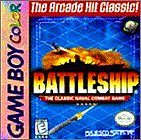 The Game: Two fleets of four warships conduct long-distance naval warfare, randomly firing torpedoes (and occasionally some higher-powered ordnance) at each other, guessing at the positions of their targets. Whoever sinks the entire opposing fleet first is the victor. (Hasbro Interactive, 1999)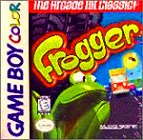
 ever to come down the pike, and yet finding a decent port of it over the years has proven to be almost as difficult as getting the amphibious one across the road in the game’s sixth level. But ask anyone about favorite video games from the early 80s, and you’re almost certain to hear Frogger in that list. The popularity of the original Frogger is borne out by the fact that a series of licensees has attempted to turn out a modern-day descendant of Frogger, and while some of those have been fun in their own right, they’ve also barely lived up to the simple joy of the original.
 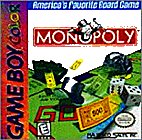 The Game: Does anyone not know this game? You and quite a few other players make a mad dash around the Monopoly board, snatching up properties, railroads, and utilities, hazarding the fickle fortunes of the Chance and Community Chest spaces, and trying to avoid taxes and jail – not to mention bankruptcy – while building an empire that will make you rich. (Majesco Sales, 1999)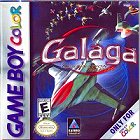
 The Game: You control the speed and direction of a marble which is racing other marbles to reach the finish line. Obstacles along the way include marble-eating creatures, treacherous cliffs and drawbridges, and the game’s own unreliable controls! (Midway, 2000)
 The Game: A boy named Speedy ventures through a mystical land, taunted by cute animals. Somehow this quest is expressed through a series of challenges in which the player tries to claim as much of the playing field as possible by enclosing areas of it. If the ever-shifting Qix touches Speedy’s marker or an uncompleted boundary, a life is lost and the boundary must be built again. Sparx, which travel only along the edges of the playing field and along the boundaries of already-enclosed areas of the screen, can also cost Speedy a life. (Taito, 2000)


 The Game: Darkness has fallen anew upon Sosaria, and Lord British calls for your service again. You set out with four adventurers on a quest to gain the experience that will be necessary to survive the long voyage to a volcanic island where the source of all the evil plaguing the world is said to be. (Sven Carlberg, 2002)
 The Game: 25 choice cuts of Intellivision goodness are crammed into something about the size of a modern-day console controller. Games include Astrosmash, Body Slam Super Pro Wrestling, Buzz Bombers, Chip Shot Super Pro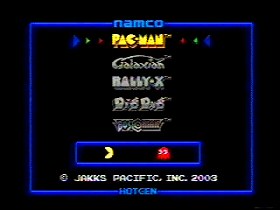
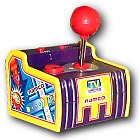 Memories: After I reviewed the dandy Techno Source Intellivision 25-in-1 TV Game, at least one e-mail suggested that I wasn’t being critical enough in my review. I praised that dandy self-contained gadget for capturing the flavor of those 25 classic Intellivision games, even if a lot of the finer details were left out. Those of you who thought I was going easy on that game should just stop reading this review now. Because I kinda dig this quintet of Namco goodness – with some significant reservations.
 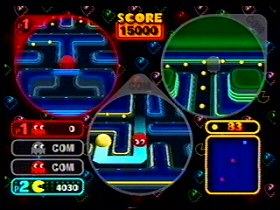 The Game: As a round yellow creature consisting of a mouth and nothing else, one player maneuvers around a relatively simple maze, gobbling small dots and evading four colorful monsters, up to three of which are controlled by his fellow players, who can eat Pac-Man on contact. In four corners of the screen, large flashing dots enable Pac-Man to turn the tables and eat the monsters for a brief period of time. Periodically, assorted items appear near the center of the maze, and Pac-Man can consume these for additional points as well. The monsters, once eaten, return to their home base in ghost form and return to the chase. If cleared of dots, the maze refills and the game starts again, but just a little bit faster. The game continues until a preset target score is reached, or until Pac-Man is caught by one of the monsters; the player controlling that monster is then handed the Game Boy Advance to take over Pac-Man’s role. (Namco, 2003 – for Nintendo Gamecube)
 The Game: DSI strikes again with Gauntlet and Rampage, two nearly perfect arcade conversions for the Game Boy Advance. In Gauntlet you’ll trade shots with ghosts, demons, and Death himself. In Rampart you’ll defend your ground and exchange buckshot with more worldly enemies. (DSI Games/Atari, 2006)
 The Game: Relive exciting arcade action on your Gameboy Advance with the latest game pack from DSI Games. Millipede, Super Breakout and Lunar Lander, three classic games from Atari, are waiting for you! (DSI Games/Atari, 2006)
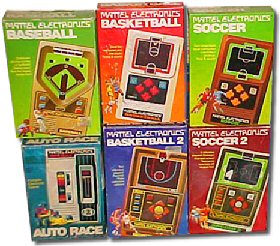
 In the beginning, home video games were at a bit of a crossroads – everyone wanted to play their favorite games at home, but parents didn’t want to tie up the only TV in the house. (This, of course, being back in the day when there was only one TV in the average American household.) The solution seemed simple: battery-powered electronic handheld games became a big hit. Though they used the same basic operating principles as their video game counterparts, and in some cases the same processors, the handheld games often relied on LEDs or matrices of pre-drawn, fixed character shapes. Often, this meant those graphics might be fancier than those that could be achieved by, say, the Atari 2600, but there was little or no fluidity to those graphics. In some games, such as
 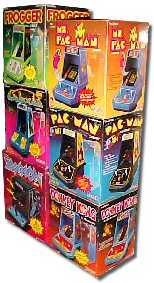 Merlin or Mattel’s enduringly popular Electronic Football, there were no “characters” at all to speak of, only grids of tiny light-emitting diodes.
 their LCD-based Microvision system.