
 The Game: You are a frog. Your task is simple: hop across a busy highway, dodging cars and trucks, until you get the to the edge of a river, where you must keep yourself from drowning by crossing safely to your grotto at the top of the screen by leaping across the backs of turtles and logs. But watch out for snakes and alligators! (Starpath, 1983)
Memories: Making crafty use of a loophole in Parker Bros.’ license for Frogger, which specified that Parkers had permission to market cartridge-based versions of the game, the plucky programmers at Starpath proceeded to make a far superior edition of Frogger for the 2600 and got it on the market by licensing the rights to do a cassette-based version.
 The Game: You control a solitary swarm of “good” bees, trailed by a couple of handy ray guns on the same vertical axis. The game starts out with a bunch of dim-witted Beebots bumbling around the screen, which you can sting with your bee swarm until the ‘bots slow down and finally expire, marked by a rather grim little tombstone! This probably sounds easy enough, but there are killer bees from outer space emerging from hives around the edge of the play area, and when their swarms collide with your swarm, you lose bees. The only defense against the killer bees is a pair of ray guns, which have to recharge after every use. (North American Philips, 1983)
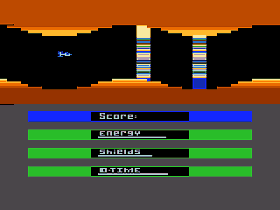 The Game: You’re piloting the Dante Dart through the innards of an enormous sentient computer. The computer was originally constructed to defend the galaxy, but now it’s gone haywire and is planning to destroy the galaxy instead. There’s only one problem with such a massive defense computer: its own internal defense mechanisms. Blast through densepack columns and laser gates as they try to fry your ship, and watch out for laser turrets, “byte bats” and other menaces which will pursue you. Your Energy meter is depleted by constant firing, so make every shot count. And your Shield meter drops as you take hits from enemy fire or crash through the defenses with your ship – something you don’t want to do too much of, lest your mission end prematurely and fatally. (Imagic, 1983)
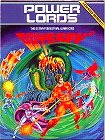 The Game: As superhero Adam Power, you’re the pilot of a space sled on patrol around the explosive Volcan Rock, an active volcano which frequently blows its top. And what better cover for the bad guys? Gryptogg, Raygoth and Arkus are perfecting their evil plans for a “gravitational ray” which basically amounts to a portable black hole – its gravity can alter the course of your space sled if you’re on a direct horizontal line-of-sight with it. Add to that meteors pummeling the ground from space and the enormous laser-eyed space serpent, and you’ve got your hands full just staying alive, let alone battling evil. (North American Philips, 1983)
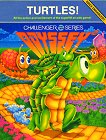 The Game: As the mama turtle, you trundle around a simple maze, pursued by nasty bugs which are lethal to the touch. You can drop bombs in their path, which will reduce their speed (and this device really does beg all sorts of biological double-entendres, doesn’t it?). Your mission is to visit the isolated cul-de-sacs in the maze – which in itself can lead to your turtle getting trapped – to retrieve your eggs and take them to safe houses dotted around the maze. If you visit the wrong place at the wrong time, you’ll wind up with not an egg, but a new bug hot on your heels. Getting all your turtle eggs to safety takes you to the next level, and eventually everything winds up moving so fast, you haven’t got a chance. (North American Philips [under license from Stern], 1983)
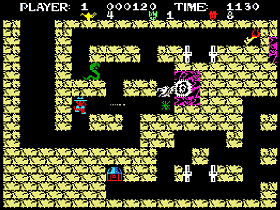 The Game: As an intrepid, pith-helmeted explorer, you’re exploring King Tut’s catacombs, which are populated by a variety of killer bugs, birds, and other nasties. You’re capable of firing left and right, but not vertically – so any oncoming threats from above or below must be outrun or avoided. Warp portals will instantly whisk you away to other parts of the maze (though this doesn’t necessarily mean safer). Gathering all of the treasures and keys will allow you to open the vault at the end of each level…which leads to the next, and even more difficult level. (Parker Brothers, 1983)
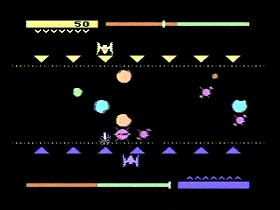 The Game: An evil force near the planet Jupiter has commandeered the asteroid belt between that giant planet and Mars as its personal defense shield. Your mission is simple: man a mobile weapons platform on the inner solar system’s side of the asteroid belt, exchange fire with the enemy (who can be the computer or another player), and try to knock out their defenses and destroy them. The battle will last only a brief time, and whoever has the best score – with a bonus given at the end for losing the least ships – wins. (Milton Bradley, 1983)
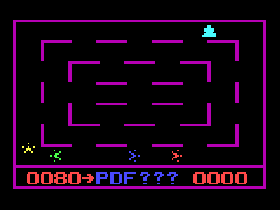 The Game: Four robotic tanks search methodically through a maze, trying to hunt you down. If you wind up in a straight line across or above/below the robot tanks, they will fire, even if a maze wall is in the way. Your job is to evade their fire, use the robots’ logic against them (i.e. try to get one tank to shoot another just because you’re in a straight line with them), or sneak up from behind and destroy them. Destroyed tanks leave a radioactive crater that you must avoid for the rest of that round; you advance to the next round by eliminating all of the tanks without being shot yourself. (Philips, 1983 – unreleased prototype)
 The Game: As everyone’s favorite pixellated clown since Bozo, you guide Mr. Do around a multi-level platform, pursued by multicolored killer critters. You have a magic power ball you can shoot at them, but if you score a hit, you’ll have to scramble around and pick up fruit and other items on the platforms until you have the strength to hurl another power ball. If, in the other hand, your power ball doesn’t score a direct hit, it will ricochet back and forth across the screen until you retrieve it, or it hits a monster that has wandered into that part of the screen. (You can only have one power ball bouncing around at a time.) (Universal, 1984)
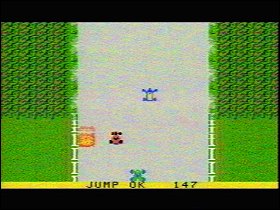 The Game: The race is on, and no moves are off-limits – bump your competitors off the road (and into apparently highly volatile vegetation that causes them to explode), or jump over them and any other obstacles that get in your way, including areas of water that cover the road. If you survive the race, you live on to the next round – at least until you run out of cars. (Coleco, 1984)
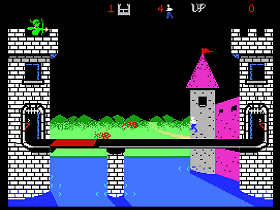 The Game: You’re another treasure-hunting glory seeker who’s about to meet more than his match. If you can survive crossing the drawbridge into the castle – a task made incredibly difficult by the glowing fireballs of dragon breath being hurled toward you – you’ve got an even more hazardous obstacle ahead: the dragon himself is guarding a huge stash of treasure. Even if he can’t stop you from pocketing every shiny thing in the castle, chances are you won’t make it out alive. (Imagic, 1984)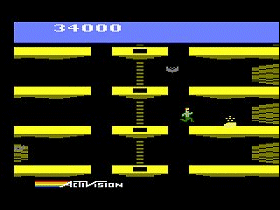


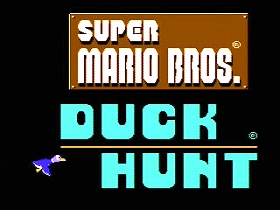 The Game: Intrepid plumbers Mario and Luigi have fallen back on Mario’s original mandate – rescuing the damsel – as they journey through the kingdom, battling Koopas and braving falls from dizzying heights, all to
 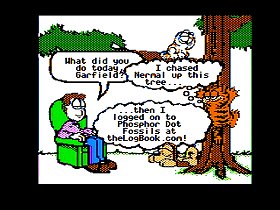 The Game: Using a simple drag-and-drop system (controlled by keyboard, mouse or joystick), put the elements of an original Garfield comic into place, including everyone’s favorite big orange cat, Odie, Jon, Nermal and all the fixtures and fittings of home (including a big burger and some lasagna). Then position speech balloons in the appropriate place, containing either signature Garfield catchphrases or your own words. Print and/or save to disk, repeat ad nauseum, and avoid Jim Davis’s lawyers thereafter! (Developmental Learning Materials, 1985)
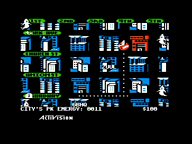 The Game: Supernarural, paranormal investigations and eliminations are the order of the day, as you open your own ghost busting franchise. You start with a finite budget and have to make some savvy choices about vehicles and gear; then it’s time to strap on a proton pack, get behind the wheel of the Ectomobile, and cruise around the Big Apple watching for flashing red buildings (telltale signs of a poltergeist party in progress). When you arrive on the scene, a little bit of driving is required, which gives you the chance to mop up a few free-roaming full-torso vaporous apparitions off the streets,
  before you arrive at your destination and try to trap a ghost without crossing the streams. All the while, supernatural forces are converging on a site formerly known as the temple of Zuul, and when the paranormal powers there reach a critical mass, it’s time for roasted marshmallow – or the end of the world. (Activision, 1985)
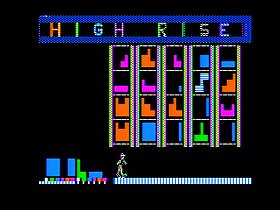 The Game: Think of it as the anti-Tetris. Five hoppers dispense geometric shapes on your command. As Barnaby, you move the pieces into place to build the most stable structure you possibly can, and if you manage to build a high enough tower, you climb to the top and advance to the next level. The first level’s shapes are fairly easy, but as you advance through levels, the pieces take on stranger and stranger shapes – and balancing them becomes harder. In later levels, you start rounds with oddball shapes already in place on the playing field, making your task that much harder. The game ends when the timer runs out without the completion of a stable structure. (Micro Learn, 1985)
 The Game: Monsters are running amok in cities across America… and you’re one of them! A giant lizard, a giant werewolf and a giant gorilla walk into a bar and tear it down. Monsters can compete to see who will topple tall buildings first, or they can qang up on puny defenseless human scum. It’s pretty easy to knock over buildings, and pretty easy to take a lot of damage from the armed forces who have been called out to stop the creatures. If they accrue too much damage, the monsters de-evolve to their un-mutated original human form, and require quick action (and additional quarters) to stay in the game. (Midway, 1986)
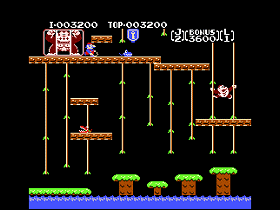 The Game: Mario has Donkey Kong in captivity, and it’s up to Donkey Kong Jr. to rescue his dad by scaling vines and chains, avoiding nasty-toothed traps and pesky birds, and reaching the key to free the great ape from Mario’s clutches. (Nintendo, 1985)
 The Game: Various shapes consisting of four blocks each fall from the top of the screen, giving the player a short time to rotate, move (left or right only), and ultimately drop each piece into place. The goal is to put complementary shapes together, forming a solid line (or several solid lines) and leaving no gaps. Completed horizontal lines disappear from the screen, and the remaining pieces drop to the bottom. Bonus points are awarded for using the tallest piece – four blocks tall – to eliminate four lines at once. Allowing the shapes to pile up until they reach the top of the screen ends the game. (freeware, 1986)
 The Game: As the bride of that most famous of single-celled omniphage life forms, your job is pretty simple – eat all the dots, gulp the large blinking dots in each corner of the screen and eat the monsters while they’re blue, and avoid the monsters the rest of the time. Occasionally various fruits and other foods will bounce through the maze, and you can gobble those for extra points. (Atari, 1984; released circa 1987)
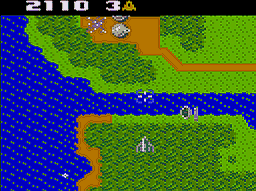 The Game: As the commander of a sleek Solvalou fighter, you’re deep into enemy territory, shooting their disc-shaped fighters out of the sky, bombing ground installations and artillery nests, bombing tanks, and trying to destroy the mothership. As you progress further behind enemy lines, heavier aircraft and more versatile and deadly ground-based defenses become the norm. Also look out for tumbling airborne mirrors – they’re impervious to your fire, but you’re toast if you fly right into them. (Atari, 1984; released circa 1987)
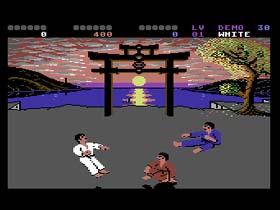 The Game: Face not one but two simultaneous opponents in what many consider the apex of Commodore 64 fighting games. IK+ supports one or two players, eighteen different moves, and more fighting action than all of Jean-Claude Van Damme’s movies combined. (System 3, 1987)
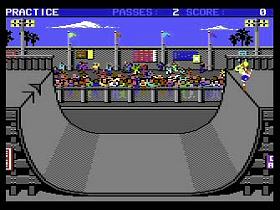 The Game: Don’t be a poseur! Skate hard or die trying in the ultimate skateboarding game for the Commodore 64. Practice or compete in five separate events that will lead you over ramps, down streets and even into abandoned pools. (Electronic Arts, 1987)
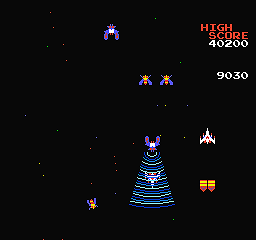 The Game: Commanding a small fleet of sleek fighter ships, you’re up against an alien invasion, arriving in wave after unfriendly wave. Alien fighters resemble butterflies and bees, but the real prize is the handful of motherships which arrives with each wave. Capable of taking two hits – the first weakens them and turns them dark blue, the second destroys them – the motherships also come equipped with a tractor beam with which to snare your fighters. But if one of your fighters is captured, and you can destroy the mothership which is towing it, your wayward fighter will be returned, doubling your firepower. (Bandai, 1988)
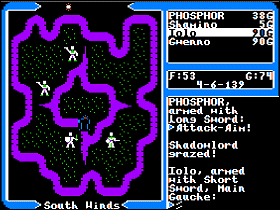 The Game: Darkness has fallen upon the land of Britannia. Lord Blackthorn, with the help and manipulation of the evil Shadowlords, has taken over, banishing Lord British from his own kingdom and ruling over the world with an iron first. Having settled into a little house in the woods after your ascension to Avatar, you are called upon once more to set things right. An underground resistance movement is quietly biding its time, waiting for Lord British to return, and hailing you and your friends as its heroes. But there are also many who have fallen in line behind Blackthorn and his dark masters – and would be happy to dispose of the Avatar for him. (Origin Systems, 1988)
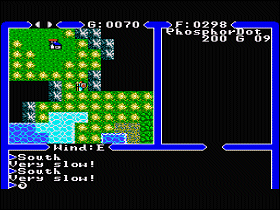 The Game: Darkness has fallen anew upon Britannia, and Lord British calls for your service again. You start out alone, accumulating traveling (and fighting) companions along your journey, striving to live by the Eight Virtues that govern conduct in the kingdom. Along the way, numerous creatures, both evil and simply pesky, challenge you. As you go forth on the quest, you must also collect the mantras of each Virtue, travel to the corresponding Shrines, and meditate there until you reach enlightenment. With enlightenment and experience come the strength to rid Britannia of evil – but beware the dark side… (Sega / Origin Systems, 1989)
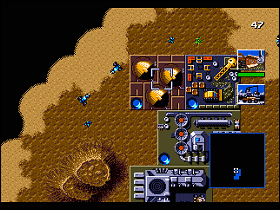 The Game: Three Houses – Atreides, Harkonnen and Ordos – converge on the planet Dune, intending to consolidate their power and eliminate one another from the business of mining the spice melange from the planet’s sandy surface. Players pick a House and then take command of both the mining and military efforts, directing and managing each, and facing stiff opposition from the other Houses. As long as spice is being extracted from Dune, the player can summon or build whatever resources are needed to continue the mission and crush the opposing forces. The only path to victory is the destruction of the other Houses and complete control of the planet. (1993, Westwood Studios / Virgin Interactive)