
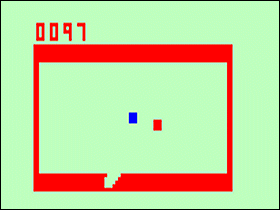
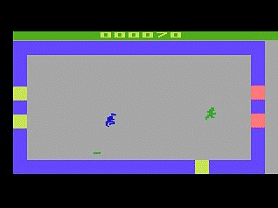
 The Game: Trapped in a square or rectangular arena, the player is represented by a mobile square. Another projectile punches its way into the arena and begins ricocheting around; points accumulate rapidly the longer the player’s square avoids contact with the projectile, but starting at 200 points, an additional projectile is added every 100 points, each on its own chaotic, bouncing path. The game ends when the player inevitably collides with one of these projectiles. (Fairchild, 1978)
Memories: Nearly every system, no matter how obscure, has at least one unique game that’s worth seeking out both hardware and software, just to try it out and see how much fun it is. Some systems, like the Atari VCS and the Intellivision, have something like half a dozen “killer apps”. When I played Dodge It on the Fairchild Channel F, it was one of those occasions where I looked up at the clock, and realized two things: it was an hour later, and I was still playing Dodge It. It’s a unique concept that I hadn’t seen elsewhere, maddeningly simple and insanely addictive. Dodge It made it worth my while to have a Channel F hooked up in my game room.
 The Game: Place your bets, ditch some cards, or play with the ones you’ve got. The computer offers the usual enticements – double down and insurance – but the odds are firmly in favor of the house. There’s no limit on how big your bet is, so you’re even free to bet an ante that’ll have you screaming “uncle!” if you lose. (Magnavox, 1978)
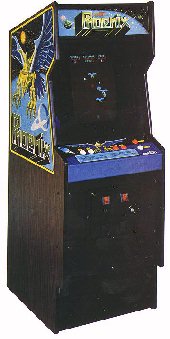 The Game: In a heavily armed space fighter, your job is pretty simple – ward off wave after wave of bird-like advance fighters and Phoenix creatures until you get to the mothership, and then try to blow that to smithereens. All of which would be simple if not for the aliens’ unpredictable kamikaze dive-bombing patterns. The
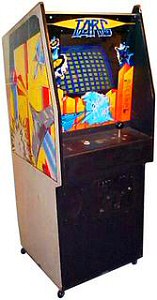 The Game: You’re trapped in a symmetrical maze with a bevy of robotic target vehicles – “Targs” – which are programmed to do just one thing: collide with your vehicle. You have one advantage on these decidedly mean streets, however – you can fire missiles ahead of your car (but the Targs are capable of dodging your projectiles too, so don’t get too cocky). Every once in a while, one of the impregnable blocks in the maze will disgorge a new enemy which is just a little bit faster and deadlier than the rest. Clearing the screen of Targs advances you to a new level with faster enemies – and eventually they’ll put the brakes on your attempts to survive. (Exidy, 1980)
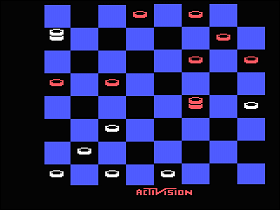 The Game: The classic game of strategy is faithfully reproduced on the
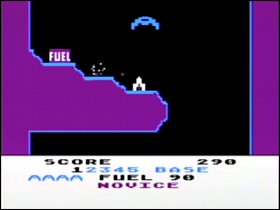 The Game: The enemy in an interplanetary war has gone underground, and you’re piloting the ship that’s taking the fight to him. But he hasn’t just hidden away in a hole; he’s hidden away in a very well-defended hole. As if it wasn’t already going to be enough of a tight squeeze navigating subterranean caverns on Mars, you’re now sharing that space with enemy ships and any number of other fatal obstacles. (Fortunately, the enemy also leaves copious numbers of helpful fuel depots for you too.) Once you fight your way to the bottom of the cave, you plant charges on the enemy mothership – meaning that now you have to escape the caverns again, and fast. (Atari, 1981)
 The Game: As the conductor of a time-traveling train, you must find and collect your passenger cars in the present day, move on to the near future to pull up to several stations and fill those cars with time travelers, and then deposit them at various attractions in the distant future. That would be difficult enough to do without running out of fuel, but you also have to contend with space creatures and repeatedly avoid collisions with a competing train by controlling the switches on the tracks. (1982, Taito)
 The Game: As a small blue spherical creature whose sole sensory organs consist of two eyes, two antennae and an enormous mouth, your mission – should you choose to accept it – is to start munching on the segmented body of the dreaded Dratapillar while avoiding its always-lethal head. When you consume one of its body segments, the Dratapillar’s two henchbeings – known only as Drats – turn white with fright and you can send them a-spinning (normally, they’re deadly to touch too). Eating all of the Dratapillar segments gets you to the next level, and the mayhem begins anew. (North American Philips, 1982)
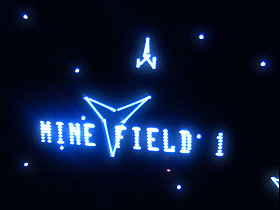 The Game: An alien ship zooms into view overhead, depositing a network of mines in deep space. Your job is to clear the spaceways, blasting each mine and then blasting the smaller mines that are released by each subsequent explosion; there are three different mine sizes, and blasting the smallest and fastest ones finally does away with them. In later stages, there are homing mines, mines that launch a missile in your direction when detonated, and other hazards. Smaller alien ships periodically zip through the screen, trying to blast you while also laying fresh mines. (GCE, 1982)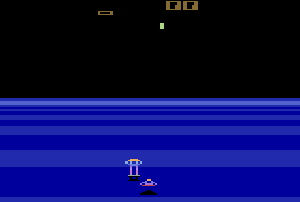
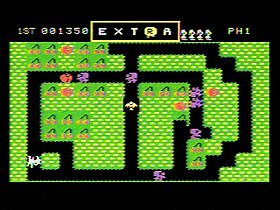 The Game: As an elfin dweller of a magic garden, you must avoid or do away with a bunch of nasty critters who are after you, while gobbling up
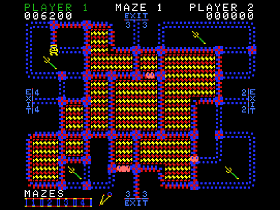 The Game: You’re a little angel (of sorts). You run around a maze consisting of zippers which close or open, depending upon whether or not you’ve already gone over that section of the maze. Zipping up one square of the maze scores points for you, but it gets trickier. Little devils chase you around the maze, trying to kill you before you can zip up the entire screen. If you zip up enough of the maze and grab a power-pellet-like object, you can dispatch some of your pursuers. Clear the screen and the fun begins anew. (Exidy, 1982)
 The Game: The war between the humans and the spacefaring enemy Dracons isn’t going well, and you’ve enlisted to join the fight. In the cockpit of your space fighter, you toggle between your flight computer (where you can find and set a course for Dracon attack groups on the map, or helpful starbases where you can replenish and repair your ship) and the direct view ahead when you engage in combat. The Dracons throw a lot of firepower at you, but your own torpedoes have a longer “reach” than their ammo. Your ship can take a pounding in a firefight, gradually eliminating your shields, your targeting ability, and even your weapons. The game is over when you can’t withdraw for repairs and are destroyed by the Dracons. (Arcadia, 1982)
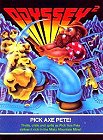 The Game: As Pete, you start out in the center of a multi-tiered mine – not at the bottom – and your boulder-smashing pick axe begins to deteriorate after about one minute. Then you either have to jump over or duck under the onslaught of falling rocks, or you’re toast. Falling to the lower levels won’t kill you, if you time it just right so as not to land right in the middle of an avalanche. When two boulders collide, they can uncover treasures such as a fresh pick axe or, more importantly, a key to the next level. As you progress through the levels, one horizontal space is deleted somewhere on the screen at random, progressing on until you have a death-trap of open space where rocks can bounce right up into your face. (North American Philips, 1982)
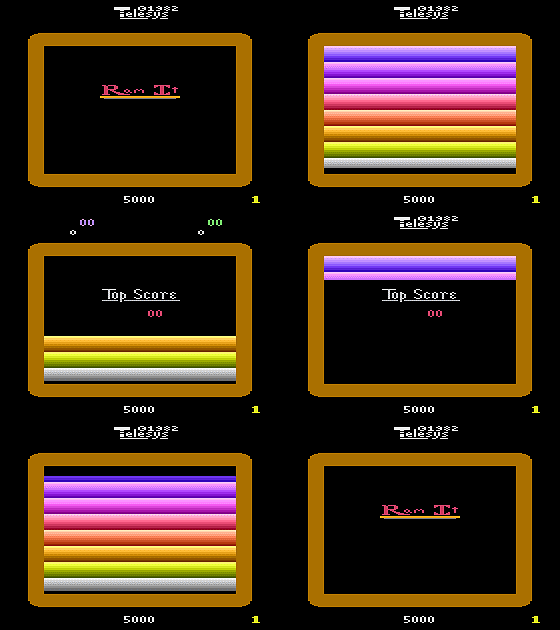 The Game: Controlling the on-screen “ramroid,” you’re up against what appears to be a malevolent bar graph. Your job is to keep the colorful bars from reaching the center of the screen from the left and right sides of the playing field; once they reach the center, you can’t eliminate them unless you’re playing a game variation where they might randomly become flashing “bonus” bars that can be eliminated with a single shot. If two bars meet at the center of the screen, they form an inpenetrable barrier that traps you above or below them. A round ends when the timer runs out (it counts down from 5000), when you’ve eliminated the last oncoming bar from the screen that you can reach, or – preferably – when you completely clear the screen of those bars. (Telesys, 1982)
 The Game: Armed with a catapult and a seemingly inexhaustible supply of projectiles (sorry, Python fans, no cows!), your task is to repeatedly and continuously smash your opponent’s castle, his catapult (rendering him harmless for a few seconds), or your opponent himself (much the same effect; a new enemy soldier enters the fray after a few seconds). (North American Philips, 1982)
 The Game: You are Tron, a lone video game warrior pitted against three other enemies with much greater armament. You can take a number of hits before you’re “de-rezzed” out of existence, but those hits can pile up pretty quickly. By throwing your disc at certain portions of the arena wall and changing them to the same color as your on-screen character, you can make tunnels for yourself – not unlike the side tunnels in Pac-Man – handy for escape or ambush. (M Network [Mattel], 1982)
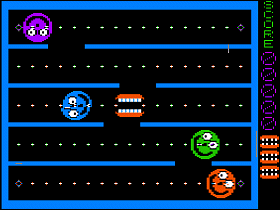 The Game: Ever had a sweet tooth? Now you are the sweet tooth – or teeth, as the case may be. You guide a set of clattering teeth around a mazelike screen of horizontal rows; an opening in each row travels down the wall separating it from the next row. Your job is to eat the tasty treats lining each row until you’ve cleared the screen. Naturally, it’s not just going to be that easy. There are nasty hard candies out to stop you, and they’ll silence those teeth of yours if they catch you – and that just bites. Periodically, a treat appears in the middle of the screen allowing you to turn the tables on them for a brief interval. Sierra On-Line, 1982
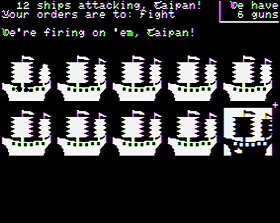 The Game: The coast of 19th century China could be a dangerous place – pirates lay in wait for passing (and relatively defenseless) ships, and that’s just the obvious danger. The buyer’s and seller’s markets in dry goods, weapons, silk and opium could pose just as much of a hazard to an independent trader’s finances. And then there’s Li Yuen’s protection racket… (Avalanche Productions [designed by Art Canfil], 1982)
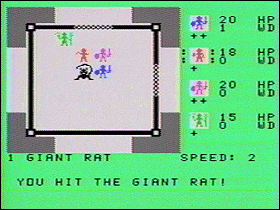 The Game: A party of up to four adventurers descends into the depths of a dungeon to recover their kidnapped king and find his magical orb. Along the way, the band of intrepid adventurers will have to fight off everything from packs of wild dogs to evil creatures determined to bring the quest to an early end. (Texas Instruments, 1982)
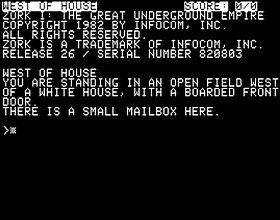 The Game: You are standing in an open field west of a white house, with a boarded front door. There is a mailbox here. (Infocom, 1982)
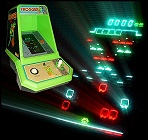 The Game: You are a frog. Your task is simple: hop across a busy highway, dodging cars and trucks, until you get the to the edge of a river, where you must keep yourself from drowning by crossing safely to your grotto at the top of the screen by leaping across the backs of turtles and logs. But watch out for snakes and alligators! (Coleco, 1982)
 The Game: A huge, Big Brother-like head pops up and says “The law: no jumping!” to your little robot, and naturally, the cocky little automaton has other ideas (replying “Oh yeah!”). And so your mission begins, guiding the robot over ramps, around narrow catwalks, and leaping across huge chasms. If the all-seeing eye opens while your robot it jumping, however, a blaster turns your hero into a heap of spare parts. If you successfully claim all of the red area on the screen, you have a narrow “launch window” in which to jump across to the eye’s platform and destroy it. The your robot launches into space, blowing away obstacles in his path, avoiding saucers and solid objects, and eventually landing on another series of ramps and catwalks to begin the quest anew. And if that doesn’t do it for you, you can put in another quarter and relax in Doodle City. (Atari, 1983)
 The Game: You control a “Chemic,” a free-floating object while can adhese itself to passing Moleks, but is vulnerable to the Atomic. Within a limited amount of time (charted by a meter at the bottom of the screen), gather and repulse Moleks around your Chemic until you’ve duplicated the example shape shown in the center of
 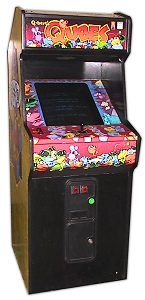 The Game: Q*Bert is back, hopping around from cube to cube, rotating the cubes 90 degrees with every hop…but a nasty bouncing rat and his minions are out to get the big Q. If one of the rat’s henchmen hops onto a cube whose top surface is the same color as its skin, it melts into the cube harmlessly. Q*Bert must change at least one row of cubes to the target color to advance to the next level – and there aren’t any flying discs this time! (Mylstar Electronics, 1983)
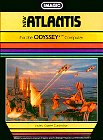 The Game: Hostile spacecraft are bombing the underwater paradise of Atlantis from above. Manning two cannons, you can knock the attacking ships out of the sky – or try to hit them at close range if they dive to bombing altitutde. When all of Atlantis’ landmarks have been wiped out, the game is over. (Imagic, 1983)
 The Game: You’re piloting a balloon-toting brat around an amusement park. Ride the rides! Slide down the slide! Crawl under the trees and play! But watch out for that balloon – the thing is vital to your survival! Don’t let it get popped against the trees, or the rides, or the walls of the amusement park. Worse yet, a cloud may appear at the side of the screen and blow your balloon away, forcing you to run after it and catch it before it collides with something and pops. Birds will also fly over the park, and they can pop your balloon too. Even if you’re not holding onto it at the time, the balloon popping ends your game. (Frankly, this reliance on the balloon seems to be a bit unhealthy, and will probably lead the game’s kid to be a shut-in with another inflatable friend by the time he’s 40.) (Phillips, 1983)
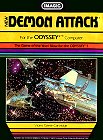 The Game: Demons coalesce into existence in mid-air above your cannon. Send them back where they came from by force – but watch out, as demons in later levels split into two parts upon being hit, which must then be destroyed individually… (Imagic, 1983)
 The Game: You are a frog. Your task is simple: hop across a busy highway, dodging cars and trucks, until you get the to the top of the screen. On the second screen, you stand at the edge of a river, where you must keep yourself from drowning by crossing safely to your grotto at the top of the screen by leaping across the backs of turtles and logs. But watch out for hungry alligators! (Phillips / Parker Brothers, 1983)