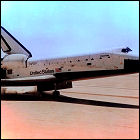
 The first shuttle to return from space, Columbia touches down on the dry lake bed strip at Edwards Air Force Base in California, two days and six hours after liftoff (and after putting a cool million miles on the odometer). The aerodynamics involved in gliding after re-entry are found to be trickier than the previous test landings of the Enterprise. Inspection of the thermal tiles lining the shuttle’s belly reveals more damage than expected, and NASA begins working to refine the process of fitting the tiles to the shuttle.

 ABC airs the fifth episode of Stephen J. Cannell’s superhero comedy series The Greatest American Hero, starring William Katt, Connie Sellecca, and Robert Culp.
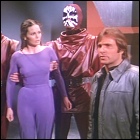 NBC airs the
 ITV airs the 37th episode of the anthology series Tales Of The Unexpected. Stuart Whitman guest stars.
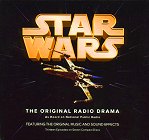 The
The 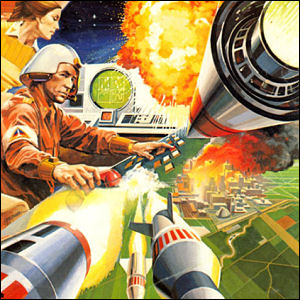 Atari releases the home version of
  CBS premieres
 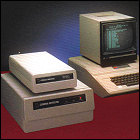 Corvus Systems, makers of hard disk drives for the Apple II and other microcomputers, releases the Corvus OmniNet, the first local area networking hardware/software bundle aimed at small businesses, schools, and even high-end home users. Since Corvus’ 5 and 10 megabyte hard disk drives for the Apple II had initial price tags in the $5,000 range, Corvus also created the OmniNet hub to allow small businesses and schools to maximize that investment by allowing multiple computers to access it. Forseeing the future of the business market, Corvus also makes OmniNet cards for the IBM PC. Though Ethernet is already in use at this time, its expensive hardware and installation is generally limited to large business customers.
 BBC 1 premieres the
 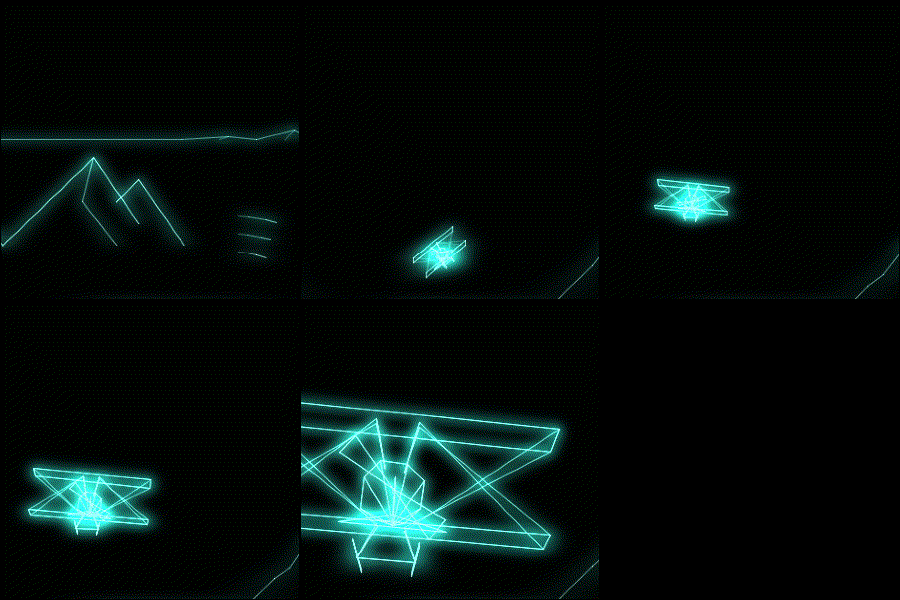 Atari releases
  BBC 1 premieres the
  ITV premieres
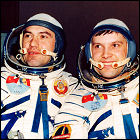 The final first-generation Soyuz spacecraft, Soyuz 40, is launched on a week-long spaceflight by the Soviet Union. With Leonid Popov and Romanian cosmonaut Dumitru Prunariu aboard, Soyuz 40 visits space station Salyut 6 for several days, and is the last spacecraft to dock at the five-year-old space station. The Soyuz 40 crew returns to Earth on May 22nd. Future Soyuz launches will use the upgraded Soyuz-T vehicles.
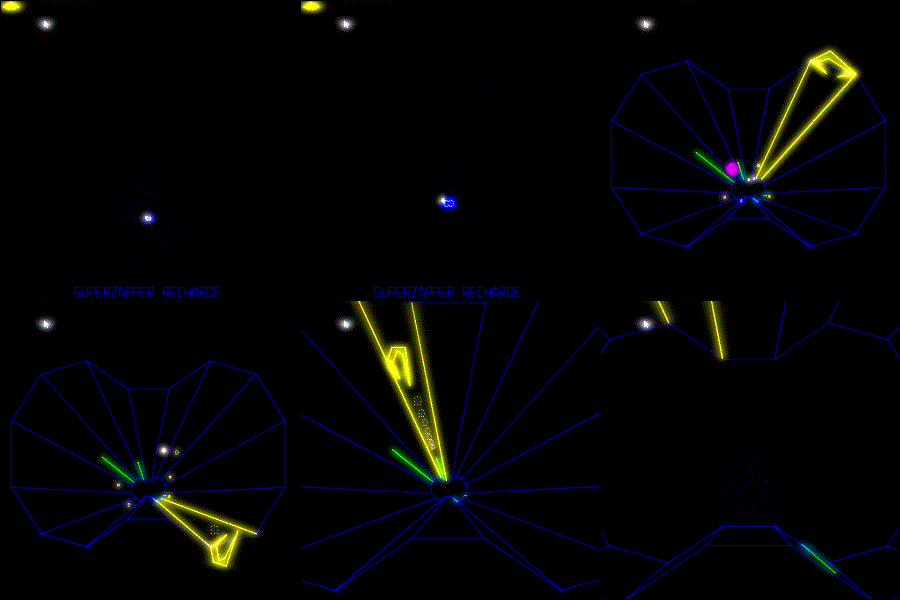 Atari releases
  BBC 1 premieres the
 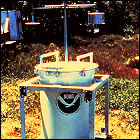 Researchers and storm chasers from the National Weather Service’s Severe Storms Laboratory in Norman, Oklahoma make the first field deployment of the 300-pound TOtable Tornado Observatory (TOTO) instrument package, a modified oil drum filled with meteorological instrumentation which is intended to be placed directly into the path of an oncoming tornado. The first deployment, in north Texas, yields no data – no tornado forms for TOTO to study. Over the next five years, despite several “close calls”, TOTO is never successfully placed in the direct path of a tornado. The TOTO program is discontinued in 1987.
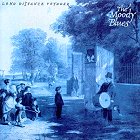 Decca Records releases the
  ITV airs
 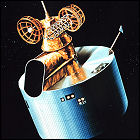 NOAA’s GOES-5 Geostationary Operational Environmental Satellite is launched from Cape Canaveral into a geosynchronous orbit over 85 degrees west longitude on Earth, a position which will change several times over GOES-5’s career until 1988, allowing it to monitor weather over the continental United States and Europe. GOES-5’s primary set of “eyes” will fail in 1984, forcing NOAA to return GOES-1 and GOES-4 to service until a replacement can be launched in 1987. Its usefulness as a weather satellite at an end, GOES-5 will be boosted into a graveyard orbit in 1990.