
 The Game: The alien abductors are back. Their henchbeings are back. And fortunately for the hapless humans on the planet’s surface, you’re back too, in a fully armed warship with a belly full of smart bombs. But the aliens have brought new and unusual reinforcements, and now the ultimate X-factor is seen visibly floating in the night sky – a stargate which could deposit your space fighter anywhere, delivering you to safety…or a rendezvous with a swarm of aliens. (Atari, 1983)
Memories: Released only in Japan in the initial burst of titles for the Famicom, this port of Williams Electronics‘ arcade sequel Stargate (also known as Defender II, a title to which the game was switched to reinforce its status as a sequel to the hit Defender). The territory-limited reach of the game is the bad news. The good news? It’s an exceptional arcade port that might just have become this reviewer’s favorite way to enjoy a legendarily difficult game.
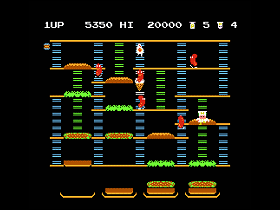 The Game: As Chef Peter Pepper, you climb around a multi-level factory whose sole function is to make some really big burgers. We’re talking about some BIG burgers here. But your ingredients aren’t exactly cooperating with you… (Namco, 1985 [Japan] / Data East, 1987 [US])
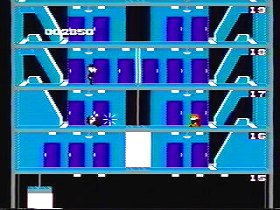 The Game: As a daring spy, you break into a top secret enemy facility, trying to grab vital secrets and evade or kill as many enemy agents as you can. Your only means of getting from floor to floor through most of the game is via the elevator – which gives you an advantage and also makes you vulnerable. (Taito, 1985)
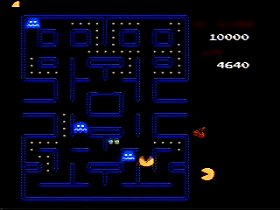 The Game: As a round yellow creature consisting of a mouth and nothing else, you maneuver around a relatively simple maze, gobbling small dots (10 points) and evading four colorful monsters who can eat you on contact. In four corners of the screen, large flashing dots (50 points) enable you to turn the tables and eat the monsters
 The Game: Intrepid plumbers Mario and Luigi have fallen back on Mario’s original mandate – rescuing the damsel – as they journey through the kingdom, battling Koopas and braving falls from dizzying heights, all to
 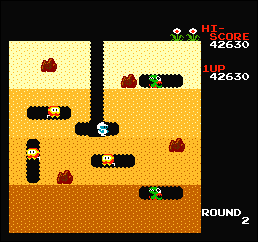 The Game: Who said landscaping was easy? You are Dig Dug, an intrepid gardener whose soil is infested with pesky Pookas and fire-breathing Fygars. You’re armed with your trusty pump, which you can use to inflate your enemies until, finally, they blow up. But both the Pookas and Fygars can crawl through the ground and can pop out into your tunnels, and if a Fygar sneaks up behind you, he can toast you if you’re not careful. (Namco, 1985)
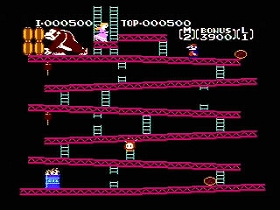 The Game: An oversized gorilla kidnaps Mario’s girlfriend and hauls her up to the top of a building which is presumably under construction. You are Mario, dodging Donkey Kong’s never-ending hail of rolling barrels and “foxfires” in your
 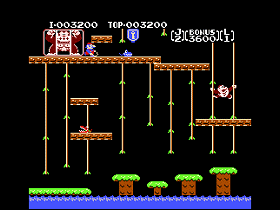 The Game: Mario has Donkey Kong in captivity, and it’s up to Donkey Kong Jr. to rescue his dad by scaling vines and chains, avoiding nasty-toothed traps and pesky birds, and reaching the key to free the great ape from Mario’s clutches. (Nintendo, 1985)
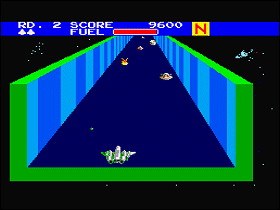 The Game: As the lone pilot daring enough to breach the defenses of Zaxxon’s space stronghold yet again, you take on a fleet of perimeter fighters, some of whom helpfully leave power-ups behind when destroyed. Then it’s into the space base once more, bristling with gun emplacements, fuel tanks that gas up your fighter when they’re shot (we haven’t quite worked that one out either), and walls that you can run face-first if you’re at just the wrong altitude. Just beyond the walls of the base lies the new and improved Zaxxon itself; if you survive that encounter, you begin again. (Sega, 1987)
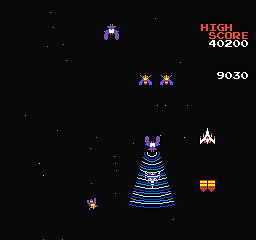 The Game: Commanding a small fleet of sleek fighter ships, you’re up against an alien invasion, arriving in wave after unfriendly wave. Alien fighters resemble butterflies and bees, but the real prize is the handful of motherships which arrives with each wave. Capable of taking two hits – the first weakens them and turns them dark blue, the second destroys them – the motherships also come equipped with a tractor beam with which to snare your fighters. But if one of your fighters is captured, and you can destroy the mothership which is towing it, your wayward fighter will be returned, doubling your firepower. (Bandai, 1988)
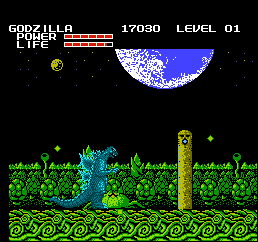 The Game: It is the year 2XXX (don’t worry, we couldn’t find it on our calendars either), and Planet X has declared war on Earth’s solar system, sending its finest kaiju into the fray. In this time of our most desperate need, Godzilla and Mothra step forward to defend the Earth and fight for humanity, taking out enemy installations, spacecraft and even those pesky enemy monsters. But even Godzilla and Mothra can only take so much damage… (Toho Studios/Nintendo, 1988)
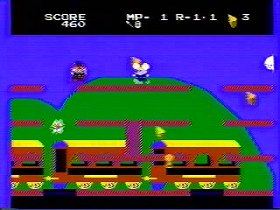 The Game: Mappy the Mouse is back, pursuing his feline arch nemesis Boss The Big Bit and his kitty kohorts through several themed zones of an amusement park. Riddled with ladders, trampolines, secret weapons and treasures, the park goes from wild west to tropical and beyond. Just avoid the cats, lest Mappy become someone’s mousy morsel. (Taxan [under license from Namco], 1988)
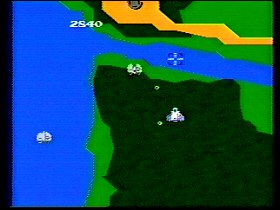 The Game: As the commander of a sleek Solvalou fighter, you’re deep into enemy territory, shooting their disc-shaped fighters out of the sky, bombing ground installations and artillery nests, bombing tanks, and trying to destroy the
  The Game: Baseball returns to the small screen – the very small screen – on the Game Boy. Step up to the plate and take a swing; after three outs, take control of the pitcher, basemen and outfield, trying to keep the computer from scoring a run. (Nintendo, 1989)
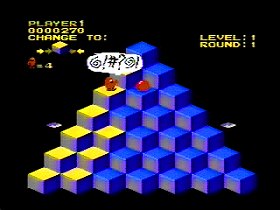 The Game: Q*Bert, a nosey little guy with a propensity for hopping, spends his time hopping around a three-dimensional pyramid of cubes, avoiding Coily the Snake and other assorted purple and red creatures, including a few who operate on a slightly different plane (i.e., they move down the pyramid as if it were rotated one-third). Any green objects and creatures Q*Bert can catch will not hurt him – in fact, the little bouncing green balls will stop time briefly for everyone but Q*Bert. If he gets into a tight spot, Q*Bert can jump off the pyramid onto a flying disc which will despoit him back at the top of the pyramid – and lure Coily to a nasty fate by jumping into nothing. Changing the colors of the top of every cube in the pyramid to the target color indicated at the top left of the screen will clear the pyramid and start the craziness all over again. If Q*Bert is hit by an enemy or falls off the pyramid, he hits bottom with a resounding, arcade- cabinet-shaking splat and a burst of incomprehensible obscenity! (Konami/Ultra, 1989)
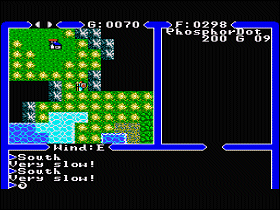 The Game: Darkness has fallen anew upon Britannia, and Lord British calls for your service again. You start out alone, accumulating traveling (and fighting) companions along your journey, striving to live by the Eight Virtues that govern conduct in the kingdom. Along the way, numerous creatures, both evil and simply pesky, challenge you. As you go forth on the quest, you must also collect the mantras of each Virtue, travel to the corresponding Shrines, and meditate there until you reach enlightenment. With enlightenment and experience come the strength to rid Britannia of evil – but beware the dark side… (Sega / Origin Systems, 1989)
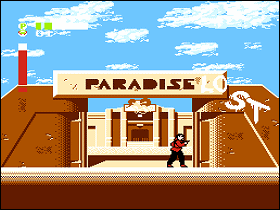 The Game: Sybok, a charismatic Vulcan cult leader, has tried to disrupt the peace process on the neutral planet Nimbus III. Players take control of one Enterprise crewman at a time to: retrieve the Nimbus III hostages (Sulu), save Kirk and Spock from a cell aboard the Enterprise (Scotty), pilot the Enterprise through asteroids and attacking Klingons (Sulu again?), and finally make a mad dash into the heart of the lair of the “god creature” (Kirk). Running out of life energy aborts the mission; fortunately, Dr. McCoy is standing by at all times and the mission can start from scratch. (Bandai, 1989 – unreleased)
 The Game: As intrepid plumber (and explorer) Mario, players have to jump through new environments and enemies to help Mario rescue Daisy. Egyptian pyramids guarded by fire-breathing Sphinxes, seaside platforms invaded by space aliens, and the usual Goombas and Koopas await Mario as he tries to reach the end of each level. As always, there are mushrooms, stars and fire flowers to help Mario power up, and helpful hidden chambers full of coins. (Nintendo, 1989)
 The Game: Cavernous rooms are loaded with gold, just ripe for the picking. But before you celebrate hitting the mother lode, look again – there are other gold-diggers homing in on the treasure. What do you have that they don’t? A drill gun that can blast a hole in the floors, into which your opponents will jump blindly. Eventually, the holes will reseal themselves, and that process will swallow your enemies (and you, if you happen to be clumsy enough to wander into the hole yourself). Grabbing all of the gold will reveal a passage to the next level of the game. (Bandai, 1989)
 The Game: You’re in charge of a getaway car loaded with crafty criminals. Your job is to sneak around the maze, avoid a bunch of cranky cops who are hot on your trail, and grab all the dough – and, of course, to escape so you can steal again another day. But the cops can trap you with a series of doors that can prevent you from getting away… (Data East, 1990)
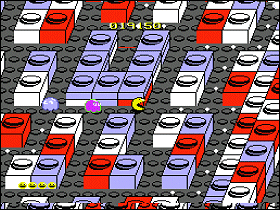 The Game: As a round yellow creature consisting of a mouth and nothing else, you maneuver around relatively simple mazes, gobbling small dots and evading five colorful monsters who can eat you on contact. In four corners of the screen, larger dots enable you to turn the tables and eat the monsters for a brief period. Periodically, assorted items appear near the center of the maze, and you can consume these for additional points as well. The monsters, once eaten, return to their home base in ghost form and return to chase you anew. If you clear the maze of dots, you advance to a new maze and the game starts again, but just a little bit faster… (Tengen, 1990)
 The Game: You are a marker, trying to claim as much of the playing field as you can by enclosing areas of it. Drawing your boundaries faster is safer, but yields fewer points. A slower draw, which leaves you vulnerable to attack from the Qix and the Sparx, gives you many more points upon the completion of an enclosed area. If the ever-shifting Qix touches your marker or an uncompleted boundary you are drawing, you lose a “life” and start again. And the Sparx, which travel only along the edges of the playing field and along the boundaries of areas of the screen you’ve already enclosed, can destroy you by touching your marker. And if you linger too long, a fuse will begin burning at the beginning of your unfinished boundary, and will eventually catch up with you. (Nintendo/Taito, 1990)
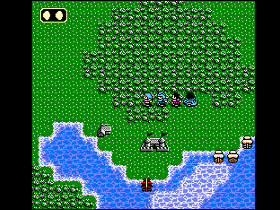 The Game: Darkness has fallen anew upon Britannia, and Lord British calls for your service again. You start out alone, accumulating traveling (and fighting) companions along your journey, striving to live by the Eight Virtues that govern conduct in the kingdom. Along the way, numerous creatures, both evil and simply pesky, challenge you. As you go forth on the quest, you must also collect the mantras of each Virtue, travel to the corresponding Shrines, and meditate there until you reach enlightenment. With enlightenment and experience come the strength to rid Britannia of evil – but, to quote a little pointy-eared green guy, beware the dark side… (FCI / Pony Canyon, 1990)
 The Game: As a daring spy, you break into a top secret enemy facility, trying to grab vital secrets and evade or kill as many enemy agents as you can. Your only means of getting from floor to floor through most of the game is via the elevator – which gives you an advantage and also makes you vulnerable. (Taito, 1991)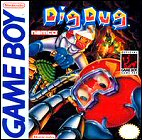
 The Game: Q*Bert, a nosey little guy with a propensity for hopping, spends his time hopping around a three-dimensional pyramid of cubes, avoiding Coily the Snake and other assorted purple and red creatures, including a few who operate on a slightly different plane (i.e., they move down the pyramid as if it were rotated one-third). Changing the colors of the top of every cube in the pyramid to the target color indicated at the top left of the screen will clear the pyramid and start the craziness all over again. If Q*Bert is hit by an enemy or falls off the pyramid, he hits bottom with a resounding, arcade- cabinet-shaking splat and a burst of incomprehensible obscenity! (NTVIC, 1992)
 The Game: Players assume the role of Susumu Kodai, a hot-headed young recruit unexpectedly thrust into a leadership role on a mission to cross the galaxy and procure a device that can restore planet Earth’s war-decimated ecosphere within a year. As if crossing the Milky Way and returning within a year wasn’t enough of a formidable task, the Space Battleship Yamato faces stiff opposition from an alien race, the Gamilas, determined to seal Earth’s fate by bringing the last-ditch rescue mission to a halt. Kodai and the Yamato’s ailing commander, Admiral Okita, must decide where to commit their forces for maximum effect. Large squarons of Cosmo Fighters can be dispatched to take the Gamilas on head-to-head on the on-screen grid, but Yamato herself can also be ordered into the thick of the action (a strategy that puts the entire mission in jeopardy if the battle is lost). Success means fighting through the Gamilas’ offensive front and reaching planet Iskandar. Failure means death for all humankind. Pick your battles wisely. (Interbec, 1992)
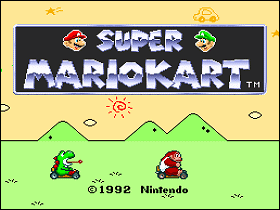 The Game: It’s a big day at the races, with a field of drivers selected from the Mushroom Kingdom: Mario, Luigi, Princess Peach, Toad, Bowser, and even Donkey Kong Jr. are among the racers vying for the top spot. From the grassy Mushroom course to the punishingly muddy Star course to the oceanside Flower course, there are challenges, hairpin turns and obstacles. Whoever can learn to navigate each course the fastest without ending up out of bounds struggling to get back on the course will be the winner. (Nintendo, 1992)
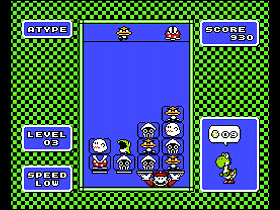 The Game: Mario has to keep more plates spinning than usual. With a plate in each hand, Mario must be moved underneath a never-ending onslaught of enemy creatures. The object of the game is to stack up identical creatures to eliminate them from play, and, when possible, to stack up the two halves of Yoshi eggs to allow a new Yoshi to hatch. Management of the creature stacks is vital, since a stack exceeding the height of the play area ends the game. In two-player mode, both players simultaneously try to outdo the other. (Nintendo, 1992)
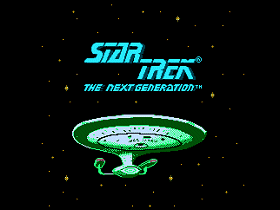 The Game: Captain Picard puts you in charge of a simulated mission aboard the Enterprise. With the helpful advice of Commander Riker, Data, Geordi, Worf and Chief O’Brien, you have to command the pride of the Federation fleet into a number of difficult situations, accomplish as much of the mission objectives as you can, and bring the Enterprise home in one piece. (Absolute, 1993)
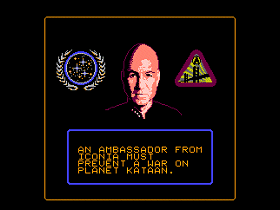 is that?) and having to go to their screens to kick in things like the shields, weapons and warp drive, when it comes right down to it, if you strip away these elements, it’s the same basic game: you’re blasting away at enemy ships and hoping to get more clean shots in at them then they get at you. He whose shields fail first gets blown out of the sky. In 11 years, the basic Star Trek game hadn’t evolved that much (but at least The Next Generation doesn’t get the torturously slow “story” scenes of Star Trek: 25th Anniversary).