
 With the success of the first wave of Playmates’ Star Trek: The Next Generation action figures, the question became: what next?
For the most part, the answer was repetition. Just do what you did before, and everything will be fine.
The same Enterprise crew members released in the first wave once again formed the backbone of the new selection of characters, only this time in the season one and two spandex uniforms.
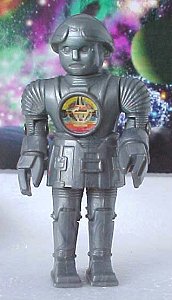 Having moved four times in the past six years, to say nothing of the trading and misplacing that kids engage in with their toys, I have a few “orphan” figures that recently turned up as I packed for my latest move. The first of these is Twiki (right), from Buck Rogers in the 25th Century. The 1979 updating of Buck Rogers catered to the younger audience with this diminutive robot, and thus Meco’s line of action figures included Twiki (with Dr. Theopolis represented by a flimsy sticker which is in surprisingly good shape on this figure). Other characters in the Buck Rogers line included Buck, Colonel Wilma Deering, Princess Ardala, Killer Kane, Emperor Draco and Tiger Man.
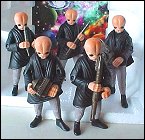 It could be argued that one of the single most defining moments in the classic trilogy was Star Wars‘ Mos Eisley Cantina scene. Most of the creature work in the movie was crammed into the opening montage in this setting – outside of Mos Eisley, the only non-humans seen in Star Wars are Jawas, droids, Tusken raiders, and the creature in the Death Star’s garbage compactor.
  Released at the same time as waves one and three, the second wave of Phantom Menace figures included two of the very best new toys in the series – and it’s hardly a coincidence that those two were among the first three that I picked up at midnight on May 3rd.
  Space may be the final frontier, but it’s also just about the last subject on which you can expect any toy manufacturer to base new products – especially the early era of space exploration. But some toy companies have done just that. Here’s a look at some of the better space toys and collectibles.
  It was a forgone conclusion that when the new Star Trek spinoff premiered in 1993, there would be more than enough merchandising to support and promote it. Indeed, companies that had once shunned the dark horse Next Generation were now beating down the doors at Paramount’s licensing department to get a piece of the highly anticipated – and publicized – new show.
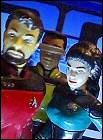 Here’s an entire series of toys fraught with bloopers.
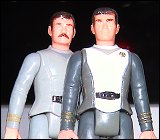 If you believed the advertising hype, Star Trek: The Motion Picture was going to be the next Star Wars. Now, of course, we all know it wasn’t, but that’s beside the point – we still got some decent toys out of the whole thing.
 Despite releasing characters from A Piece Of The Action and City On The Edge Of Forever, Playmates’ most inspired choice of episode-specific classic Trek characters was its four-piece subset of toys from The Cage, the original pilot which NBC rejected.
  Playmates learned one valuable lesson from the first wave of Deep Space Nine figures: get the figures on the shelves within a year of the show’s premiere. The Deep Space Nine toys took a year to hit the stores, and though their quality was arguably worth the wait, the buzz surrounding the launch of that series had died down by the time the figures appeared. Not so with the Voyager figures – these arrived in store within six months of the series premiere on UPN.
 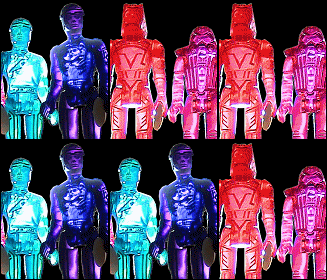 How do you merchandise a movie with such abstract imagery as Disney’s 1982 computerphile favorite Tron? It’s not easy, but Tomy figured it out. Rather than the traditional paint job, Tomy opted to mold the Tron figures in translucent plastic, painting on only the “circuitry” details of each character’s computer-world uniform. No characters from the movie’s real-world scenes were ever made.
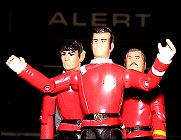 After the smash success of Star Trek II: The Wrath of Khan, Ertl stepped up to the plate to grab the toy license for Star Trek III – which, of course, was a much less action-oriented movie. Ertl produced only four characters, as well as small die-cast metal replicas of the Enterprise (not as good as the earlier version released by another manufacturer for Star Trek: The Motion Picture) and the Klingon Bird of Prey.
 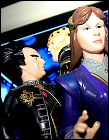 In 1998, Exclusive Premiere, the makers of numerous nostalgic pop culture figures and dolls, finally put in a bid to make Babylon 5 action figures. Though the cerebral nature of the series didn’t lend itself to a huge, exciting, Star Wars-scale line of toys – after all, how much action can an action figure of Ambassador Kosh really have? – it was nice to have, at long last, some fun little reminders of the B5 universe. In one of his Usenet postings, even series creator J. Michael Straczynski admitted to being a fan of the toys.
  1996: Voyager was over a year old, First Contact was on the way, and Worf had been a fixture on Deep Space Nine for several months. In a way, this time frame was the last hurrah for Star Trek merchandising, before the public tired too much of the franchise. Playmates, having seen very limited success with its lines of Deep Space Nine and Voyager action figures, folded all of its Star Trek toys into a generically-packaged range whose blister card simply bore a movie-era “Star Trek” logo. While continuing to introduce characters from the later series, Playmates also acceeded to fan demand for more version of the classic Star Trek characters.
 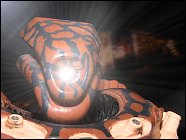 Very late in 1998, Exclusive Premiere released a long-awaited second wave of Babylon 5 characters by popular demand. In many toy stores, the first wave of figures were still warming the shelves, and were discounted from their lofty $8.00 price tag to around $3.00 each. B5 fans were eagerly picking up the figures, but the cold consumer reality of it was that it seemed like they were the only ones doing so.
 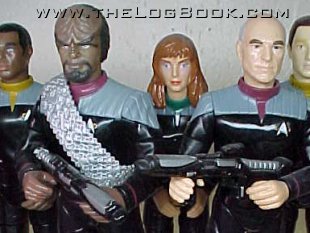 Welcome to our look at the Star Trek: First Contact toys, or “how Playmates killed the Star Trek action figures.”
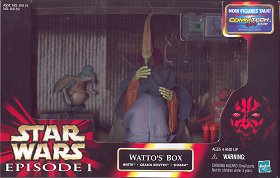 Man, I need to get myself into a Star Wars flick someday.