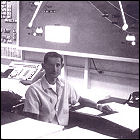
 Recent Jet Propulsion Laboratory hire Michael Minovitch submits the first of a series of papers and technical memorandums on the possibility of using carefully-calculated gravitational assist maneuvers to speed transit time between celestial bodies while requiring minimal engine/fuel use. Where most previous scientific thought concentrated on using engine burns (and a lot of fuel) to cancel the effects of a planet’s gravity, Minovitch demonstrated that gravity could be a big help with a carefully calculated trajectory. Though nearly every planetary mission since then has capitalized on Minovitch’s research, it was initially rejected by JPL. Minovitch’s calculations are later revisited by Caltech grad student Gary Flandro, who flags down a particular combination of Minovitch’s pre-computed trajectories for a “grand tour” of the outer solar system, a mission which will eventually be known – in a somewhat scaled-down, less grand form – as Voyager.

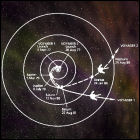 The Grand Tour Outer Planets mission is proposed to NASA by the Jet Propulsion Laboratory. Using a combination of the gravitational assist trajectories computed by JPL’s Michael Minovitch in
 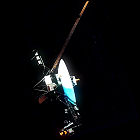 Having spent six years wrangling with various mission profiles for a “Grand Tour” of the outer solar system, made possible by a favorable planetary alignment occurring only once every 175 years, NASA finally authorizes a very stripped-down version of its original ambitious Grand Tour plans. The Mariner Jupiter/Saturn ’77 mission will consist of two twin unmanned spacecraft to be launched in
 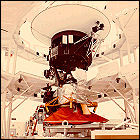 NASA Administrator James Fletcher announces that the ambitious twin Mariner Jupiter/Saturn ’77 space probes, due to be launched later in the year, have been christened with new names: Voyager 1 and Voyager 2. The name change has been initiated by recently-promoted Voyager program manager John Casani, who thinks the spacecraft need a name that’s less of a mouthful (the name “Discoverer” was also considered). For the first time, NASA openly admits that one of the vehicles – Voyager 2 – may continue on to Uranus and Neptune should its Saturn flyby go well in 1981, depending on the spacecraft’s health.
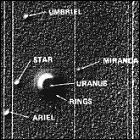 A team of MIT astronomers, flying in a plane modified to serve as an airborne high-altitude telescope, plans to observe the planet Uranus as it eclipses, or “occults”, a star. But the team observes more occultations than expected both before and after the planet itself passes in front of the star. The inevitable conclusion is that Uranus has rings, made of material too dark to be detected by existing Earthbound telescopes. Further observations are given top priority: NASA’s Voyager 2 space probe, due to lift off later in 1977, may last long enough to reach Uranus, and the newly discovered rings must be taken into account when planning its flyby trajectory.
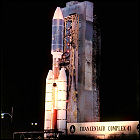 NASA launches Voyager 2 (weeks ahead of Voyager 1), giving the unmanned space probe the best shot of taking advantage of a favorable planetary alignment known as the “Grand Tour”. Using a series of carefully calculated gravity assists, Voyager has the potential to visit all four of the major outer gas planets – Jupiter, Saturn, Uranus and Neptune – in under 15 years without having to expend fuel to make the trip. If Voyager 2 survives long enough to visit Uranus or Neptune, it will become the first man-made spacecraft to visit either planet.
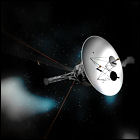 NASA’s Voyager 2 space probe, leaving the inner solar system en route to a grand tour of the outer planets, suddenly stops transmitting to Earth, failing to acknowledge commands sent by its ground controllers. Any chance of the probe conducting its studies of Jupiter and Saturn, let alone Uranus or Neptune, is in serious jeopardy. Discovering a problem with Voyager 2’s ability to compensate for the Doppler shift in signals coming from Earth, NASA engineers devise a workaround to compensate for this problem from the ground, saving the mission.
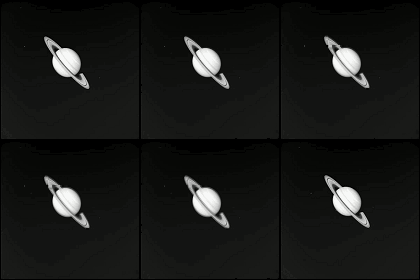 With the Jupiter encounter behind it, NASA’s Voyager 2 unmanned spacecraft is given a new backup mission plan, replacing the original Jupiter/Saturn backup plan implemented after a radio receiver failure befell the spacecraft in 1978. Intended to reap the minimum acceptable science observations (including photography) and transmit them to Earth should Voyager 2’s ability to receive new commands be lost, this new backup mission load now includes automated observation plans for Saturn and Uranus, the latter of which will not be reached until 1986.
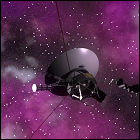 NASA engineers complete a multi-year project to completely reprogram Voyager 2 during the unmanned space probe’s five-year journey from Saturn to Uranus. A planet receiving only a fraction of the sunlight that made photography possible at Jupiter and Saturn, Uranus requires much longer exposures, slower camera shutter speeds, and incredibly precise camera tracking. To compensate for the extreme lag in comunications to and from Uranus, data compression algorithms are devised using techniques that simply didn’t exist at the time of Voyager 2’s construction and original programming, but the compression scheme is an all-or-nothing proposition: it ties up Voyager 2’s backup computer, meaning that a failure of the main computer during a critical maneuver could send the probe off-course, perhaps even colliding with the bodies it intends to study.
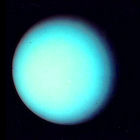 Voyager 2 visits the third planet on its grand tour of the outer solar system, becoming the first and only man-made spacecraft to visit Uranus. Since the blue-green planet and its moon are tipped over, Voyager has fewer opportunities to gather images of the moons of Uranus, but a close pass by its innermost large satellite, Miranda, yields pictures of one of the stranger surfaces in the solar system: a moon that was ripped apart and melted back together in the distant past. The atmosphere of Uranus reveals almost no details to Voyager 2’s cameras in the scant visible light available this far from the sun, but ten new moons are discovered, and the planet’s elusive dark rings are captured in several images. With no other missions to Uranus in the pipeline, Voyager 2’s brief flyby remains the primary source of most of our knowledge of the seventh planet from the sun. It will now take Voyager 2 three years to reach Neptune, its final target.
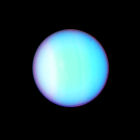 Astronomers using the Hubble Space Telescope discover two new moons of Uranus that eluded detection during Voyager 2’s 1986 flyby: Cupid and Mab. Both small, dark bodies that orbit closer to Uranus than any of the planet’s large satellites, Cupid and Mab raise the number of known Uranian satellites above 20. Mab’s orbit keeps it within the planet’s outermost ring, while Cupid’s orbit is only 500 miles further out than that of Belinda, one of the small moons discovered in 1986 by Voyager 2. Cupid is the tiniest of the inner moons of Uranus, roughly 11 miles in diameter.