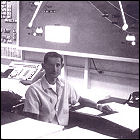
 Recent Jet Propulsion Laboratory hire Michael Minovitch submits the first of a series of papers and technical memorandums on the possibility of using carefully-calculated gravitational assist maneuvers to speed transit time between celestial bodies while requiring minimal engine/fuel use. Where most previous scientific thought concentrated on using engine burns (and a lot of fuel) to cancel the effects of a planet’s gravity, Minovitch demonstrated that gravity could be a big help with a carefully calculated trajectory. Though nearly every planetary mission since then has capitalized on Minovitch’s research, it was initially rejected by JPL. Minovitch’s calculations are later revisited by Caltech grad student Gary Flandro, who flags down a particular combination of Minovitch’s pre-computed trajectories for a “grand tour” of the outer solar system, a mission which will eventually be known – in a somewhat scaled-down, less grand form – as Voyager.

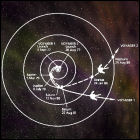 The Grand Tour Outer Planets mission is proposed to NASA by the Jet Propulsion Laboratory. Using a combination of the gravitational assist trajectories computed by JPL’s Michael Minovitch in
 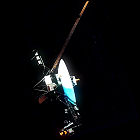 Having spent six years wrangling with various mission profiles for a “Grand Tour” of the outer solar system, made possible by a favorable planetary alignment occurring only once every 175 years, NASA finally authorizes a very stripped-down version of its original ambitious Grand Tour plans. The Mariner Jupiter/Saturn ’77 mission will consist of two twin unmanned spacecraft to be launched in
 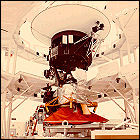 NASA Administrator James Fletcher announces that the ambitious twin Mariner Jupiter/Saturn ’77 space probes, due to be launched later in the year, have been christened with new names: Voyager 1 and Voyager 2. The name change has been initiated by recently-promoted Voyager program manager John Casani, who thinks the spacecraft need a name that’s less of a mouthful (the name “Discoverer” was also considered). For the first time, NASA openly admits that one of the vehicles – Voyager 2 – may continue on to Uranus and Neptune should its Saturn flyby go well in 1981, depending on the spacecraft’s health.
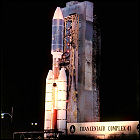 NASA launches Voyager 2 (weeks ahead of Voyager 1), giving the unmanned space probe the best shot of taking advantage of a favorable planetary alignment known as the “Grand Tour”. Using a series of carefully calculated gravity assists, Voyager has the potential to visit all four of the major outer gas planets – Jupiter, Saturn, Uranus and Neptune – in under 15 years without having to expend fuel to make the trip. If Voyager 2 survives long enough to visit Uranus or Neptune, it will become the first man-made spacecraft to visit either planet.
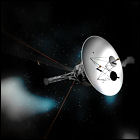 NASA’s Voyager 2 space probe, leaving the inner solar system en route to a grand tour of the outer planets, suddenly stops transmitting to Earth, failing to acknowledge commands sent by its ground controllers. Any chance of the probe conducting its studies of Jupiter and Saturn, let alone Uranus or Neptune, is in serious jeopardy. Discovering a problem with Voyager 2’s ability to compensate for the Doppler shift in signals coming from Earth, NASA engineers devise a workaround to compensate for this problem from the ground, saving the mission.
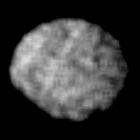 A team of American astronomers discovers what they believe is a third moon of Neptune from ground-based telescope observations, but S/1981N1 isn’t seen again for several years, so the discovery is left in the “unconfirmed” category…until it is next seen by Voyager 2 in 1989, confirming the original sighting many years later. In 1991, the International Astronomical Union will name this moon Larissa. (Voyager 2 photo of Larissa shown)
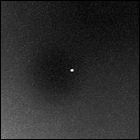 From within 500 million miles, cameras aboard NASA’s Voyager 2 unmanned space probe can now get a better look at planet Neptune than is possible with ground-based telescopes on Earth – even though, at present, that means a tiny disk only eight pixels across in images measuring 800 x 800 pixels. Voyager 2 is still over a year away from its closest encounter with Neptune, and even its own best photos don’t reveal any detail in the blue-green planet’s atmosphere. What is known is that, despite receiving less than half the sunlight and heat of the next innermost planet, Uranus, Neptune maintains the same temperature as Uranus. This means that Neptune is generating more heat than it receives from the sun.
 For the first time, images transmitted to Earth by NASA’s unmanned Voyager 2 space probe reveal visible cloud features in the atmosphere of Neptune, from a distance of 185,000,000 miles. This is a welcome relief to mission scientists who felt let down by a lamentable lack of any atmospheric detail in the clouds of Uranus, a planet visited by Voyager 2 in 1986. In the months ahead, even more detail will be revealed in Neptune’s upper atmosphere.
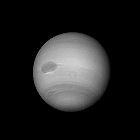 Images transmitted to Earth by NASA’s unmanned Voyager 2 spacecraft, from a distance of 129,000,000 miles, reveal a consistent feature in Neptune’s atmosphere, an oval-shaped storm system near the Neptunian equator very similar in size and position to the Great Red Spot on Jupiter. This storm, quickly nicknamed the Great Dark Spot, allows Voyager scientists to estimate Neptune’s rotational period much earlier than expected. At the distance between Voyager 2 and Neptune, the smallest features on the planet that can be seen are at least 2,400 miles across, meaning the newly detected storm system is gigantic.
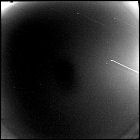 NASA announces the confirmation of what are believed to be partial rings around planet Neptune, as discovered in images taken by the unmanned Voyager 2 space probe. The ring arcs are found in close proximity to several new satellites, also spotted in Voyager 2 images, which are too small to have been seen form Earth-based telescopes. Ground-based telescopes had led scientists to believe that they would find partial rings, or complete dark rings, at Neptune; at this time, however, and at a distance of 13 million miles, what the project scientists don’t expect is that the rings will be revealed to completely encircle the planet within mere weeks.
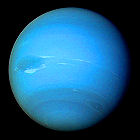 The unmanned space probe Voyager 2, almost exactly 12 years after leaving Earth, visits its last planet in the solar system, Neptune. Since mission planners have no further targets for Voyager, they have a free hand in picking its final destinations. An extremely close trajectory over Neptune’s north pole, bringing Voyager 2 within 18,000 miles of the cloudtops of the solar system’s windiest planet, deflects Voyager downward behind Neptune for a close look at its large moon, Triton. Six new moons are discovered, and the “ring arcs” that astronomers have theorized for years turn out to be complete rings made of extremely dark material. After the surprisingly featureless face of Uranus, Neptune proves to be unexpectedly active, with a large dark storm dominating its atmosphere.
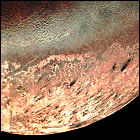 As scientists marvel over the latest data and pictures from Voyager 2 as it leaves Neptune, images of the planet’s large moon Triton prove to be jaw-dropping. Active geysers blast dark material – possibly evidence of cryovolcanism – over the moon’s mottled surface, and an atmosphere is measured. Virtually no craters caused by meteor impacts are spotted, meaning that Triton’s surface is geologically active – all completely new discoveries to Earth-based scientists. Perhaps the most frustrating part of all of the new information is that no further missions to Neptune are in serious consideration by NASA to follow up on Voyager 2’s discoveries.
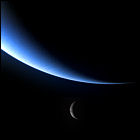 NASA’s unmanned Voyager 2 space probe leaves the vicinity of the planet Neptune, the outermost planet to have been explored by a man-made spacecraft. (At this point in time, Pluto is still considered a planet – the only one to which NASA hasn’t sent a space probe – though by the time a vehicle is dispatched to Pluto in the 21st century, Pluto has been demoted to “minor planet” status.) Though not expected to function beyond 2025 due to the slow decay of its nuclear power source, Voyager 2 may survive long enough to pass within 25,000,000,000,000 miles of Sirius in a quarter of a million years.
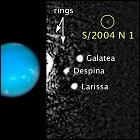 Using Hubble Space Telescope images of Neptune taken between 2004 and 2009, astronomers discover a 14th moon circling the outermost planet of the solar system. Not given an official, mythologically-derived name yet, the moon is initially designated S/2004 N1, and is a small, dark body with a diameter of roughly 12 miles, making it Neptune’s smallest discovered satellite to date, orbiting the planet once a day at a distance of 65,400 miles.
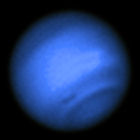 NASA’s Hubble Space Telescope confirms the observations of Earthbound astronomers with high-powered telescopes: a new dark atmospheric feature has emerged on the planet Neptune, signifying a major new storm system in the planet’s atmosphere. The new vortex feature emerges near the south polar area of Neptune, and was first observed by telescope in 2015.