
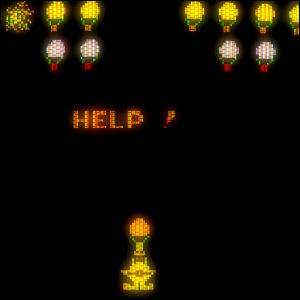
 Namco releases the arcade video game King & Balloon, a shooter game with cute characters and a medieval setting, with early speech synthesis. Though the game becomes a staple of the company’s later arcade compilations on home consoles over a decade later, it does not gain a wide following in arcades.
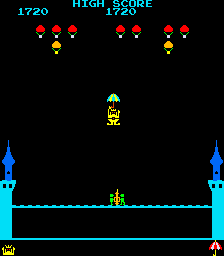
 The Game: Manning a fairly agile cannon located on a platform at a castle, your task is simple: protect the King! However, there’s a flotilla of even more agile balloons above you who are there to kidnap his royal highness. As the King is hoisted away by his assailants, he yells “Help!” If you shoot down the offending balloon, the King shouts “Thank you!” as he floats back to the safety of the castle via an umbrella. The balloons can ram your cannon kamikaze-style and flatten it for a few seconds, but curiously, you have an unlimited supply of cannons. However, if the balloon marauders get three Kings off the screen, your game ends. (Namco, 1980)
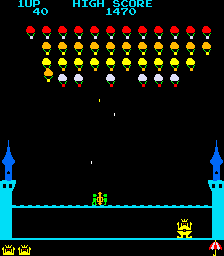
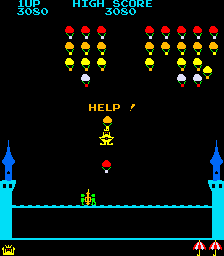
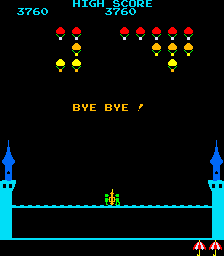
Memories: One of the most bizarre and obscure entries in the resumè of Namco (also responsible for classics like Galaga, Xevious, Dig Dug and a little thing we call Pac-Man), King & Balloon comes across as nothing so much as a bizarre attempt to repurpose Galaxian into a cutesy game. The one-shot-on-screen-at-a-time, the attack patterns of the balloons and some of the sound effects hammer the similarities home.
King & Balloon sports some of the arcade’s earliest speech synthesis – or maybe almost speech synthesis. Maybe the game’s designers just settled for something which almost sounds like the words in question; it doesn’t help that the King in question has a voice befitting neither royalty nor Elvis, but sounds – more than anything – like a Smurf. I still  get a chuckle out of the plaintive squeak of “Thank you!” every time I shoot a balloon off the little guy’s head, as if I haven’t just done him (and myself) a huge favor. He doesn’t seem too alarmed if the balloons succeed in abducting him off the top of the screen – he just says “Bye bye!”
A Phosphor Dot Fossil examined by Earl Green