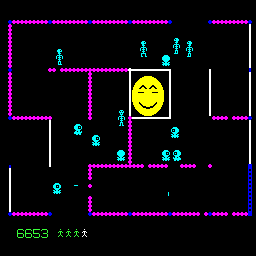
 The Game: You’re back in the maze, but this time, the stakes are increased, the danger is increased, and your strategic options are only slightly increased. Touching the walls, the robots, the robots’ laser blasts, or even your own ricocheted lasers are deadly. And of course, the inevitable appearance by Evil Otto is also deadly. However, you can temporarily repel the smiley little bugger by blasting him until his grin turns into the frown – but he will reappear mere seconds later, moving much faster every time he must retreat and reappear – so you’re not doing yourself any favors. If you enter a generator room, you can halt all the robots in their tracks by penetrating the walls surrounding the generator and blasting it. “Beaded” walls can be eaten away, bit by bit, by laser fire from anyone who shoots it, while solid walls will ricochet lasers around until they hit something – which could mean a death trap for you. (Stern, 1982)
Memories: I can’t even begin to estimate how many orders of magnitude harder Frenzy is than its inspiration, Stern’s mega-hit Berzerk. There are many times when you have approximately a second – before the characters on the screen begin moving – to assess your strategic situation, which usually isn’t too promising, often placing you in a triangulation of crossfire from three or four different robots that you haven’t even begun to figure out how to reach.

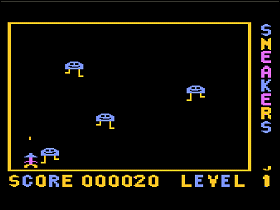 The Game: Alien invaders are descending on your world, taking on unusual forms in the process: sneaker-clad stomping creatures, roaming eyeballs, “H-wing fighters,” flying saucers and more. Try to use their unusual patterns of movement against them and keep them from destroying your fighter. (Sirius Software, 1981)
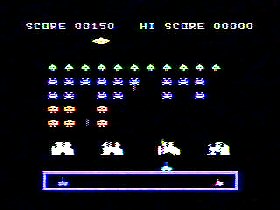 The Game: It’s quite simple, really. You’re the pilot of a ground-based mobile weapons platform, and there are buttloads of alien meanies headed right for you. Your only defense is a quartet of shields which are degraded by any weapons fire – yours or theirs – and a quick trigger finger. Occasionally a mothership zips across the top of the screen. When the screen is cleared of invaders, another wave – faster and more aggressive – appears. When you’re out of “lives,” or when the aliens manage to land on Earth…it’s all over. (Texas Instruments, 1981)
 The Game: As a round yellow creature consisting of a mouth and nothing else, you maneuver around a relatively simple maze, gobbling small yellow dots and evading four monsters who can eat you on contact. In four corners of
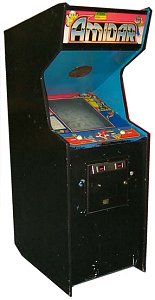 The Game: I’ll try to explain this as best I can. You’re a paintroller (recent escapee from Make Trax?) beseiged by pigs. Or a gorilla pursued by natives. Or something like that. It depends on which level you’re playing. You must try to enclose as many of the spaces in the game area as possible, in a zig-zagging pattern. This, the attract mode wisely advises us, is “Amidar movement.” You have one way to avoid an imminent head-on collision – you can hit the jump button, which doesn’t make you jump, but forces everything else on the board to jump. Enclosing all of the available spaces advances you to the next level, with different animal enemies. (Stern [under license from Konami], 1982)
 The Game: Help Mr. F. Lea get to the top in this dog-eat-dog world. Cross a treacherous yard full of lawn-mowers (and helpfully slow-moving dogs), swing from tail to tail until you’ve jumped on every dog on the screen, scale the big dog’s back and jump over his spots, and climb to the top of Dog Hollow while avoiding the dog toys and bones being thrown at you from the top of the screen. You’d better be itching to win. (Pacific Novelty, 1982)
 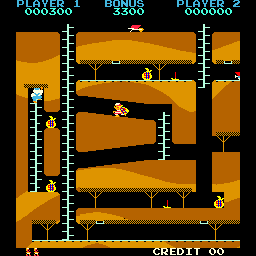 The Game: You’re a thief trying to make away with all the loot buried in a complex maze of interconnected mines and shafts, and you’d get away with it if it weren’t for some pesky cops who are hot on your trail. You can drop bags of money on them from a level above, or temporarily brain them with a pick, and they’ll occasionally also bumble into open mine shafts of their own accord. In any of these events, they vanish for a little while to recover before reappearing. But any of these things will do you in too! (Stern/Seeburg [under license from Valadon Automation], 1982)
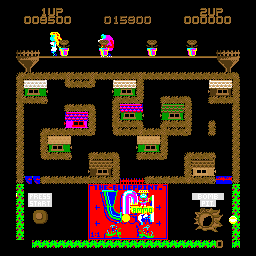 The Game: You are the intrepid, barbershop-quartet-suited J.J. (hey, it’s better than being O.J.!), out to save a damsel in distress from a pursuing monster. How does a guy in a little striped suit do this? By building a mobile, tennis-ball-launching contraption to dispatch said dastardly monster, naturally. The catch? The eight pieces of your mechanical creation are hidden somewhere among ten little houses in a maze – and those houses that don’t contain parts of your machine contain a bomb that must be dumped into the bomb pit immediately (else they’ll explode and kill J.J.). Critters also roam the maze to annoy you, including one pesky monster who will prematurely jump on the “start” button, rattling your still-unfinished machine to bits. If you don’t build your Rube Goldberg gizmo in time, the monster catches the damsel and you lose a life. (Bally/Midway, 1982)
 The Game: Players guide a caterpillar around a maze of twigs and branches, snatching up nourishment and the occasional treat, and avoiding other insect life; some parts of the branches can be turned. Some of the treats will allow the caterpillar to consume other insects for a brief time. Portions of the maze can be rotated, which can work against the player (cutting off the best or only escape route) or can work to the player’s advantage (effectively shutting a door in pursuers’ faces, or even smashing them if they’re in the wrong place at the right time). Clearing the maze allows the caterpillar to turn into a butterfly and escape (who needs a pupal stage anyway?); the player advances to the next level, where a new caterpillar needs help navigating a new maze. (Orca, 1982)
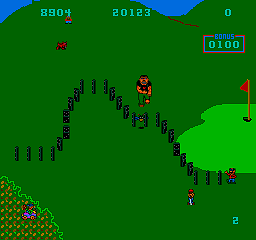 The Game: The town square or the local golf course seems like a reasonable place to set up a huge row of dominoes, doesn’t it? Well, your on-screen protagonist sure seems to think so, and your job is to help him set up his dominoes without allowing any of a number of on-screen “enemies” – such as absent-minded shoppers pushing carts, bees, or a bemuscled bonehead – to knock the dominoes over. (Bally/Midway, 1982)
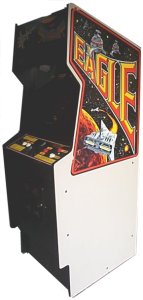 The Game: As commander of the three-stage fighter rocket Eagle, your job is to ward off endless varieties of evasively weaving space attackers. Every time you knock out two consecutive screens of assailants, you’ll have an opportunity to dock your ship to another one of Eagle’s three stages, until all three portions of the ship are combined to create one bad-ass weapons platform. But you can also lose stages very quickly, ending your game – a bigger ship makes a bigger and easier target. (Centuri [under license from Nichibutsu], 1982)
 The Game: Don’t take this personally, but you’re a yo-yo in The Electric Yo-Yo, trying to clear all the dots from the screen and trying just as hard to avoid the bug-eyed monsters and other enemies who seem to be natural predators of toys on strings. You must plan your movement around the screen carefully – the further you can move in a straight line to eliminate the most dots, the faster you’ll move.
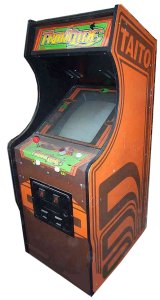 The Game: In a very genteel and almost inappropriately cute game about armored combat, you’re a lone footsoldier fighting your way through a platoon of enemy troops, trying to take out as many of them as you can until you find your way to a handy empty tank. (Nice of the enemy to allow your government to plant friendly tanks behind their borders, isn’t it?) But once you man your own tank, enemy tanks surround you. If one of them hits your tank, you have mere seconds to bail out before your tank blows, and you have to dodge cannon fire until you can find another friendly tank to commandeer. Finally, after crossing hazardous stretches of desert and fighting off entire battallions of enemy tanks, you’re en route to the final confrontation, a showdown with the enemy’s armored headquarters… (Taito, 1982)
 The Game: Players control the Jolly Jogger as he attempts to draw borders around every square area on the playing field. There are several special squares which temporarily give Jolly Jogger the ability to freeze his pursuers for a while; at all other times, they are to be avoided at all costs. Running around every square on the screen clears that level and introduces a new maze of squares where the process begins anew. A lit fuse counts down the time available to Jolly Jogger to complete each screen; if time runs out, a life is lost. (Taito, 1982)
 The Game: You are the king of the jung…uh, pirate ship! Swinging from rope to rope! Swimming through shark-infested waters! Jumping and ducking huge rolling boulders! And vanquishing knive-weilding pirates (wait, aren’t they supposed to be on your side if you’re a pirate too?) to rescue the damsel! (Taito, 1982)
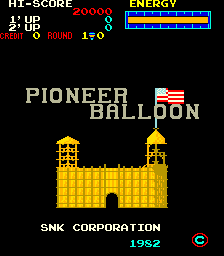 The Game: This is a game about the rough-and-tumble history of the taming of the North American continent, as told by someone who’s never been allowed access to any kind of reading material at all. You pilot a balloon across a scrolling landscape, avoiding (or blasting) birds and bombing a convoy of covered wagons. After conquering this level, you move on to a village of boomerang-throwing natives (and hey, early America was just thick with those puppies, wasn’t it?), followed by coconut-hurling gorillas (another prominent feature on the landscape of the early United States). A brief stage follows in which you must evade a series of random tornadoes, and then you have more wagons to bomb. At least they got something right – there are tornadoes in the U.S. (Rock-Ola [under license from SNK], 1982)
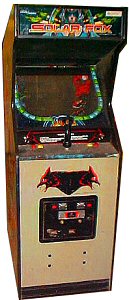 The Game: Your ship is confined to a grid-like playing field, which isn’t all that bad until you take into account that armed ships are gliding along all four of the “walls” surrounding that grid, blasting away at you like a fish in a barrel. Your job is the clear the grid of the objects filling it, and wherever possible, to fire a well-timed shot at the ships trying to destroy you. Clearing the grid advances you to the next level. (Bally/Midway, 1982)
 The Game: Super Mouse is on the case. He’s trying to grab all the food from every level of the screen. While he’s on the case, cats are on the chase, trying to catch Super Mouse. Two blocks of cheese on the top levels of the screen can be dropped on top of the cats, or the cats can be tricked into chasing Super Mouse over a trap door that’ll dump them in a water tank. But the cats don’t stay gone for long. Super Mouse advances to a new level when he takes every piece of food back to his secret hideout. (Taito, 1982)
 The Game: As the conductor of a time-traveling train, you must find and collect your passenger cars in the present day, move on to the near future to pull up to several stations and fill those cars with time travelers, and then deposit them at various attractions in the distant future. That would be difficult enough to do without running out of fuel, but you also have to contend with space creatures and repeatedly avoid collisions with a competing train by controlling the switches on the tracks. (1982, Taito)
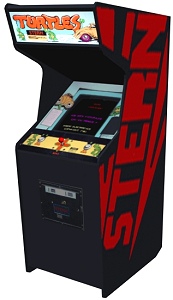 The Game: You are the Mama Turtle. Your helpless KidTurtles are stuck in a high-rise building, hiding from mean and hungry beetles. The beetles change colors in accordance with their speed and ferocity, from less aggressive green and blue beetles to fast, furious yellow and red beetles. Mama Turtle has to evade the beetles (which are deadly to touch at all times) and touch the mystery squares throughout the maze. The squares could reveal another beetle, or they could reveal one of the KidTurtles. When Mama Turtle picks up a KidTurtle, a safe house appears – usually all the way across the maze – and she must deposit the KidTurtles in the safe house, one at a time. Mama Turtle’s only recourse against the beetles is to lay “bombs” in the maze. Each bomb – and there can only be one on screen at a time – will reduce the first beetle that hits it back to the lowest speed/danger level, buying Mama Turtle a little time. (Mama Turtle can pass over her own bombs harmlessly.) The catch? You only start out with three bombs (is anyone else drawing some grim biological anologies to what Mama Turtle’s “bombs” might be at this point?), and you can replenish your supply of bombs only by running over an occasional flashing symbol which appears at the precise center of the maze…which is usually the most dangerous spot on the screen. Clearing a maze of KidTurtles allows you to climb to the next floor of the building and start anew. (Stern [under license from Konami], 1982)
 The Game: You control a hapless creature who can jump between rows of moving bricks and even temporarily build a brick around himself. You’re trying to help him gather gifts for Lola, the object of his desires, at the opposite end of the screen; she won’t even pay attention to you until you’ve accumulated a certain number of gifts for her. (Demanding, isn’t she? I can hear Dr. Phil screaming “Stay away from her! She’s bad for you!” already.) Other than Lola’s curiously materialistic outlook on life, your biggest obstacles are colorful critters who would happily jump on you and end your quest. You can hide from them temporarily by building a brick around yourself, but if they catch you, it’s time to start over again. (Cinematronics, 1982)
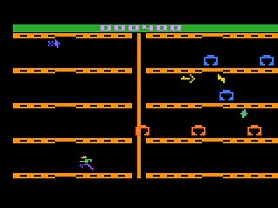 The Game: As video warrior Tron, you scale the heights of the MCP’s domain, avoiding Tanks, Recognizers and Grid Bugs, and trying to collect Bits. You can occasionally hitch a brief ride on a perpetually airborne Solar Sailer on one level, allowing you to fly over your opponents’ heads for a few seconds. (M Network [Mattel], 1982)
 The Game: The game begins as the skull-like face of Spyruss the Deathless (the Timelord of Chaos, no less!) taunts you (well, only if you had the Voice), and then a bunch of pesky spaceships pops out of a vortex to shoot at you. They shoot at you rather a lot. Fortunately, you can shoot back with reckless abandon, but their ammunition – as you ascend into the higher levels of the game – can track you and even, if you don’t destroy their shots in mid-air, crawl along the ground briefly while you head for the opposite side of the screen, neatly trapped for their next volley. (North American Philips, 1982)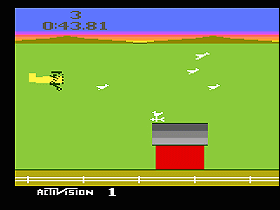
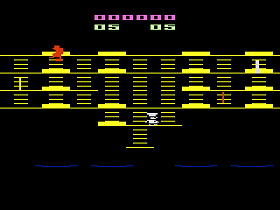 The Game: As Chef Peter Pepper, you climb around a multi-level factory whose sole function is to make some really big burgers. We’re talking about some BIG burgers here. But your ingredients aren’t exactly cooperating with you… (M Network [Mattel, under license from Data East], 1982)
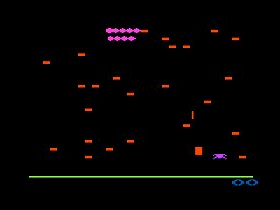 The Game: Centipedes, spiders and fleas invade your garden of ‘shrooms. Spiders follow an evasive course and can collide with you at any moment. Fleas poison the mushrooms, making them impervious to your fire (and thus giving the
 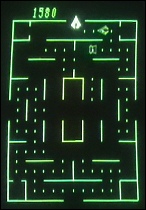 The Game: Years before Robovac and Roomba, there was Clean Sweep, a vacuum cleaner patrolling the vaults of a bank and picking up stray bits of money. (Makes you wonder who programmed it, and who’s emptying the bag!) As you grab more wayward currency, your bag fills up; when you hear an alarm sound, you have to go to the center of the maze to empty your bag and start anew; until you do that, you can’t pick up any more dead presidents. But those aren’t the only alarm bells going off here: things that look alarmingly like huge forceps are chasing you around. If they grab you, it’s your money and your life. There are four corners in the vault that will power up your vacuum cleaner temporarily, enabling you to suck up those forceps and (for a brief while) grab all the cash in your path without filling your bag. Clearing the maze advances you to the next level; losing all your lives leaves the bank wide open. (GCE, 1982)
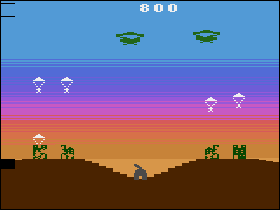 The Game: Helicopters and planes are dumping paratroopers directly over your land-locked cannon. Your job is to take out both aircraft and paratroopers before the enemy can land on and slowly destroy the rows of buildings on either side of the cannon. Once enemy paratroopers raze a building to the ground, they begin doing something even deadlier: digging tunnels toward your cannon so they can destroy it from below with a giant bomb, at which time your point defense career is over. (U.S. Games, 1982)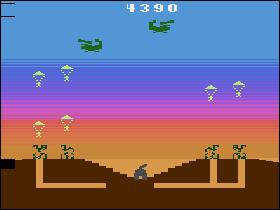
 Seasoned Missile Commanders looking for a new posting can do a lot worse than signing up to go Commando.
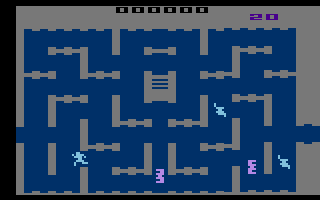 The Game: Robots, spiders and critters, oh my! You’re a lone human in a maze teeming with deadly robots, spiders and other nasties, and your trusty gun – which can dispatch any or all of the above – has only a limited amount of ammunition. You can obtain more ammo by walking over a briefly-occurring flashing gun symbol – but until then, if you’re out of ammo, you’re no longer the hunter, but the hunted. (M Network [Mattel], 1982)