
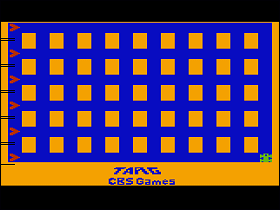
 The Game: You’re trapped in a symmetrical maze with a bevy of robotic target vehicles – “Targs” – which are programmed to do just one thing: collide with your vehicle. You have one advantage on these decidedly mean streets, however – you can fire missiles ahead of your car (but the Targs are capable of dodging your projectiles too, so don’t get too cocky). Every once in a while, one of the impregnable blocks in the maze will disgorge a new enemy which is just a little bit faster and deadlier than the rest. Clearing the screen of Targs advances you to a new level with faster enemies – and eventually they’ll put the brakes on your attempts to survive. (CBS Video Games, 1984)
Memories: Exidy‘s offbeat menagerie of arcade games was ripe for licensing in the early 1980s, and for the most part it was Coleco that jumped on that bandwagon, grabbing the rights for games such as Mouse Trap, Venture, Ladybug and Mr. Do, both for their own ColecoVision console and as a third-party title for competing platforms like the Intellivision and the Atari 2600. CBS‘ short-lived entry into the video game market saw them licensing games originating with Bally/Midway (Gorf, Omega Race, Blue Print, etc.), but at one point CBS won the rights to, and advertised, a cartridge version of Targ. The game was completely programmed and ready to go – and then the crash hit.
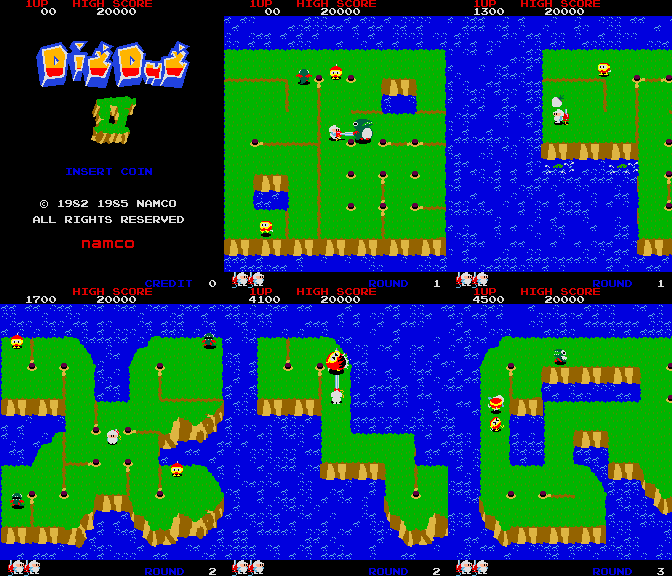


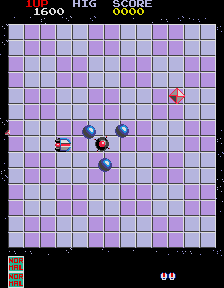
 The Game: Two players’ vehicles start in opposite corners of a confined grid; when moved, each vehicle leaves a light cycle-style trail of that player’s color (red or gold) in its wake. But here’s the twist: the players won’t be eliminated by running over the opponent’s “wake.” Instead, running over the other player’s wake once will knock that portion of it down; running over the resulting gap refills that space with your color instead. The object of the game is to occupy as much of the grid as possible by the end of 45 seconds. (Each game consists of three 45-second rounds, and each successive round adds obstacles such as walls, or gaps through which players’ vehicles can fall, resulting in a delay while that vehicle is replaced.) The winner of the best two out of three rounds wins the game. (1985, Bally [under license from Sente Ltd.] – unreleased)
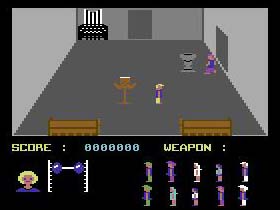 The Game: Find Jason Voorhees and destroy him before he slaughters your friends in this game based on the popular horror movie franchise. People will definitely die; the only questions are who, when, and by whom. (Dormark, 1985)
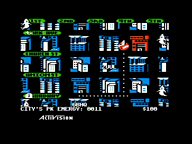 The Game: Supernarural, paranormal investigations and eliminations are the order of the day, as you open your own ghost busting franchise. You start with a finite budget and have to make some savvy choices about vehicles and gear; then it’s time to strap on a proton pack, get behind the wheel of the Ectomobile, and cruise around the Big Apple watching for flashing red buildings (telltale signs of a poltergeist party in progress). When you arrive on the scene, a little bit of driving is required, which gives you the chance to mop up a few free-roaming full-torso vaporous apparitions off the streets,
  before you arrive at your destination and try to trap a ghost without crossing the streams. All the while, supernatural forces are converging on a site formerly known as the temple of Zuul, and when the paranormal powers there reach a critical mass, it’s time for roasted marshmallow – or the end of the world. (Activision, 1985)
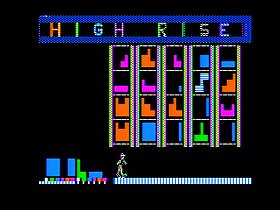 The Game: Think of it as the anti-Tetris. Five hoppers dispense geometric shapes on your command. As Barnaby, you move the pieces into place to build the most stable structure you possibly can, and if you manage to build a high enough tower, you climb to the top and advance to the next level. The first level’s shapes are fairly easy, but as you advance through levels, the pieces take on stranger and stranger shapes – and balancing them becomes harder. In later levels, you start rounds with oddball shapes already in place on the playing field, making your task that much harder. The game ends when the timer runs out without the completion of a stable structure. (Micro Learn, 1985)
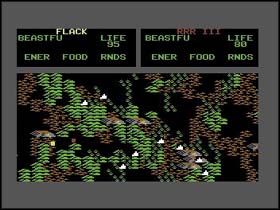 The Game: Put your money where your fangs are in this monster mash-up that pits twelve different types of creatures against each other in the ultimate battle for survival. Arm your creature with the best weapons and armor to prepare him for games of Capture the Flag, Tournament-Style Battles, or an all out invasion. (Electronic Arts, 1985)
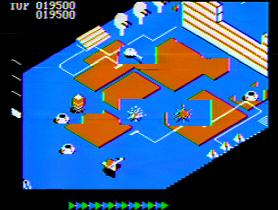 The Game: As the pilot of a lone fighter infiltrating a spaceborne fortress, your mission is simple – survive long enough to vanquish the evil Super Zaxxon robot hidden deep within the fortress, and take out as much of the defenses as you can in the meantime. (Sega, 1985)
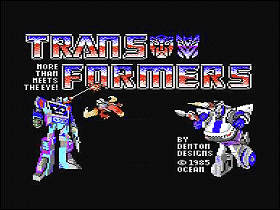 The Game: The raging battle between the Autobots and Decepticons continues in this exclusive title for the Commodore 64 computer. Take control of five different Transformers in the Autobots’ quest for Energon. (Ocean Software, 1985)
 The Game: Defend Earth from the comets! Halley’s Comet is on a collision course with Earth, and it’s teeming with evil aliens bent on destroying humanity. They attack the player’s ship in endless waves, even building walls in space that the player can collide with before they realize what’s happening. Power-ups can be revealed by blasting away at meteors, though catching them and accumulating their firepower in the middle of a fierce firefight is a skill unto itself. Smaller comets plunge toward the Earth at lightning speed. Any alien ships or comets that the player doesn’t destroy keep going and attack the planet; if too many are allowed to strike at Earth directly, or if the player runs out of ships, the game ends. (Taito, 1986)
 The Game: Monsters are running amok in cities across America… and you’re one of them! A giant lizard, a giant werewolf and a giant gorilla walk into a bar and tear it down. Monsters can compete to see who will topple tall buildings first, or they can qang up on puny defenseless human scum. It’s pretty easy to knock over buildings, and pretty easy to take a lot of damage from the armed forces who have been called out to stop the creatures. If they accrue too much damage, the monsters de-evolve to their un-mutated original human form, and require quick action (and additional quarters) to stay in the game. (Midway, 1986)
 The Game: As the commander of a sleek Solvalou fighter, you’re deep into enemy territory, shooting their disc-shaped fighters out of the sky, bombing ground installations and artillery nests, bombing tanks, and trying to destroy the mothership. As you progress further behind enemy lines, heavier aircraft and more versatile and Buy this gamedeadly ground-based defenses become the norm. Also look out for tumbling airborne mirrors – they’re impervious to your fire, but you’re toast if you fly right into them. (Nintendo [under license from Namco], 1986)
 The Game: How high can you go? Help Jumpman (Mario) save Pauline from Donkey Kong’s clutches by climbing ladders and avoiding barrels. (Ocean Software, 1986)
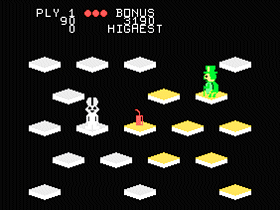 The Game: As Topper the top-hat-wearing turtle, your job is to jump from platform to platform until every platform on the screen is the same color, all without jumping into the empty space beyond the platforms. But as easy as this task may sound, it’s not that easy: rambunctious rabbits are ready to pounce on you, or at the very least keep you from reaching all of the platforms. Random explosives appear on some platforms and you have to avoid that platform until the danger has passed – and not even all of the platforms stay in one place. (Navarone Software, 1986)
 The Game: Destroy massive motherships while fighting waves of enemies and avoiding obstacles at breakneck speeds in this groundbreaking horizontal SHMUP. There’ll be time to rest when you’re dead. (Hewson, 1986)
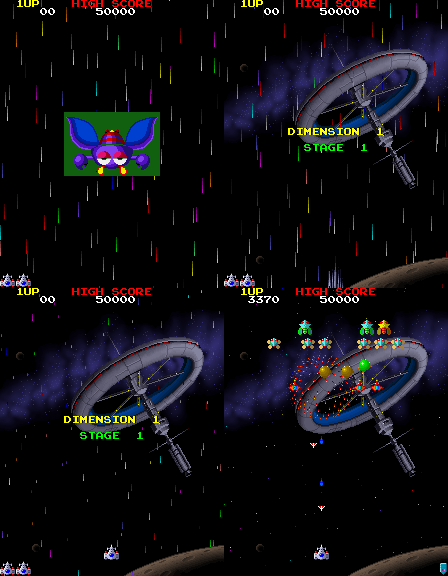 The Game: Commanding a small fleet of sleek fighter ships, you’re up against an alien invasion, arriving in wave after unfriendly wave. Alien fighters resemble butterflies and bees, but the real prize is the handful of motherships which arriveswith each wave. Capable of taking two hits – the first weakens them and turns them dark blue, the second destroys them – the motherships also come equipped with a tractor beam with which to snare your fighters. But if one of your fighters is captured, and you can destroy the mothership which is towing it, your wayward fighter will be returned, doubling your firepower. (Namco, 1987)
 The Game: You are a marker, trying to claim as much of the playing field as you can by enclosing areas of it. Drawing your boundaries faster is safer, but yields fewer points. A slower draw, which leaves you vulnerable to attack from the Qix Dragon and the Sparx, gives you many more points upon the completion of an enclosed area. If the jumpy Qix Dragon touches your marker or an uncompleted boundary you are drawing, you lose a “life” and start again. And the Sparx, which travel only along the edges of the playing field and along the boundaries of areas of the screen you’ve already enclosed, can destroy you by touching your marker. And if you linger too long, a fuse will begin burning at the beginning of your unfinished boundary, and will eventually catch up with you. (Taito, 1987)
 The Game: As the pilot of a lone space cruiser, you must try to clear the spaceways of a swarm of free-floating asteroids, but the job isn’t easy – Newton’s laws of motion must be obeyed, even by asteroids. When you blow a big rock into
 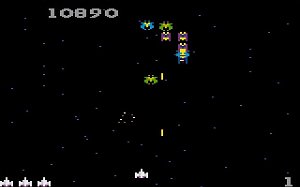 The Game: Commanding a small fleet of sleek fighter ships, you’re up against an alien invasion, arriving in wave after unfriendly wave. Alien fighters resemble butterflies and bees, but the real prize is the handful of motherships which arrives with each wave. Capable of taking two hits – the first weakens them and turns them dark blue, the second destroys them – the motherships also come equipped with a tractor beam with which to snare your fighters. But if one of your fighters is captured, and you can destroy the mothership which is towing it, your wayward fighter will be returned, doubling your firepower. (Atari, 1984; released circa 1987)
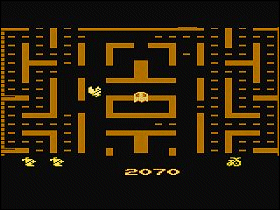 The Game: As the offspring of a round yellow creature consisting of a mouth and nothing else, you maneuver around a bigger maze than your parents ever had to deal with, gobbling small dots and evading four colorful monsters who can eat you on contact. Six large flashing dots in the maze enable you to turn the tables and eat the monsters for a brief period. Periodically, assorted toys will begin hopping through the maze, turning every uneaten dot they touch into a larger dot which yields more points, but also forces little Pac to slow down to digest them. (Atari, 1987)
 The Game: As the bride of that most famous of single-celled omniphage life forms, your job is pretty simple – eat all the dots, gulp the large blinking dots in each corner of the screen and eat the monsters while they’re blue, and avoid the monsters the rest of the time. Occasionally various fruits and other foods will bounce through the maze, and you can gobble those for extra points. (Atari, 1984; released circa 1987)
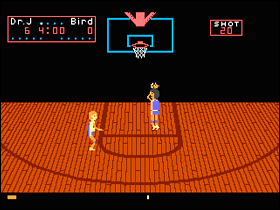 The Game: Dr. J and Larry Bird take to the hardwood for one-on-one half-court basketball action. Each player has his own signature moves, from lay-ups to three-point shots to steals. One or two players can play to a predetermined score or to a time limit. (Atari [under license from Electronic Arts], 1987)
 The Game: It’s your big chance to qualify for the big race at one of four tracks: the oval test track, Seaside, Suzuka, and the Mt. Fuji track from the original Pole Position. First, you try to get through the qualifying heat, racking up laps around the track as fast you can and accumulating as few wrecks as possible. If you pass muster, then you get to try it again with other cars on the track! (Atari, 1984; released circa 1987)
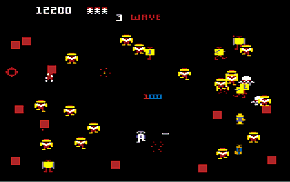 The Game: In the year 2084, all hell has broken loose on Earth. Robotic servants, created to perform dangerous tasks and defend their human creators, have decided they can do without their masters. The robots have evolved into new and terrifying varieties – the ever-multiplying Ground Roving UNit Terminators (GRUNTs), indestructible Hulks, self-replicating Quarks and Tanks, and most horrfying of all, the Brain robots, which capture humans and reprogram them into super-fast killing machines. And the only thing protecting the last remaining survivors of homo sapiens is your strength, endurance and cunning. (Atari, 1984 [released in 1987])
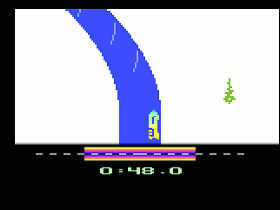 The Game: The Olympic torch is the warmest thing to be found in this multi-event recreation of the Winter Olympics. Downhill skiing, luge, slalom skiing and other events are represented here, and players can even pick which country they’re representing as they go for the gold. (Epyx, 1987)