
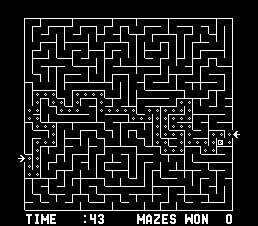
 The Game: You control a dot making its way through a twisty maze with two exits – one right behind you and one across the screen from you. The computer also controls a dot which immediately begins working its way toward the exit behind you. The game is simple: you have to guide your dot through the maze to the opposite exit before the computer does the same. If the computer wins twice, the game is over. (Midway, 1976)
Memories: Not, strictly speaking, the first maze game, Midway’s early B&W arcade entry The Amazing Maze Game bears a strong resemblence to that first game, which was Atari’s Gotcha. Gotcha was almost identical, except that its joystick controllers were topped by pink rubber domes, leading to Gotcha being nicknamed “the boob game.” Amazing Maze was just a little bit more austere by comparison.
 The Game: Up to four players control markers that leave a solid “wall” in their wake. The object of the game is to trap the other players by building a wall around them that they can’t avoid crashing into – or forcing them to crash into their own walls. Run into a wall, either your own or someone else’s, ends your turn and erases your trail from the screen (potentially eliminating an obstacle for the remaining players). The player still standing at the end of the round wins. (Ramtek, 1976)
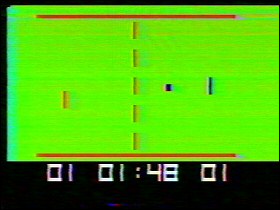 The Game: Activated by leaving a cartridge out of the slot, powering the system up and pressing one of the selector keys, Tennis and Hockey are built into the system. Timed games can be selected, and the traditional rules of each sport apply. (Fairchild, 1976)
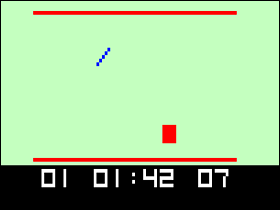 The Game: The first Channel F “Videocart” packs three games into one bright yellow package. Shooting Gallery is a straightforward target practice game in which players try to draw a bead on a moving target. Tic-Tac-Toe is the timeless game of strategy in small, enclosed spaces, and Quadradoodle is a simple paint program, long, long before its time. (Fairchild, 1976)
 The Game: Up to four players control markers that leave a solid “wall” in their wake. The object of the game is to trap the other players by building a wall around them that they can’t avoid crashing into – or forcing them to crash into their own walls. Run into a wall, either your own or someone else’s, ends your turn and erases your trail from the screen (potentially eliminating an obstacle for the remaining players). The player still standing at the end of the round wins. (Midway, 1977)
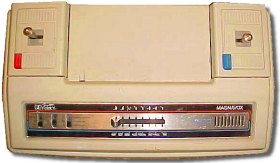 The final member of the Odyssey stand-alone console family tree, the Odyssey 4000 boasts more games than any of its predecessors since Ralph Baer’s original Odyssey, and was only the second of the dedicated Odyssey consoles to feature color (after the experimental Odyssey 500). And for those who have ever held the joystick of a Magnavox Odyssey² in their hands, the Odyssey 4000 offers another familiar element – its joysticks are exactly the same mold as those of the Odyssey², only rotated 90 degrees, and sporting some major differences in internal mechanisms. Though multidirectional, the joysticks are designed to favor vertical movement and offer some resistance to horizontal movement.
  The Game: Piloting a mobile cannon around a cluttered playfield, you have but one task: clear the screen of mines, without blowing yourself up, in the time allotted. If you don’t clear the screen, or you manage to detonate a mine so close to yourself that it takes you out, the game is over. If you do clear all the mines, you get a free chance to try it again. Two players can also try to clear the minefield simultaneously. (Gremlin, 1978)
 The Game: Long before Frogger and Frog Bog, there were simply Frogs, the original arcade amphibians. One or two frogs hop along a lily pad at the bottom of the screen, scoping out tasty flies to eat. When you’ve got a morsel in your frog’s reach, jump and try to activate your frog’s tongue at just the right time. (You’ll know if you’ve snared a meal because your frog will seem to ascend the screen in heavenly bliss.) Whoever has the most points at the end of the timed game is the supreme frog. (Gremlin, 1978)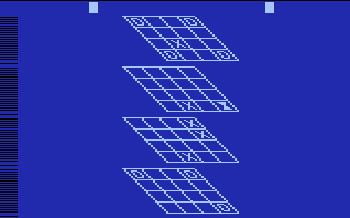

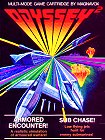 The Game: War is pixellated, blocky hell on the Odyssey²! In Armored Encounter, two combatants in tanks circumnavigate a maze peppered with land mines, searching for the optimum spot from which to blow each other to kingdom come. In Sub Chase, a bomber plane and a submarine, both maneuverable in their own way, try to take each other out without blasting any non-combatant boats routinely running between them (darn that civilian shipping!). In both games, the timer is counting down for both sides to blow each other straight to hell. (Magnavox, 1978)
 The Game: In Baseball!, you are, quite simply, one of two teams playing the great American game. If you’re up at bat, your joystick and button control the man at the plate and any players on base. If you’re pitching, your button and joystick control how wild or straight your pitches are, and you also control the outfielders – you can catch a ball on the fly, or pick it up and try to catch the other player away from his bases. (Magnavox, 1978)
 The Game: Hit the hardwood in one of two sports. Roll your big shiny one down the lanes and try to knock down all the pins in Bowling!, or go for a basket in Basketball! Not possible in Odyssey² Basketball!: fouls, three-point shots, free throws, most steals… (Magnavox, 1978)
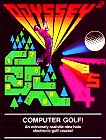 The Game: As man eked out his existence in the dark ages with only his animal cunning and the brutal power of the club, so do you in this golf simulation, in which you putter around nine different courses in an attempt to make a hole in one – or simply to stay under par. (Magnavox, 1978)
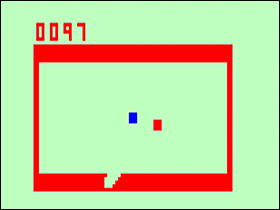 The Game: Trapped in a square or rectangular arena, the player is represented by a mobile square. Another projectile punches its way into the arena and begins ricocheting around; points accumulate rapidly the longer the player’s square avoids contact with the projectile, but starting at 200 points, an additional projectile is added every 100 points, each on its own chaotic, bouncing path. The game ends when the player inevitably collides with one of these projectiles. (Fairchild, 1978)
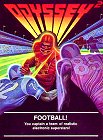 The Game: Woooooo, Packers. Classic pigskin comes to sluggish life in this over-complicated video game edition. Despite the Odyssey’s full keyboard, the game forces players to look up plays in the manual and execute them with joystick commands. After that, aside from some minimal control of whoever has the ball, it’s a bit like watching an ant farm. (Magnavox, 1978)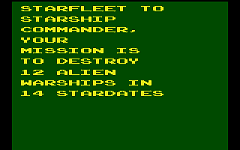
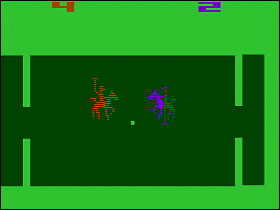 The Game: Climb onto your trusty four-legged ride for a good old fashioned game of horse hockey. Try to knock the ball into your opponent’s goal, but don’t put yourself in a position where you can’t defend your own. (Atari, 1978)
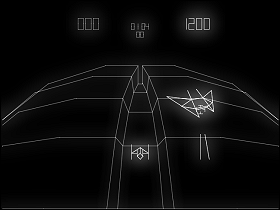 The Game: The player pilots a space fighter into an endless dogfight above a space station trench. Enemy ships attack from all directions, and even zip down the trench; and and all of these can be blasted into bits for points. Beware the fastest of these enemy fighters, which will appear with very little notice and fire directly at the player’s score, relieving it of points every time the fighter is successful with its attack! (Cinematronics, 1979)
 The Game: Purporting to be based on the ancient Chinese game of Go, Dynasty! is actually more of a variation of Othello. The same strategies apply, and can be played with two players, one against the computer, or – for those who are feeling a little bit lazy – the computer vs. itself. (Magnavox, 1979)
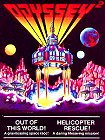 The Game: In this two-for-one game, you take to the skies in one of two different ways. Out Of This World! is a classic lunar lander game, in which you must balance your descent speed and your remaining fuel to make a safe landing on the surface of the moon, and then safely return to dock with your command module in orbit again. Helicopter Rescue! is a simplistic game in which you pilot a helicopter, trying to retrieve as many people as possible from a doomed hotel and take them safely to a nearby ground station. Precision and timing are of the essence. (Honestly, though, we never see what’s wrong with that hotel – there’s no evidence of fire, terrorists, massive fiddygibber infestations…) (Magnavox, 1979)
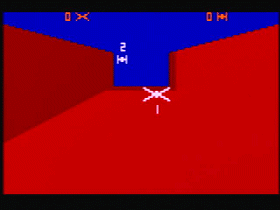 The Game: As a lone space pilot flying down a seemingly endless trench, your job is simple – blast or bomb all of the vaguely-bow-tie-shaped space fighters that you see. If your fighter is on the lower half of the screen, you’re blasting straight ahead/upward; if you move your fighter near the top of the screen, you can bomb any fighters below you. The game ends when you run out of ships; fortunately you never seem to run out of ammo. (Bally, 1979)
 The Game: It’s all the thrills of pinball, minus approximately 75% of the excitement! Use your joystick to control the plunger tension and launch your ball into play. Use the action button to pop the flippers, keeping your ball on the field and out of trouble. The bumpers and spinner score big points…well, relatively speaking. (Magnavox, 1979)
 The Game: Why worry about space invaders when there are more pressing earthly threats? Players guide a mobile cannon at the bottom of the screen, trying to take out a constant barrage of balloon bombers dropping live bombs. A direct hit to the cannon costs the player a “life,” but if the player allows a bomb to hit bottom, the results can be almost as dangerous: bombs crater the surface that the player’s cannon moves across, and allowing those pits to collect on the surface can severely limit the player’s movements, to the point of leaving the cannon a motionless sitting duck for the next round of balloon bombs, or a plane that periodically drops cluster bombs from overhead. (Taito, 1980)
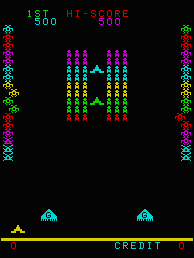 The Game: The invaders are back, and this time they plan on making quick work of Earth’s defenses. Columns of alien invaders descend from space, staying safely outside of the range of the player’s cannon. A few aliens at a time break formation and attempt to reach the player’s floating stockpiles of ordnance and extra ships floating in the center of the screen; if the aliens are able to reach these items, the player will lose a life. The only option is to take out the invaders before they succeed. (Universal, 1980)
 The Game: The good news: Darwin was right, evolution is a thing. The bad news: this does not work in your favor. You man a laser cannon trying to intercept alien insects making their way toward the bottom of the screen; at the most inconvenient times, the bugs revert to a pupal stage during which they’re either impossible to hit or invulnerable. They then emerge in a newer, faster, deadlier form bent on destroying you. (Universal, 1980)
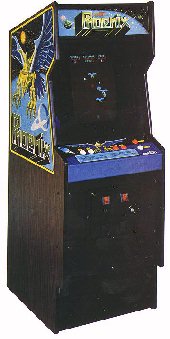 The Game: In a heavily armed space fighter, your job is pretty simple – ward off wave after wave of bird-like advance fighters and Phoenix creatures until you get to the mothership, and then try to blow that to smithereens. All of which would be simple if not for the aliens’ unpredictable kamikaze dive-bombing patterns. The
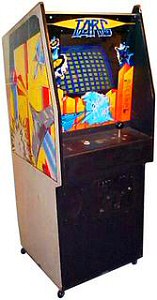 The Game: You’re trapped in a symmetrical maze with a bevy of robotic target vehicles – “Targs” – which are programmed to do just one thing: collide with your vehicle. You have one advantage on these decidedly mean streets, however – you can fire missiles ahead of your car (but the Targs are capable of dodging your projectiles too, so don’t get too cocky). Every once in a while, one of the impregnable blocks in the maze will disgorge a new enemy which is just a little bit faster and deadlier than the rest. Clearing the screen of Targs advances you to a new level with faster enemies – and eventually they’ll put the brakes on your attempts to survive. (Exidy, 1980)
 The Game: As a yellow sailor man consisting of a head and nothing else (jaundice was really bad in those days), you maneuver around a relatively simple maze, gobbling small dots and evading four colorful monsters who can eat you on contact. In four corners of the screen, large flashing dots enable you to turn the tables and eat the monsters for a brief period for an escalating score. The monsters, once eaten, return to their home base in ghost form and return to chase you anew. If cleared of dots, the maze refills and the game starts again, but just a little bit faster… (unknown bootleg manufacturer, 1980)