
 The Game: An adorable kitten (and his twin, in the case of two-player games) runs and jumps around a maze of obstacles, trying to stay out of the clutches of such enemies as an insect in a lab coat, a large and angry-looking tomato, and a crocodile that walks upright. (Further levels add new and even stranger enemies to avoid.) The kitten(s) can push the blocks making up the maze, hopefully smashing an enemy against another block or one of the playfield’s outer walls in the process, temporarily removing that enemy from play. A defeated enemy drops numerous items, including coins, diamonds, and one of several keys needed to open a door allowing access to the next level of the game. (Konami, 1988)
Memories: Even in the late ’80s, game companies weren’t above “borrowing” each other’s concepts and play mechanics, and here we have a prime example of Konami “borrowing” the basic play mechanic of one of Sega‘s more low-key sleeper hits, because just six years before Kitten Kaboodle, enemies were being squished by blocks pushed by a penguin.


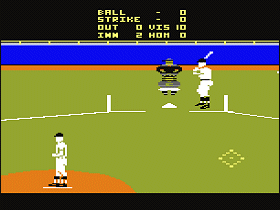 The Game: Batter up! We’re live from the baseball diamond with TV sports-style camera angles that switch to show you where the action is. (Absolute, 1988)
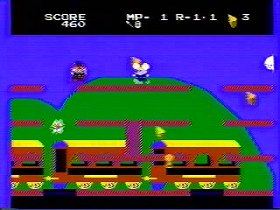 The Game: Mappy the Mouse is back, pursuing his feline arch nemesis Boss The Big Bit and his kitty kohorts through several themed zones of an amusement park. Riddled with ladders, trampolines, secret weapons and treasures, the park goes from wild west to tropical and beyond. Just avoid the cats, lest Mappy become someone’s mousy morsel. (Taxan [under license from Namco], 1988)
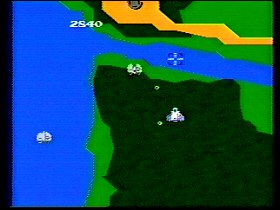 The Game: As the commander of a sleek Solvalou fighter, you’re deep into enemy territory, shooting their disc-shaped fighters out of the sky, bombing ground installations and artillery nests, bombing tanks, and trying to destroy the
 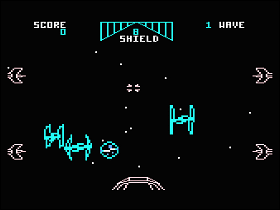 The Game: You’re an intrepid X-Wing pilot participating in the last-ditch Rebel attempt to destroy the Death Star – before it destroys the Rebel base on Yavin IV. TIE Fighters try to intercept you, but you can destroy them (as well as use your own lasers to blast their incoming fire out of the sky). Then you move in to attack the Death Star itself, with its incredibly hazardous system of gunnery towers and bunkers. Once you’ve gotten past the surface defenses, you dive into the trench that will lead you to an exhaust port which is the only means of destroying the Death Star – but there are defenses in the trench as well, and your deflector shields can only take so much… (Domark / Zeppelin Games Ltd., 1988)
 The Game: Baseball returns to the small screen – the very small screen – on the Game Boy. Step up to the plate and take a swing; after three outs, take control of the pitcher, basemen and outfield, trying to keep the computer from scoring a run. (Nintendo, 1989)
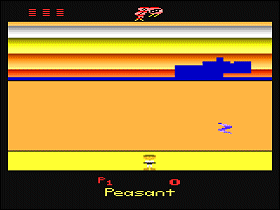 The Game: A worm-like dragon taunts you from atop a multi-colored wall, one which you must topple to reunite your divided village. To accomplish this task, you must bounce hurled projectiles into the wall. Collecting power-ups along the way will affect the behavior of the projectile, from making it a weapon capable of wiping out large portions of the wall to making it return to you repeatedly, like a boomerang. You advance to the next level by eliminating the wall. (Atari, 1989)
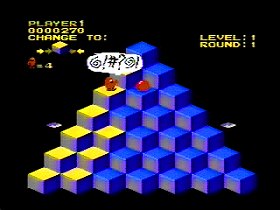 The Game: Q*Bert, a nosey little guy with a propensity for hopping, spends his time hopping around a three-dimensional pyramid of cubes, avoiding Coily the Snake and other assorted purple and red creatures, including a few who operate on a slightly different plane (i.e., they move down the pyramid as if it were rotated one-third). Any green objects and creatures Q*Bert can catch will not hurt him – in fact, the little bouncing green balls will stop time briefly for everyone but Q*Bert. If he gets into a tight spot, Q*Bert can jump off the pyramid onto a flying disc which will despoit him back at the top of the pyramid – and lure Coily to a nasty fate by jumping into nothing. Changing the colors of the top of every cube in the pyramid to the target color indicated at the top left of the screen will clear the pyramid and start the craziness all over again. If Q*Bert is hit by an enemy or falls off the pyramid, he hits bottom with a resounding, arcade- cabinet-shaking splat and a burst of incomprehensible obscenity! (Konami/Ultra, 1989)
 The Game: As intrepid plumber (and explorer) Mario, players have to jump through new environments and enemies to help Mario rescue Daisy. Egyptian pyramids guarded by fire-breathing Sphinxes, seaside platforms invaded by space aliens, and the usual Goombas and Koopas await Mario as he tries to reach the end of each level. As always, there are mushrooms, stars and fire flowers to help Mario power up, and helpful hidden chambers full of coins. (Nintendo, 1989)
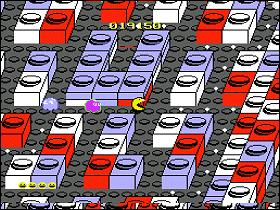 The Game: As a round yellow creature consisting of a mouth and nothing else, you maneuver around relatively simple mazes, gobbling small dots and evading five colorful monsters who can eat you on contact. In four corners of the screen, larger dots enable you to turn the tables and eat the monsters for a brief period. Periodically, assorted items appear near the center of the maze, and you can consume these for additional points as well. The monsters, once eaten, return to their home base in ghost form and return to chase you anew. If you clear the maze of dots, you advance to a new maze and the game starts again, but just a little bit faster… (Tengen, 1990)
 The Game: You are a marker, trying to claim as much of the playing field as you can by enclosing areas of it. Drawing your boundaries faster is safer, but yields fewer points. A slower draw, which leaves you vulnerable to attack from the Qix and the Sparx, gives you many more points upon the completion of an enclosed area. If the ever-shifting Qix touches your marker or an uncompleted boundary you are drawing, you lose a “life” and start again. And the Sparx, which travel only along the edges of the playing field and along the boundaries of areas of the screen you’ve already enclosed, can destroy you by touching your marker. And if you linger too long, a fuse will begin burning at the beginning of your unfinished boundary, and will eventually catch up with you. (Nintendo/Taito, 1990)
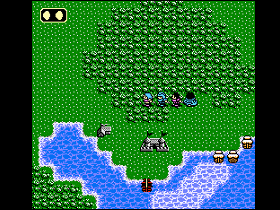 The Game: Darkness has fallen anew upon Britannia, and Lord British calls for your service again. You start out alone, accumulating traveling (and fighting) companions along your journey, striving to live by the Eight Virtues that govern conduct in the kingdom. Along the way, numerous creatures, both evil and simply pesky, challenge you. As you go forth on the quest, you must also collect the mantras of each Virtue, travel to the corresponding Shrines, and meditate there until you reach enlightenment. With enlightenment and experience come the strength to rid Britannia of evil – but, to quote a little pointy-eared green guy, beware the dark side… (FCI / Pony Canyon, 1990)
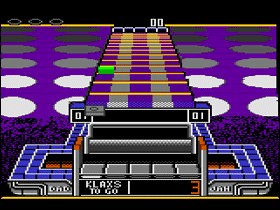 The Game: It is the nineties, as the intro screen says, and there is time for this home version of Klax, in which players try to stack colored bricks according to on-screen instructions: horizontal, vertical and diagonal rows may be required. The conveyor belts carrying the bricks gradually speed up until the bricks are zipping toward the bottom of the screen at a dizzying pace. Allowing too many bricks to slide off the bottom of the screen without catching them will forfeit the game, as will failing to come up with the configuration of stacked bricks demanded by the on-screen instructions. (Atari, 1990)
 The Game: Q*Bert, a nosey little guy with a propensity for hopping, spends his time hopping around a three-dimensional pyramid of cubes, avoiding Coily the Snake and other assorted purple and red creatures, including a few who operate on a slightly different plane (i.e., they move down the pyramid as if it were rotated one-third). Changing the colors of the top of every cube in the pyramid to the target color indicated at the top left of the screen will clear the pyramid and start the craziness all over again. If Q*Bert is hit by an enemy or falls off the pyramid, he hits bottom with a resounding, arcade- cabinet-shaking splat and a burst of incomprehensible obscenity! (NTVIC, 1992)
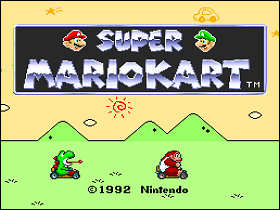 The Game: It’s a big day at the races, with a field of drivers selected from the Mushroom Kingdom: Mario, Luigi, Princess Peach, Toad, Bowser, and even Donkey Kong Jr. are among the racers vying for the top spot. From the grassy Mushroom course to the punishingly muddy Star course to the oceanside Flower course, there are challenges, hairpin turns and obstacles. Whoever can learn to navigate each course the fastest without ending up out of bounds struggling to get back on the course will be the winner. (Nintendo, 1992)
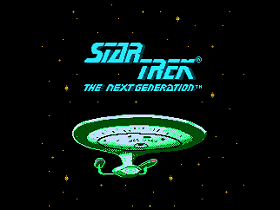 The Game: Captain Picard puts you in charge of a simulated mission aboard the Enterprise. With the helpful advice of Commander Riker, Data, Geordi, Worf and Chief O’Brien, you have to command the pride of the Federation fleet into a number of difficult situations, accomplish as much of the mission objectives as you can, and bring the Enterprise home in one piece. (Absolute, 1993)
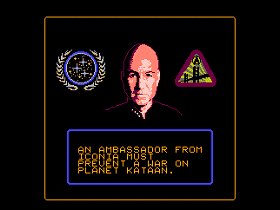 is that?) and having to go to their screens to kick in things like the shields, weapons and warp drive, when it comes right down to it, if you strip away these elements, it’s the same basic game: you’re blasting away at enemy ships and hoping to get more clean shots in at them then they get at you. He whose shields fail first gets blown out of the sky. In 11 years, the basic Star Trek game hadn’t evolved that much (but at least The Next Generation doesn’t get the torturously slow “story” scenes of Star Trek: 25th Anniversary).
 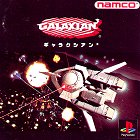 The Game: An alien war fleet is closing in on Earth, armed with a powerful weapon that can eradicate the entire planet. You (and, if you happen to have some fellow gunners, four others) man the artillery batteries of an armed-to-the-teeth ship on a mission to take the fight to the aliens before they can bring it to Earth. If you successfully complete that mission, you can also move on to a second mission to defend the planet Gourb from the Galaxian fleet. (Namco, 1995)
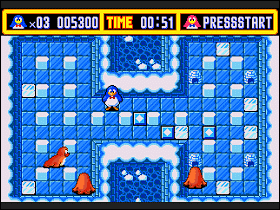 The Game: Pengo the penguin is trapped in an ice maze with seals, walking snowmen and other predators. Pengo can defeat his enemies by pushing ice blocks toward them, crushing them in the process. Pengo can also create new ice blocks via some biological process that’s perhaps best left unexplored (and if he doesn’t leave the spot where he generates ice blocks immediately after starting that process, he’ll be temporarily frozen to that spot); those blocks can also become ammo in a pinch. Treats such as dollar signs and popsicles – both valuable commidities to penguins – appear from time to time. Defeating all enemies on a given level advances Pengo to the next screen. (Sega, 1995, for Japanese market only)

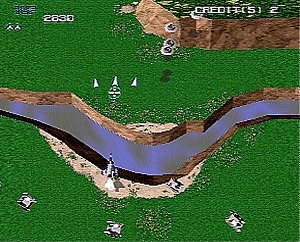
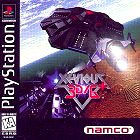 Memories: This somewhat obscure Namco title updates and revives their classic arcade title Xevious, which accumulated a cult following in 1983 when the game was released Stateside by Atari. Truth be told, Xevious 3D/G+ doesn’t rewrite the book or reinvent the wheel. For the most part, the game simply puts the original Xevious in a vaguely third-person 3-D perspective, adds some weapons and enemies (most notably the enormous and hard-to-kill Bosses), and kicks ass graphically. I liked this a lot. It has a great deal of respect and reverence for its source material.
 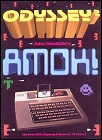 The Game: You’re alone in a maze filled with armed, hostile robots who only have one mission – to kill you. If you even so much as touch the walls, you’ll wind up dead. You’re a little bit faster than the robots, and you have human instinct on your side…but even that won’t help you when SmileyBot, a deceptively friendly and completely indestructible smiley face, appears to destroy you if you linger too long in any one part of the maze. The object of the game? Try to stay alive however long you can. (John Dondzila Classic Gaming Creations, 1998)
 The Game: Old Atari cartridges taking up too much space in your apartment? Have no fear – a huge portion of Activision’s catalog of titles for the 2600 have been squeezed onto a single CD. (Activision, 1999)
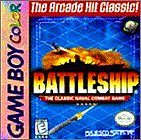 The Game: Two fleets of four warships conduct long-distance naval warfare, randomly firing torpedoes (and occasionally some higher-powered ordnance) at each other, guessing at the positions of their targets. Whoever sinks the entire opposing fleet first is the victor. (Hasbro Interactive, 1999)
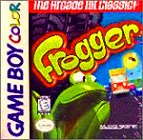
 ever to come down the pike, and yet finding a decent port of it over the years has proven to be almost as difficult as getting the amphibious one across the road in the game’s sixth level. But ask anyone about favorite video games from the early 80s, and you’re almost certain to hear Frogger in that list. The popularity of the original Frogger is borne out by the fact that a series of licensees has attempted to turn out a modern-day descendant of Frogger, and while some of those have been fun in their own right, they’ve also barely lived up to the simple joy of the original.
 The Game: Strap yourself into the very fast, very dangerous world of pod racing. Rocket through dozens of different courses, facing off against opponents who