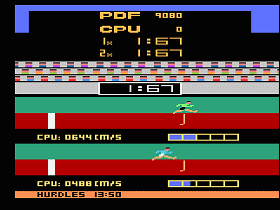
 The Game: It’s time for the 1984 Olympics! Qualify and compete in such events as the 100-meter dash, the long jump, javelin throw, and the shot-put. (Atari, 1984)
Memories: In many cases, Atari faced a major obstacle in licensing major arcade games: the time and money required to secure the license (if it wasn’t already part of an overall deal), and the fact that by skipping the licensing process, Activision or Imagic would virtually always get there first with a more visually pleasing and playable product. But this time, Activision’s sheer speed helped Atari out: The Activision Decathlon practically did some of the R&D for Atari.
Both are Olympic-themed, multi-event games, and both require unconventional control mechanisms. Decathlon, released a year before Atari’s home version of Track & Field, required 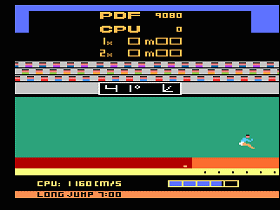 players to whip their joysticks back and forth so violently that many perfectly good, sturdy controllers had to be retired after their Olympic careers.
The trick is, Atari uses essentially the same control mechanism for Track & Field – the arcade game’s vigorous button-pounding is replicated by rapid-fire left-right motion… but Atari manufactured a special Track & Field controller with heavy-duty arcade quality buttons, both replicating the arcade experience and saving many a joystick.
And the controller isn’t the only improvement. Track & Field is a rare instance of Atari turning out the superior version of the same game concept. Decathlon is a prettier game to look out, but on many levels, Track & Field is simply more fun.
 There’s no reason not to enjoy both, though: try Decathlon with Atari’s Track & Field controller sometime. But if you’re going to play only one Olympic game on the 2600, Track & Field takes home the gold.
A Phosphor Dot Fossil examined by Earl Green

 The Game: You’re piloting a fighter jet on a canyon run through enemy territory. You can’t fly outside the canyon walls, so stay over the river and blast everything in sight. Well, almost everything – flying your plane on top of “FUEL” buoys instead of shooting them puts a little bit of gas in the tank, and if you run out of fuel, you might as well just swallow the next enemy bullet, because you’re goin’ down. (Activision, 1984)
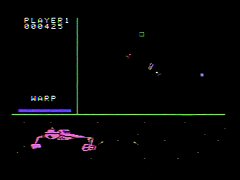 The Game: Welcome aboard, Captain. Your mission is to travel from sector to sector, eliminating Klingon incursions into Federation space without getting your Constitution-class starship and her crew destroyed. Friendly starbases offer aid and allow you to make resupply stops so you can keep up the good fight – and you do have to keep a careful eye on your phaser, shield and warp power. Periodically you’ll even have to navigate a minefield laid by the murderous Nomad probe while trying to catch a fleeting glimpse of Nomad itself so you can destroy it. (Coleco [under license from Sega], 1984)
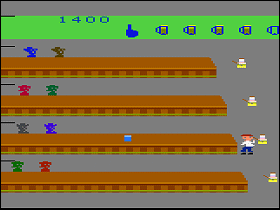 The Game: As a beleaguered bartender, you have to serve drinks to an endless onslaught of bar patrons, never allowing them to reach the end of the bar. You must also pick up empty glasses as they slide back toward you, and you can also grab a tip whenever one briefly appears. Clearing the screen of all pixellated hardened drinkers – erm, sorry, soft drinkers – takes you to the next screen, and other scenarios, including outdoor sporting events. (Bally/Midway-Sega, 1984)
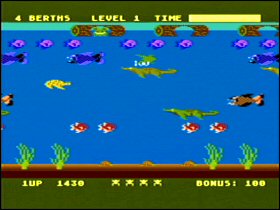 The Game: Frogger’s back, and he needs your help to do so much more than just cross the road. First, help Frogger navigate an assortment of underwater dangers to reach the safety of a log at the water’s surface, and then help him hop across the backs of various animals and objects to cross the river. Once this is accomplished, you help Frogger ascend to heaven…and then the whole process starts once more. (Parker Brothers, 1984)
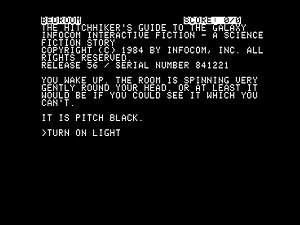 The Game: You’re Arthur Dent, and you’ve woken up with a very bad hangover. Between your state of inebriation and the fact that the Earth will shortly be demolished to make way for a hyperspace bypass, this is an inauspicious start, especially since you must fulfill your destiny as one of the only two human beings left alive in the universe to even begin to get anywhere in this game. (Infocom, 1984)
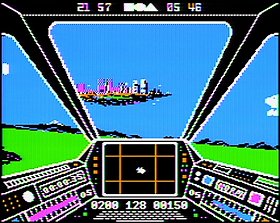 The Game: The invasion is on, and as usual, you’re the only thing standing between Earth and alien domination. (Ever wonder why no one else is answering their pagers at times like these when the call goes out?) Fortunately, your aircraft is a kick-ass piece of military hardware, capable everything from breaking the sound barrier to hovering, helicopter-like, over a friendly installation to defend from an onslaught of enemy tanks. But the enemy makes up for its occasionally lackluster hardware with impressive numbers – and whether the hail of gunfire is coming from their tanks, their jets, or their motherships (which look suspiciously like little Comet Empires from Star Blazers), you can rack up a fatal amount of damage pretty quickly. (Electronic Arts, 1984)
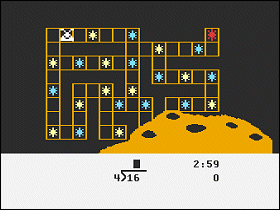 The Game: Poor Thid. He’s lost in space, a long way from home, and he’ll need all of Earth’s intellectual and technological resources to get him home. Or, actually, since he’s on a budget, any old kid with an Atari home computer will do. Solve division problems of varying degrees of difficulty to help Thid return to his home planet, and keep in mind, time is limited for both equation solving and maneuvering. Even if you get your numbers right, Thid can accidentally run into “Badid Stars” that will explode, sending him plummeting into a different part of the star maze. You win the game by returning Thid to his home planet at the bottom of the screen, though if you’re feeling particularly daring, you can take a detour for double points along the way. (Roklan, 1984)
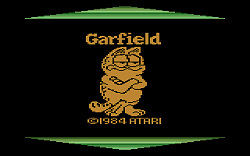 The Game: You are the world’s most famous lasagna-munchin’ mouser, hopping from fencepost to fencepost, grabbing airborne hamburgers (!!?) and dodging potted plants being thrown at you. Eventually you reach home, where you can antagonize Odie the dog, who has somehow made his way to the top of Jon’s house. (Atari, never released [developed circa 1984])

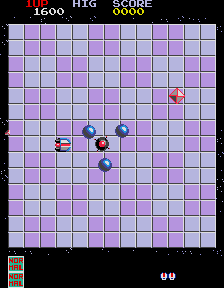
 The Game: Two players’ vehicles start in opposite corners of a confined grid; when moved, each vehicle leaves a light cycle-style trail of that player’s color (red or gold) in its wake. But here’s the twist: the players won’t be eliminated by running over the opponent’s “wake.” Instead, running over the other player’s wake once will knock that portion of it down; running over the resulting gap refills that space with your color instead. The object of the game is to occupy as much of the grid as possible by the end of 45 seconds. (Each game consists of three 45-second rounds, and each successive round adds obstacles such as walls, or gaps through which players’ vehicles can fall, resulting in a delay while that vehicle is replaced.) The winner of the best two out of three rounds wins the game. (1985, Bally [under license from Sente Ltd.] – unreleased)
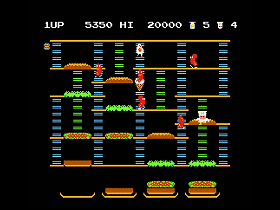 The Game: As Chef Peter Pepper, you climb around a multi-level factory whose sole function is to make some really big burgers. We’re talking about some BIG burgers here. But your ingredients aren’t exactly cooperating with you… (Namco, 1985 [Japan] / Data East, 1987 [US])
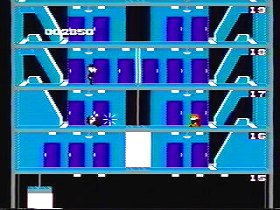 The Game: As a daring spy, you break into a top secret enemy facility, trying to grab vital secrets and evade or kill as many enemy agents as you can. Your only means of getting from floor to floor through most of the game is via the elevator – which gives you an advantage and also makes you vulnerable. (Taito, 1985)
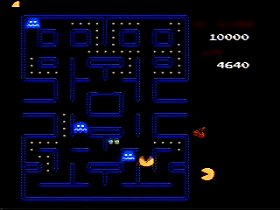 The Game: As a round yellow creature consisting of a mouth and nothing else, you maneuver around a relatively simple maze, gobbling small dots (10 points) and evading four colorful monsters who can eat you on contact. In four corners of the screen, large flashing dots (50 points) enable you to turn the tables and eat the monsters
 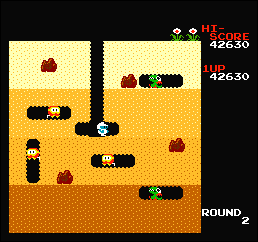 The Game: Who said landscaping was easy? You are Dig Dug, an intrepid gardener whose soil is infested with pesky Pookas and fire-breathing Fygars. You’re armed with your trusty pump, which you can use to inflate your enemies until, finally, they blow up. But both the Pookas and Fygars can crawl through the ground and can pop out into your tunnels, and if a Fygar sneaks up behind you, he can toast you if you’re not careful. (Namco, 1985)
 The Game: How high can you go? Help Jumpman (Mario) save Pauline from Donkey Kong’s clutches by climbing ladders and avoiding barrels. (Ocean Software, 1986)
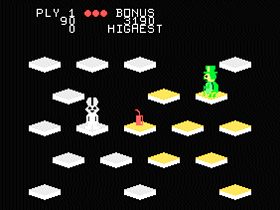 The Game: As Topper the top-hat-wearing turtle, your job is to jump from platform to platform until every platform on the screen is the same color, all without jumping into the empty space beyond the platforms. But as easy as this task may sound, it’s not that easy: rambunctious rabbits are ready to pounce on you, or at the very least keep you from reaching all of the platforms. Random explosives appear on some platforms and you have to avoid that platform until the danger has passed – and not even all of the platforms stay in one place. (Navarone Software, 1986)
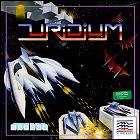 The Game: Destroy massive motherships while fighting waves of enemies and avoiding obstacles at breakneck speeds in this groundbreaking horizontal SHMUP. There’ll be time to rest when you’re dead. (Hewson, 1986)
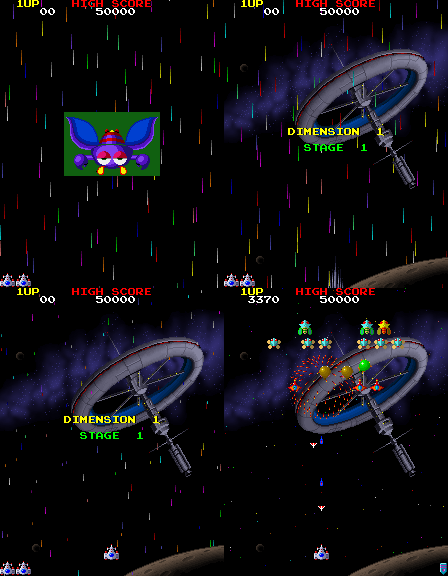 The Game: Commanding a small fleet of sleek fighter ships, you’re up against an alien invasion, arriving in wave after unfriendly wave. Alien fighters resemble butterflies and bees, but the real prize is the handful of motherships which arriveswith each wave. Capable of taking two hits – the first weakens them and turns them dark blue, the second destroys them – the motherships also come equipped with a tractor beam with which to snare your fighters. But if one of your fighters is captured, and you can destroy the mothership which is towing it, your wayward fighter will be returned, doubling your firepower. (Namco, 1987)
 The Game: As the pilot of a lone space cruiser, you must try to clear the spaceways of a swarm of free-floating asteroids, but the job isn’t easy – Newton’s laws of motion must be obeyed, even by asteroids. When you blow a big rock into
 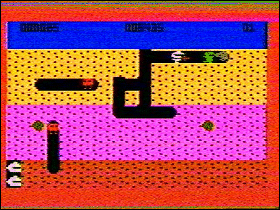 The Game: You are Dig Dug, an intrepid gardener whose soil is infested with pesky Pookas and fire-breathing Fygars. You’re armed with your trusty pump, which you can use to inflate your enemies until, finally, they blow up. But both the Pookas and Fygars can crawl through the ground and can pop out into your tunnels, and if a Fygar sneaks up behind you, he can toast you if you’re not careful. (INTV Corp., 1987)
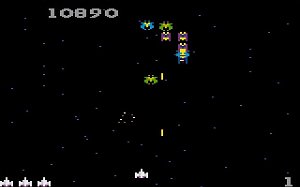 The Game: Commanding a small fleet of sleek fighter ships, you’re up against an alien invasion, arriving in wave after unfriendly wave. Alien fighters resemble butterflies and bees, but the real prize is the handful of motherships which arrives with each wave. Capable of taking two hits – the first weakens them and turns them dark blue, the second destroys them – the motherships also come equipped with a tractor beam with which to snare your fighters. But if one of your fighters is captured, and you can destroy the mothership which is towing it, your wayward fighter will be returned, doubling your firepower. (Atari, 1984; released circa 1987)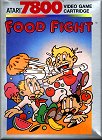
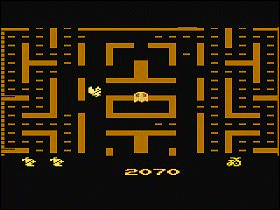 The Game: As the offspring of a round yellow creature consisting of a mouth and nothing else, you maneuver around a bigger maze than your parents ever had to deal with, gobbling small dots and evading four colorful monsters who can eat you on contact. Six large flashing dots in the maze enable you to turn the tables and eat the monsters for a brief period. Periodically, assorted toys will begin hopping through the maze, turning every uneaten dot they touch into a larger dot which yields more points, but also forces little Pac to slow down to digest them. (Atari, 1987)
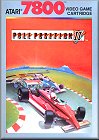 The Game: It’s your big chance to qualify for the big race at one of four tracks: the oval test track, Seaside, Suzuka, and the Mt. Fuji track from the original Pole Position. First, you try to get through the qualifying heat, racking up laps around the track as fast you can and accumulating as few wrecks as possible. If you pass muster, then you get to try it again with other cars on the track! (Atari, 1984; released circa 1987)
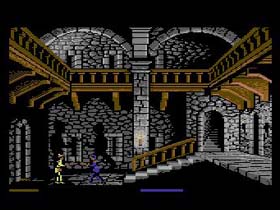 The Game: The King of England has been assassinated and the crown has gone missing! To regain the crown and restore order you’ll need to conquer the entire country, one castle at a time. Equal parts strategy and action make for lots of fun and replayability. The ultimate cinematic experience for the Commodore 64. (Cinemaware, 1987)
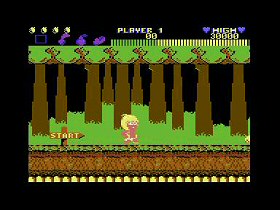 The Game: Wonderboy’s girlfriend Tanya has been abducted and it’s up to you to get her back. You’ll have to be pretty crafty to avoid the dangers of Wonderland in this classic Sega platformer. (Activision, 1987)
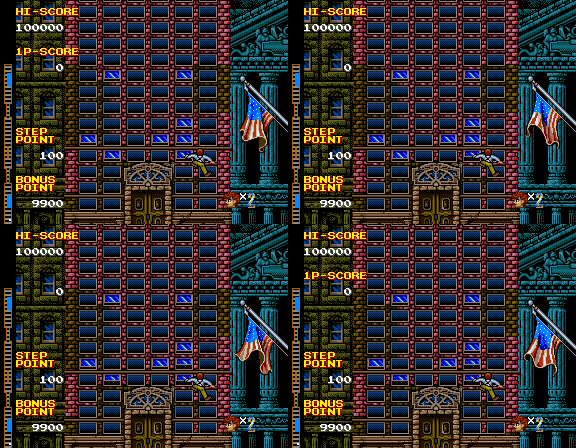 The Game: You control a daredevil stunt climber on his trip up the side of a skyscraper in a major metropolitan area, using no ropes, no nets, and nothing but his hands and his feet. Obstacles such as falling jam boxes can cause you to plunge to your death several stories below. When you reach the top – if you reach the top, that is – a helicopter lifts you away to your next challenge. (Nihon Bussan Co., Ltd. [Nichibutsu], 1988)