
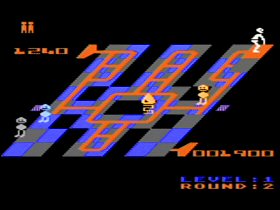
 The Game: You’re the circuit maker, and they’re the circuit breakers. You hop around a maze-like structure, dropping circuitry patterns in your wake, as a variety of adversaries try to stop you from completing a circuit leading from the power source at your starting point to the receptacle across the maze from you. Colliding with any of them will cost you a life, but you can entice them to try to chase you off the maze and into oblivion while you escape safely. Completing the circuit advances you to the next maze – just on’t get too caught up in your power trip. (Tronix, 1983)
Memories: A neat combination of some well-worn game play elements, Juice is an eminently playable example of taking elements from different games and combining them into a new one. Bits of Pac-Man and Q*Bert, with a hint of Zaxxon‘s 3-D isometric perspective, combine to make Juice! unique and fun.
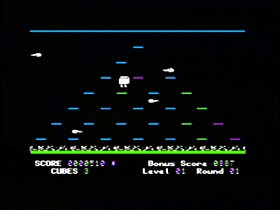 The Game: You’re Mr. Cool, an ice cube who chills out while hopping around a pyramid-shaped series of platforms. Fireballs streak across the pyramid from time to time, and they’ll melt you if they touch you. If you can stay cool long enough, you can advance through the game by changing the color of every platform to your target color by hopping onto each one – though in later levels it’ll take more than one hop, putting you in the path of more fireballs that could cause you to lose your cool. If you have one meltdown too many, the game is over. (Sierra On-Line, 1983)
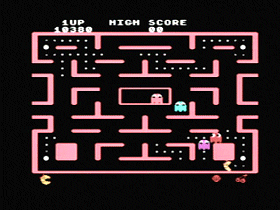 The Game: As the bride of that most famous of single-celled omniphage life forms, your job is pretty simple – eat all the dots, gulp the large blinking dots in each corner of the screen and eat the monsters while they’re blue, and avoid the monsters the rest of the time. Occasionally various fruits and other foods will bounce through the maze, and you can gobble those for extra points. (Atarisoft, 1983)
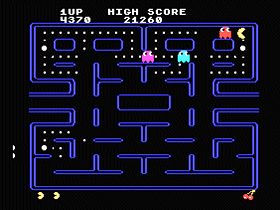 The Game: As a round yellow creature consisting of a mouth and nothing else, you maneuver around a relatively simple maze, gobbling small dots and evading four colorful monsters who can eat you on contact. In four corners of the screen, large flashing dots enable you to turn the tables and eat the monsters for a brief period. Periodically, assorted items appear near the center of the maze, and you can consume these for additional points as well. The monsters, once eaten, return to their home base in ghost form and return to chase you anew. If cleared of dots, the maze refills and the game starts again, but just a little bit faster… (Atarisoft, 1983)
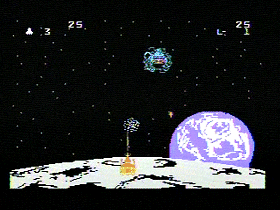 The Game: Demons coalesce into existence in mid-air above your cannon. Send them back where they came from by force. (Texas Instruments, under license from Imagic, 1983)
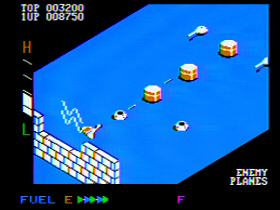 The Game: As the pilot of a lone fighter infiltrating a spaceborne fortress, your mission is simple – survive long enough to vanquish the evil Zaxxon robot hidden deep within the fortress, and take out as much of the defenses as you can in the meantime. (Datasoft, 1983)
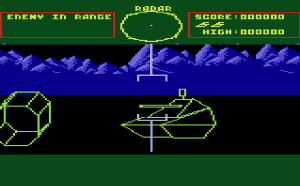 The Game: As the pilot of a heavy tank, you wander the desolate battlefield, trying to wipe out enemy tanks and landing vehicles. (Atari, 1983)
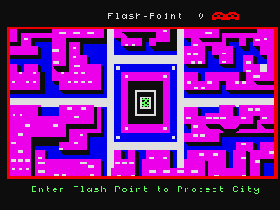 The Game: A zombie infestation has overrun the city. The player, in a mobile unit bristling with weapons, must venture into the infested areas and eliminate the zombies – or die. The center of the infestation screens features a green area surrounding the player’s vehicle; this must be preserved as much as possible while fighting off the zombies, as bonus points are awarded for guarding that space. If the player survives, it’s time to move on to the scene of the next zombie attack. (North American Philips, 1983 – unreleased prototype)
 The Game: What if you were out to perform daring, air-show-style aerial acrobatics, and someone was shooting at you at the same time? Wouldn’t that be dandy? Lucky you, that’s what you’re doing in this game. With a mandate to DESTROY TERMINAL, you set out to obliterate an airport terminal protected by armed hot air balloons. The closer you get to carrying out that mission, the more fiercely they defend their turf. When you do level the terminal to the ground, a door opens up, allowing you to fly your plane into a massive maze of pipes, and if you can navigate that labyrinth, you reach “the end” – where you must fend off more adversaries to touch down safely and start again. (Coleco, 1983 – unreleased / recovered and released by CGE Services, 2003)
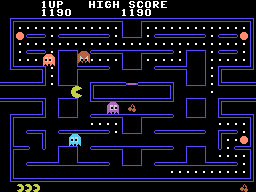 The Game: As a round yellow creature consisting of a mouth and nothing else, you maneuver around a relatively simple maze, gobbling small dots (10 points) and evading four colorful monsters who can eat you on contact. In four corners of the screen, large flashing dots (50 points) enable you to turn the tables and eat the monsters for a brief period for an escalating score (200, 400, 800 and 1600 points). Periodically, assorted items appear near the center of the maze, and you can consume these for additional points as well. The monsters, once eaten, return to their home base in ghost form and return to chase you anew. If cleared of dots, the maze refills and the game starts again, but just a little bit faster… (Atarisoft, circa 1983 [never released])
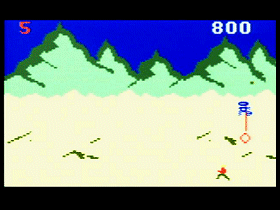 The Game: Robots descend from the mountains with one mission in mind: they’d like to fry you. In fact, they’re pretty adamant on that point. You’re armed with a weapon that can fling anti-robot grenades at them, but you have to account for a trajectory that can be affected by your own movement; mountainous outcroppings give you shelter, but not for long, since they also give the robots target practice. If you score a direct hit and blast a robot apart, you’re left with a narrow window of opportunity in which to land another grenade and permanently dismantle the remaining robot parts…if you can’t accomplish that, the robot will gather up its parts and reassemble itself to have another go at you. (Activision, 1983 – never released)
 The Game: The Green Goblin and his henchmen are terrorizing the city once more, and it’s up to Spider-Man to restore order. But the odds are against him: he can only attach his web to the surface of the building, naturally, but the
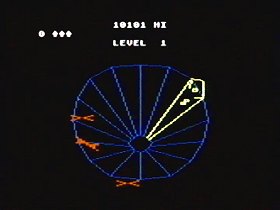 The Game: As a strangely crablike creature, you scuttle along the rim of an abstract, hollow geometric tube, zapping red bow-tie-ish critters and purple diamond-shaped things which carry them. There are also swirly green things which spin “spikes” like webs, and by the way, you should avoid spikes. (Atari, 1983)
 The Game: As an intrepid, pith-helmeted explorer, you’re exploring King Tut’s catacombs, which are populated by a variety of killer bugs, birds, and other nasties. You’re capable of firing left and right, but not vertically – so any oncoming threats from above or below must be outrun or avoided. Warp portals will instantly whisk you away to other parts of the maze (though this doesn’t necessarily mean safer). Gathering all of the treasures and keys will allow you to open the vault at the end of each level…which leads to the next, and even more difficult level. It’s like The Mummy, only much more entertaining. (Parker Brothers, 1983 – unreleased prototype)
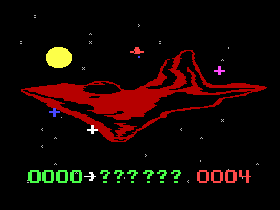 The Game: As the pilot of a lone space cruiser, you must try to clear the spaceways of a swarm of pesky and relatively harmless drone UFOs, but the job isn’t easy. You can ram the alien ships with your ship’s shields, destroying them (but forcing your shields offline for a few precious seconds during which anything could collide with your unprotected ship and destroy you), or shoot them (which also forces your shields down for a recharge). To that screenful of bite-sized chunks o’ death, add an unpredictable Killer UFO that likes to pop in and shoot at you, and suddenly being an interstellar traffic cop ain’t so easy. (Philips, 1983)
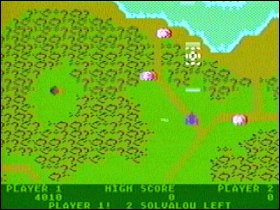 The Game: As the commander of a sleek Solvalou fighter, you’re deep into enemy territory, shooting their disc-shaped fighters out of the sky, bombing ground installations and artillery nests, bombing tanks, and trying to destroy the mothership. As you progress further behind enemy lines, heavier aircraft and more versatile and deadly ground-based defenses become the norm. Also look out for tumbling airborne mirrors – they’re impervious to your fire, but you’re toast if you fly right into them. (Atari, 1983)
 The Game: Pirates have boarded your ship, and it’s up to you to defend the whole boat. Evade the pirates in the twisty mazes of barrels and treasures in the cargo deck, or pick up one of those barrels and brain the nearest pirate with it. Be careful – some pirates hide inside the barrels, and it’s instant death to pick up an “occupied” barrel and not back off quickly. Some containers reveal a treasure when you pick them up, and you can go back and grab the treasures for bonus points. Clear the deck of pirates to advance to the next level and start again. (Capcom, 1984)
 The Game: As the commander of a sleek Solvalou fighter, you’re deep into enemy territory, shooting their disc-shaped fighters out of the sky, bombing ground installations and artillery nests, bombing tanks, and trying to destroy the mothership. As you progress further behind enemy lines, heavier aircraft and more versatile and Buy this gamedeadly ground-based defenses become the norm. Also look out for tumbling airborne mirrors – they’re impervious to your fire, but you’re toast if you fly right into them. (Atari [under license from Namco], 1984)
 The Game: Pong just got a lot more difficult. The table-tennis-inspired sport is now played at blow-your-hair-back speeds on a 3-D field, with vehicles called rotofoils serving as the paddles. Up to four players can compete, or you can humiliate yourself by trying to fight computer-controlled opponents. (Atari/Lucasfilm Games, 1984)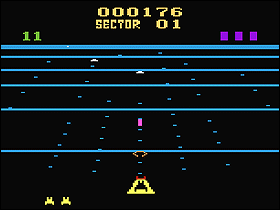
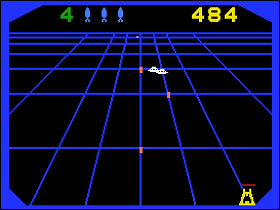 The Game: Alien ships are sliding toward you on a gridwork of energy; as the pilot of the Beamrider, your job is to destroy them before they get too close to home (i.e. the bottom of the screen). They can fire back, though, and while in some cases you can return fire and intercept their shots, it depends on what kind of weaponry they’re using. When you run out of Beamriders, the aliens take over. (Activision, 1984)
 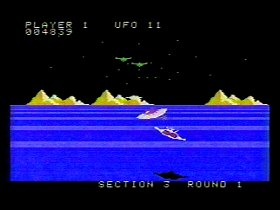 The Game: Zoom being the operative word here, your mission – as space hero Buck Rogers – is to fly in close quarters with all kinds of enemy ships, landers and structures, fending off their attacks, and generally staying alive as long as possible. Obligatory robot wisecracks and utterances of “beedy-beedy-beedy” not included. (Coleco [under license from Sega], 1984)
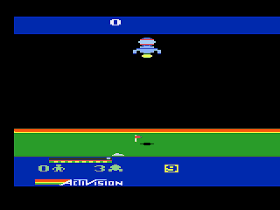 The Game: Sometimes it’s not all about saving the whole freakin’ world. Sometimes it’s about just being a cabbie. Picking people up, zipping through traffic, and trying to get them to where they’re going without them – or yourself – killed in the process. Substitute traffic for alien ships and space debris, and you’ve got Cosmic
 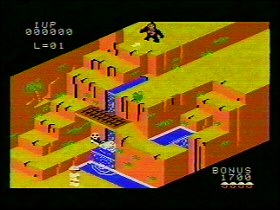 The Game: Bongo the Ape sets your toes on fire while you’re asleep during a jungle expedition. So naturally, you drop everything to take revenge on the goofy gorilla. But first you have to reach him. The first level is a hazardous assortment of ramps and levels and a waterfall to jump across. Be careful of pesky little monkeys who can weigh you down so you move slower (and jump lower), and watch out for snakes. Then you have to hop across various islands and dodge more snakes as you try to get across a river. (Coleco [under license from Sega], 1984)
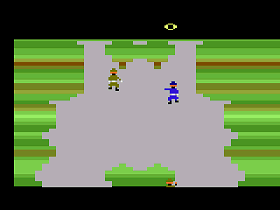 The Game: You’re a lone footsoldier fighting your way through a platoon of enemy troops, trying to take out as many of them as you can until you find your way to a handy empty tank. But once you man your own tank, enemy tanks surround you. If one of them hits your tank, you have mere seconds to bail out before your tank blows, and you have to dodge cannon fire until you can find another friendly tank to commandeer. After crossing hazardous stretches of desert and fighting off entire battallions of enemy tanks, you’re en route to the final confrontation, a showdown with the enemy’s armored headquarters… (Coleco, 1984)
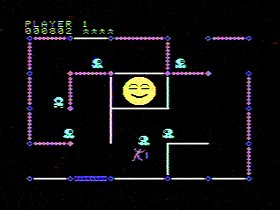 The Game: You’re back in the maze, but this time, the stakes are increased, the danger is increased, and your strategic options are only slightly increased. Touching the walls, the robots, the robots’ laser blasts, or even your own ricocheted lasers are deadly. And of course, the inevitable appearance by Evil Otto is also deadly. However, you can temporarily repel the smiley little bugger by blasting him until his grin turns into the frown – but he will reappear mere seconds later, moving much faster every time he must retreat and reappear – so you’re not doing yourself any favors. If you enter a generator room, you can halt all the robots in their tracks by penetrating the walls surrounding the generator and blasting it. “Beaded” walls can be eaten away, bit by bit, by laser fire from anyone who shoots it, while solid walls will ricochet lasers around until they hit something – which could mean a death trap for you. (Coleco, 1984)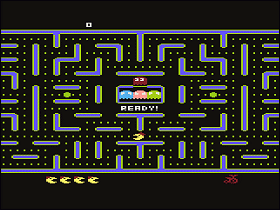
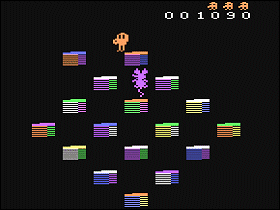 The Game: Q*Bert is back, hopping around from cube to cube, rotating the cubes 90 degrees with every hop…but a nasty bouncing rat and his minions are out to get the big Q. If one of the rat’s henchmen hops onto a cube whose top surface is the same color as its skin, it melts into the cube harmlessly. Q*Bert must change at See the videoleast one row of cubes to the target color to advance to the next level – and there aren’t any flying discs this time! (Parker Brothers, 1984)