
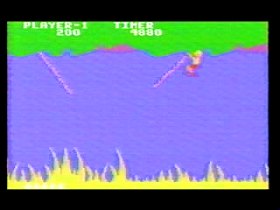
 The Game: You are an intrepid, pith-helmeted explorer of the jungle! Swinging from vine to vine! Swimming through crocodile-infested waters! Jumping and ducking huge rolling boulders! And vanquishing spear-weilding natives to rescue the damsel! (Atarisoft, 1983)
Memories: One of a handful of Atarisoft games for the ColecoVision, Jungle Hunt proves a point: while Coleco was trying to drive discriminating gamers toward its own console with subpar ports of games like Zaxxon (compare the ColecoVision edition to the Atari 2600 port) and Donkey Kong (again, compare the ColecoVision and 2600 versions), Atari – post-2600 Pac-Man debacle – was at least trying to turn out quality games for whatever platform it released games on.
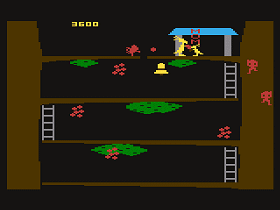 The Game: As a mama marsupial trying to save your baby from many malignant marauding monkeys, you go on a rescue mission that involves climbing through many, many levels of the monkeys’ treehouse village, punching primates, dodging airborne apples, grabbing various fruit items along the way (considering the abundance See the videoof apples, strawberries, cherries and bananas, one can only assume these are Pac-Man’s table leavings), and avoiding the big, purple boxing-glove-stealing ape. (Atari, 1983)
 The Game: In a bizarre collision of two very different game play elements that would probably be considered minigames today, you’re a fearless helicopter rescue pilot for the 4077th, fishing wounded U.S. soldiers out of harm’s way during the Korean War. When the window of your helicopter no longer shows up as hollow, you’ve got a full load and must safety return the wounded to the M*A*S*H base, and then go to retrieve more wounded. An enemy tank scoots along the bottom of the screen, trying to down both your helicopter and a computer-controlled chopper or an opponent’s chopper. This does not help matters, although being shot down merely causes a delay as an emergency vehicle appears – miraculously impervious to enemy fire – to push the wreckage off the screen before a new helicopter appears. Every so often, the action suddenly switches to the operating table, where you have to retrieve projectiles from victims’ bodies without causing worse damage as you remove them, and with the clock ticking down – if you fail to complete the surgery in time, then it’s goodbye, farewell and amen to that patient. (Think of the board game Operation! here and you’ve got the idea.) (20th Century Fox Games Of The Century, 1983)
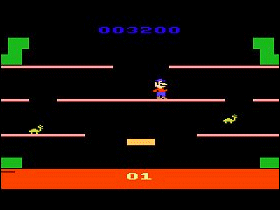 The Game: As Mario (or Luigi, if you’re playing with a second person), you’re trying to rid the sewers of such pests as evil lobsters and turtles. Try to grab as many coins as you can (it’s amazing what people let fall down the drain and into the sewer system sometimes), and always be on the lookout for the fireballs which bounce from level to level. Just how did all these things get into the sewers, anyway? (Atari, 1983)
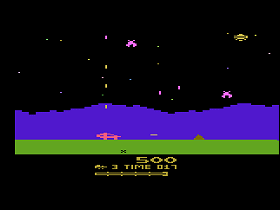 The Game: Driving an agile, armed moon buggy across the lunar surface, you must jump over craters and land mines, shoot large boulders (some occasionally mobile) out of your way, and try not to be on the receiving end of hostile fire from alien ships that try to strafe you. Some of the ships, which look very suspiciously like the triangle-of-spheres enemy ships from Gyruss, can even bomb the moon and make new craters for you to jump over – which may put you right into their line of fire.
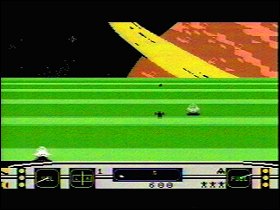 The Game: As the pilot of a super-fast intergalactic rescue ship (which is also armed to the teeth, which explains the absence of a red cross painted on the hull), you must navigate your way through hazardous comets and space debris, entering low orbit around various planets from which you must rescue a certain number of stranded civilians. But there’s a reason you’re armed – some alien thugs mean to keep those people stranded, and will do their best to blast you into dust. You can return the favor, and after you rescue the needed quota of people from the surface, you must align your ship with a series of launch rings to reach orbit again. (Imagic, 1983)
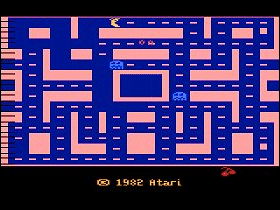 The Game: As the bride of that most famous of single-celled omniphage life forms, your job is pretty simple – eat all the dots, gulp the large blinking dots in each corner of the screen and eat the monsters while they’re blue, and avoid
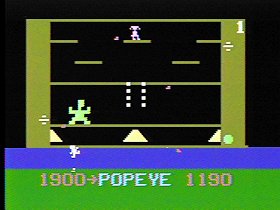 The Game: Well, blow me down! Popeye the sailor man gets his own video game. As Popeye, you’re trying to catch Olive Oyl’s falling hearts before they descend to sea level and are lost, while ducking Bluto’s punches at the same time. A can of spinach appears every so often, giving you the opportunity to read the big bully the riot act (comic strip-style, of course). (Parker Brothers, 1983)
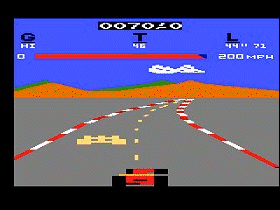 The Game: It’s your big chance to qualify for an unspecified big race at a track near Mt. Fuji in Japan. First, you try to get through the qualifying heat, racking up laps around the track as fast you can and accumulating as few wrecks as possible. If you pass muster, then you get to try it again with other cars on the track! (Atari, 1983)
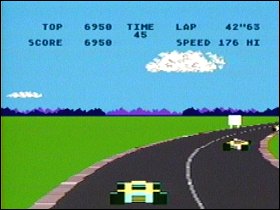 The Game: Prepare to qualify! Fly to the finish line in a fierce field of Formula One competitors in a qualifying lap. Leaving the track is trouble – and hitting one of the billboards dotted around the edges of the Mt. Fuji track is a sure way to miss out on the subsequent race. (Atari, 1983)
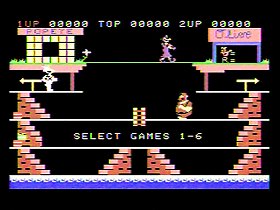 The Game: Well, blow me down! Popeye the sailor man gets his own video game. On level one, you’re trying to catch Olive Oyl’s falling hearts before they descend to sea level and are lost, while ducking Bluto’s punches at the same time. A can of spinach appears every so often, giving you the opportunity to read the big bully the riot act (comic strip-style, of course). On level two, the falling hearts are replaced by falling musical notes, and you’ll need Wimpy’s hefty help to keep Swee’Pea from drifting away on a balloon. (Parker Brothers, 1983)
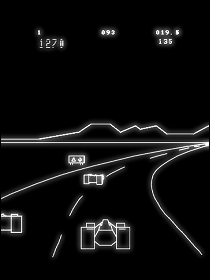 The Game: Prepare to qualify! Fly to the finish line in a fierce field of Formula One competitors in a qualifying lap. Leaving the track is trouble – and hitting one of the billboards dotted around the edges of the Mt. Fuji track is a sure way to miss out on the subsequent race. (GCE, 1983)
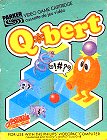 The Game: Q*Bert, a nosey little guy with a propensity for hopping, spends his time hopping around a pyramid of colorful blocks, avoiding Coily the Snake and other assorted purple and red creatures, including a few who operate on a slightly different plane (i.e., they move down the pyramid as if it were rotated one-third). Any green objects and creatures Q*Bert can catch will not hurt him – in fact, the little bouncing green balls will stop time briefly for everyone but Q*Bert. If he gets into a tight spot, Q*Bert can jump off the pyramid onto a flying disc which will deposit him back at the top of the pyramid – and lure Coily to a nasty fate by jumping into nothing. Changing the colors of the top of every block in the pyramid to the target color indicated at the top left of the screen will clear the pyramid and start the craziness all over again. (Parker Brothers, 1983)
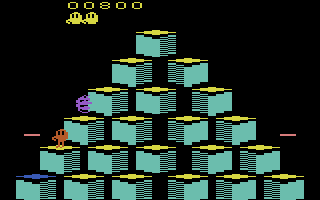 The Game: Q*Bert, a nosey little guy with a propensity for hopping, spends his time hopping around a three-dimensional pyramid of cubes, avoiding Coily the Snake and other assorted purple and red creatures, including a few who operate on a slightly different plane (i.e., they move down the pyramid as if it were rotated one-third). Any green objects and creatures Q*Bert can catch will not hurt him – in fact, the little bouncing green balls will stop time briefly for everyone but Q*Bert. If he gets into a tight spot, Q*Bert can jump off the pyramid onto a flying disc which will deposit him back at the top of the pyramid – and lure Coily to a nasty fate by jumping into nothing. Changing the colors of the top of every cube in the pyramid to the target color indicated at the top left of the screen will clear the pyramid and start the craziness all over again. If Q*Bert is hit by an enemy or falls off the pyramid, he hits bottom with a burst of incomprehensible obscenity! (Parker Brothers, 1983)

 The Game: Batter up! Take charge of a team on the baseball diamond for a practice round, or a game lasting 3, 6 or 9 innings. And if you think being behind a joystick will save you from hearing from the umpire, think again. (Atari, 1983)
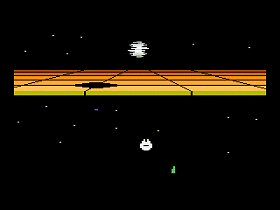 The Game: Presumably, you play the part of Lando Calrissian in this game, which seems to follow the events in the latter half of the film
 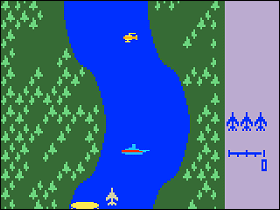 The Game: You’re piloting a fighter jet on a canyon run through enemy territory. You can’t fly outside the canyon walls, so stay over the river and blast everything in sight. Well, almost everything – flying your plane on top of “FUEL” buoys instead of shooting them puts a little bit of gas in the tank, and if you run out of fuel, you might as well just swallow the next enemy bullet, because you’re goin’ down. (Activision, 1983)
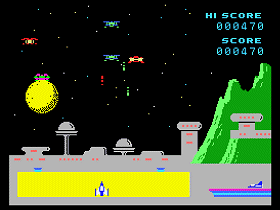 The Game: Aliens are closing in on your planetary base, and apparently you’re the only one on call to fend them off. Shields protect your ground-hugging mobile cannon, but they tend to be eroded away quickly by both incoming enemy fire and your own shots from the ground. If enemy ships infiltrate your protective bunker, you can find yourself in a very close-quarters firefight. When you eliminate a wave of alien ships, the next wave moves in to attack. (Spectravideo, 1983)
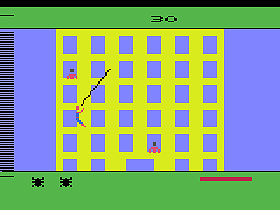 The Game: The Green Goblin and his henchmen are terrorizing the city once more, and it’s up to Spider-Man to restore order. But the odds are against him: he can only attach his web to the surface of the building, naturally, but the Goblin’s underlings are ready and eager to cut Spidey’s web should it be planted near them. Worse yet, the difficult-to-navigate high voltage tower at the top of the building is riddled with the Goblin’s bombs, and even if Spidey can defuse them, there’s a Super Bomb waiting for him at the top of the building – and he can only put it out of commission after dealing with the Green Goblin personally. (Parker Brothers, 1983)
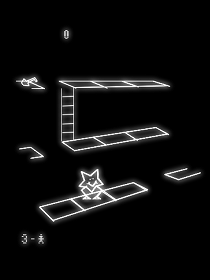 The Game: Poor Spike – his girlfriend Molly has been snatched by a beastly enemy, and it’s up to Spike to rescue her (after, of course, declaring “Darnit!”). Spike must climb his way up several ever-moving platforms. He can change the position of the ladders he uses to climb up these platforms, but it’s not as easy as simply reaching the top: to advance to the next level, Spike has to grab a key. Beastly henchmen scoot along the platforms to bump Spike off to his death, but Spike can kick them away momentarily. (GCE, 1983)
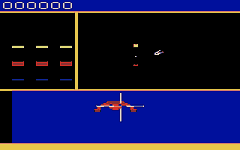 The Game: Welcome to the bridge. Your mission is to travel from sector to sector, eliminating Klingon incursions into Federation space without getting your ship and crew destroyed. Friendly starbases offer aid and allow you to make resupply stops so you can keep up the good fight – and you do have to keep a careful eye on your phaser, shield and warp power… (Sega, 1983)
 The Game: The alien abductors are back. Their henchbeings are back. And fortunately for the hapless humans on the planet’s surface, you’re back too, in a fully armed warship with a belly full of smart bombs. But the aliens have brought new and unusual reinforcements, and now the ultimate X-factor is seen visibly floating in the night sky – a stargate which could deposit your space fighter anywhere, delivering you to safety…or a rendezvous with a swarm of aliens. (Atari, 1983)
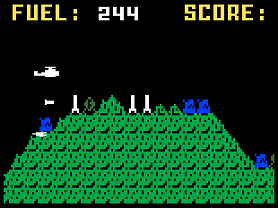 The Game: You’re piloting a heavily armed helicopter straight into a heap o’ trouble. Ground and air defenses have been mounted in this enemy installation to stop you at any costs. Missiles, anti-aircraft turrets, and even other vehicles will See the videodo anything to knock you out of the sky – and given the chunky terrain, the odds are in favor of the house. Your only saving grace is that you’re armed to the teeth. But, as you may have guessed by now, even that may not be enough to save you. (Parker Brothers, 1983)
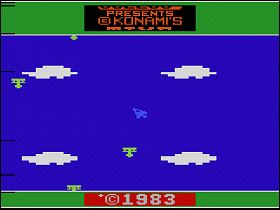 The Game: You’re flying solo through the fourth dimension! In what must be the least subtle time-traveling intervention since the last time there was a time travel episode on Star Trek: Voyager, you’re blasting your way through dozens of aircraft from 1940 through 1982. From WWII-era prop planes, to Vietnam-era helicopters, to 1982, where you confront jet fighters with the same maneuverability as your plane, you’re in for quite a wild ride. Rescue parachutists and complete the level by destroying “boss” craft such as heavy planes and dirigibles. (Coleco, 1983)
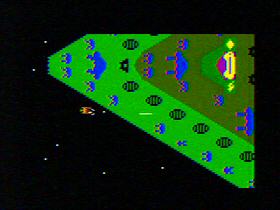 The Game: Piloting a series of solo space fighters, you’re humanity’s last hope against a fleet of gigantic, triangular wedge-shaped battle cruisers bearing down on Earth. Launching from a staging area equipped with a hyperspace gate to fling your fighters into the void at top speed, you must strafe these cruisers in your fighter, bombing and blasting their gun emplacements, engines, and an assortment of weak spots on their ship. The enemy cruisers also have defensive fighters that they’ll launch to keep you from getting the job done, and of course the cruisers themselves are bristling with enormous laser cannons. Hitting all of the guns, engines and other “soft targets” on a cruiser will destroy it, giving you a momentary reprieve until the next cruiser arrives. If you run out of ships or fail to stop the enemy, they’ll wipe out your planet – game over, indeed. (Activision, 1982)
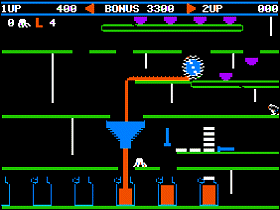 The Game: You control a spider, wandering though a factory that makes cider, and to survive this trip you better be a good hider, for the spider can’t survive with any apples that might collide ‘er. The spider can become a rider on conveyor belts, but she can also fall off if the spider tries to jump over something wider than she can navigate. The goal is to help your spider reach home despite all the perils that would divide ‘er. (Sierra On-Line, 1983)
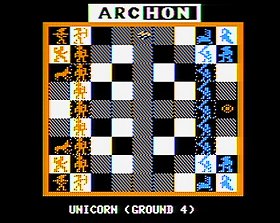 The Game: What if chess pieces were living creatures, each with its own unique abilities? And what if, every time to pieces met on the board, they had to fight amongst themselves to occupy the square in question? That’s Archon in a nutshell. (Electronic Arts, 1983)
 The Game: How high can you go? Help Jumpman (Mario) save Pauline from Donkey Kong’s clutches by climbing ladders and avoiding barrels. (AtariSoft, 1983)