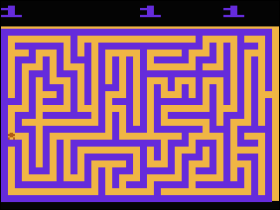
 The Game: Up to four players control markers that leave a solid “wall” in their wake. The object of the game is to trap the other players by building a wall around them that they can’t avoid crashing into – or forcing them to crash into their own walls. Run into a wall, either your own or someone else’s, ends your turn and erases your trail from the screen (potentially eliminating an obstacle for the remaining players). The player still standing at the end of the round wins. (Ramtek, 1976)
Memories: If you’re a fan of the “Light Cycle” concept made popular by Tron (both the movie and the game), this is where it all started, with an obscure game from a relatively obscure manufacturer. But that obscurity isn’t earned by a game that essentially launched and entire genre.
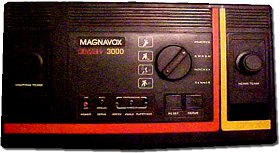 It adds nothing to the Odyssey 2000’s “four action-packed video games,” but the Odyssey 3000 is a quantum leap in the design aesthetic of the console itself. Finally breaking away from the basic casing design that had been in place since the Odyssey 100, Odyssey 3000 packs four games (well, really just three plus a Tennis “practice mode”) into a sleek, futuristic-looking black wedge with highlights that almost anticipate – believe it or not – the look of the computer screens in Star Trek: The Next Generation (though to be more realistic, it may have been influenced by the design line of Atari’s Fuji logo). The controllers are detachable but hardwired, and nestle snugly into the console itself.
  The Game: Up to four players control markers that leave a solid “wall” in their wake. The object of the game is to trap the other players by building a wall around them that they can’t avoid crashing into – or forcing them to crash into their own walls. Run into a wall, either your own or someone else’s, ends your turn and erases your trail from the screen (potentially eliminating an obstacle for the remaining players). The player still standing at the end of the round wins. (Midway, 1977)
 The Game: Piloting a mobile cannon around a cluttered playfield, you have but one task: clear the screen of mines, without blowing yourself up, in the time allotted. If you don’t clear the screen, or you manage to detonate a mine so close to yourself that it takes you out, the game is over. If you do clear all the mines, you get a free chance to try it again. Two players can also try to clear the minefield simultaneously. (Gremlin, 1978)
 The Game: Long before Frogger and Frog Bog, there were simply Frogs, the original arcade amphibians. One or two frogs hop along a lily pad at the bottom of the screen, scoping out tasty flies to eat. When you’ve got a morsel in your frog’s reach, jump and try to activate your frog’s tongue at just the right time. (You’ll know if you’ve snared a meal because your frog will seem to ascend the screen in heavenly bliss.) Whoever has the most points at the end of the timed game is the supreme frog. (Gremlin, 1978)
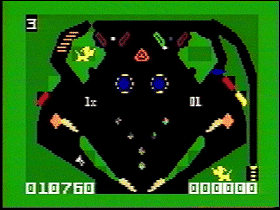
 The Game: It’s like pinball, but not quite. Not only are the bouncing-ball physics and bumpers of pinball present, but so are walls of bricks which, when destroyed, add to your score and sometimes redirect your ball in unpredictable directions. Pinball meets Breakout. (Namco, 1978)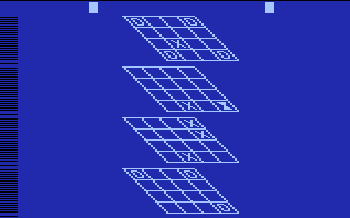

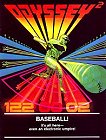 The Game: In Baseball!, you are, quite simply, one of two teams playing the great American game. If you’re up at bat, your joystick and button control the man at the plate and any players on base. If you’re pitching, your button and joystick control how wild or straight your pitches are, and you also control the outfielders – you can catch a ball on the fly, or pick it up and try to catch the other player away from his bases. (Magnavox, 1978)
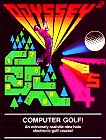 The Game: As man eked out his existence in the dark ages with only his animal cunning and the brutal power of the club, so do you in this golf simulation, in which you putter around nine different courses in an attempt to make a hole in one – or simply to stay under par. (Magnavox, 1978)

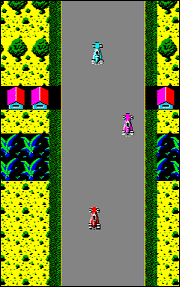 The Game: Players get behind the wheel of a roaring race car, viewed from overhead, as it navigates a series of roads and occasional tunnels whose width varies dramatically. Tunnels are illuminated only by headlights, which means that collisions with other cars are, if not certain, then at least much more likely. Any collision results in the player’s car having to get into traffic again from a dead standstill at the side of the road. (Sega, 1979)
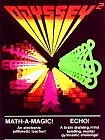 The Game: Wow! We must be in the future, for we now have electronic flash cards! This is more or less the function fulfilled by Math-A-Magic, while Echo is a slightly watered down version of the classic electronic game Simon. (Magnavox, 1979)
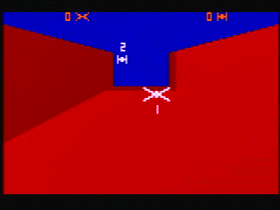 The Game: As a lone space pilot flying down a seemingly endless trench, your job is simple – blast or bomb all of the vaguely-bow-tie-shaped space fighters that you see. If your fighter is on the lower half of the screen, you’re blasting straight ahead/upward; if you move your fighter near the top of the screen, you can bomb any fighters below you. The game ends when you run out of ships; fortunately you never seem to run out of ammo. (Bally, 1979)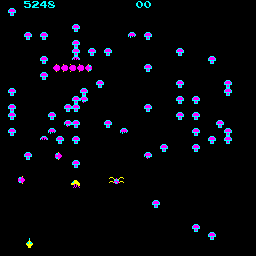
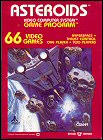

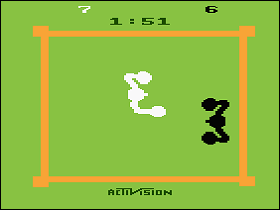
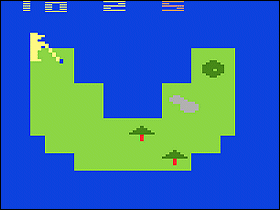
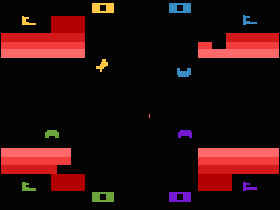
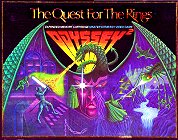 The Game: In the opening screen – the mists of time, so the rulebook tells us – two players pick their characters’ classes. Warriors are sword-wielding strongmen, wizards can cast spells from a distance, phantoms can walk through solid walls (but not lava formations), and changelings can become invisible when they move. The two intrepid adventurers then set forth on a quest to retrieve the ten rings of power from randomly selected dungeons and filled with randomly selected horrors. (Magnavox, 1980)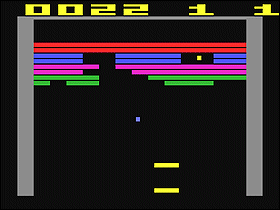
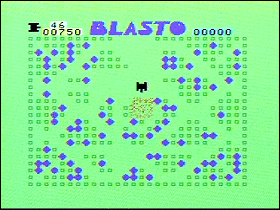 The Game: Piloting your mobile cannon around a cluttered playfield, you have but one task: clear the screen of mines, without blowing yourself up, in the time allotted. If you don’t clear the screen, or manage to detonate a mine so close to yourself that it takes you out, the game is over. If you do clear all the mines, you get a free chance to try it again. Two players can also try to clear the minefield simultaneously. (Texas Instruments, 1980)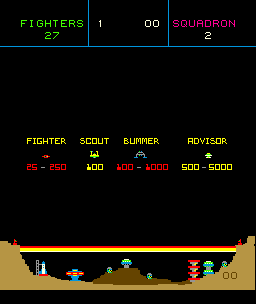
 The Game: The Martians are coming! And they’re coming in colorful vector graphics! The tripod-like Martian War Machines land, extend their legs, and begin marching inexorably toward your cannon, pausing momentarily to sweep the bottom of the screen with their deadly heat rays, or hurling spirals of energy your way to slow down your cannon. You have a shield that can offer you mere moments of protection, but if it wears out or you find yourself in the Martians’ sights, your spiky-headed cannon operator is fried, and the cannon is promptly manned by another spiky-headed gunner. When your spiky-headed infantry is exhausted, the Martian invasion continues… (Cinematronics, 1981)
 The Game: An oversized gorilla kidnaps the girlfriend of an unidentified plumber and hauls her up to the top of a building. You are that plumber who shall remain nameless, dodging
 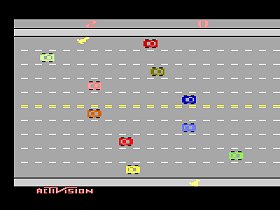 The Game: Why the chicken crossed the road is no longer the question. Now the question is will the chicken cross the road? That part is up to you. You are the chicken. You must avoid traffic, but that’s a real challenge when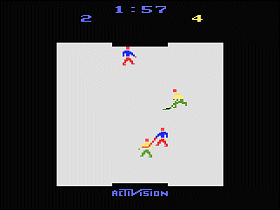
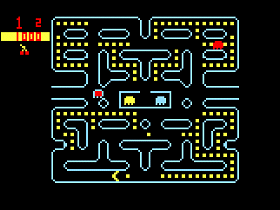 The Game: As a round yellow creature consisting of a mouth and nothing else, you maneuver around a relatively simple maze, gobbling small dots and evading four colorful monsters who can eat you on contact. In four corners of the screen, large flashing dots enable you to turn the tables and eat the monsters for a brief period. Periodically, assorted items appear near the center of the maze, and you can consume these for additional points as well. The monsters, once eaten, return to their home base in ghost form and return to chase you anew. If cleared of dots, the maze refills and the game starts again, but just a little bit faster… (Bally, 1981)