
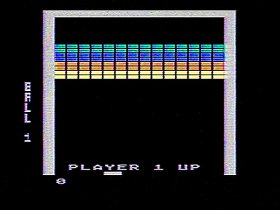
 The Game: You’ve got a mobile paddle and – well, frankly, balls. But you don’t have a lot of balls at your disposal (am I the only one becoming a little bit uncomfortable discussing this?), so you have to make the best use of them that you can to knock down the rows of colorful bricks overhead. In some games, there may be other, free-floating balls trapped in “cavities” in the bricks, and setting them loose will mean you’ll have several balls – and not all of them necessarily yours, disturbingly enough – to handle. Missing one of your balls – and we all know how painful that can be – forces you to call another ball into play. Losing all of your balls, as you’ve probably guessed by now, ends the game. So, in essence, Super Breakout is a metaphor for life from the masculine perspective. (Atari, 1982)
Memories: So let’s see here. Atari had this great new console which sported, essentially, the guts of their Atari 400 computer, quite a bit of processing power (for its day) for a game-playing machine. Capable of detailed, colorful graphics and excellent sound effects, the Atari 5200 would, of course, need a fantastic pack-in title at launch, something which would showcase its amazing abilities. And that’s all fine and well, but what the poor 5200 wound up with was Super Breakout.
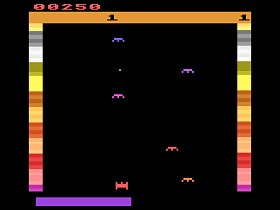 The Game: A lone space pilot is faced with the impossible task of fending off an entire alien invasion force single-handedly. Colliding with either the aliens or their decidedly unfriendly fire costs the player a ship. Clearing the screen of aliens only reveals a further wave of extraterrestrial killing machines. (Tigervision, 1982)
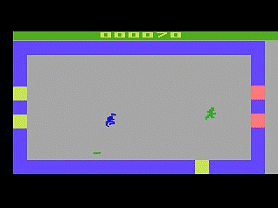 The Game: You are Tron, a lone video game warrior pitted against three other enemies with much greater armament. You can take a number of hits before you’re “de-rezzed” out of existence, but those hits can pile up pretty quickly. By throwing your disc at certain portions of the arena wall and changing them to the same color as your on-screen character, you can make tunnels for yourself – not unlike the side tunnels in Pac-Man – handy for escape or ambush. (M Network [Mattel], 1982)
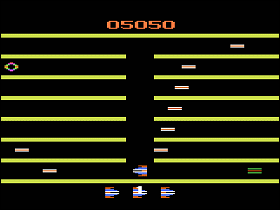 The Game: Players pilot a ship trapped in a maze of vertically stacked level, teeming with aliens who are all deadly to the touch. The good news is that the ship has an inexhaustible supply of ammo. The not-so-good news is that the bad guys have an inexhaustible supply of bad guys. Players have to keep the ship from colliding with the enemy, while shooting at the enemy and watching out for split-second opportunities to grab any bonus items that may make a fleeting appearance. Just one word of caution: the prizes turn into smart bombs if you wait too long to go pick them up. (20th Century Fox, 1982)
 The Game: You type! It talks! And occasionally you have to throw the damnedest misspellings at it to get it to say the simplest words. And despite the back of the box claiming that it “plays fun games,” it’s much more likely that it’ll just make some fun (and weird) sounds. (Magnavox, 1982)
 The Game: Your Vanguard space fighter has infiltrated a heavily-defended alien base. The enemy outnumbers you by six or seven to one at any given time (thank goodness for animated sprite limitations, or you’d be in real trouble!). You can fire above, below, ahead and behind your ship, which is an art you’ll need to master since enemy ships attack from all of these directions. You can’t run into any of the walls and expect to survive, but you can gain brief invincibility by flying through an Energy block, which supercharges your hull enough to ram your enemies (something which, at any other time, would mean certain death for you as well). At the end of your treacherous journey lies the alien in charge of the entire complex – but if you lose a life at that stage, you don’t get to come back for another shot! (Atari, 1982)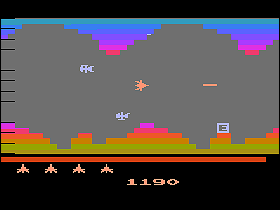

 The Game: As intrepid (and perpetually happy) adventurer Winky, armed only with a bow and arrow, you’re on a treasure hunt of the deadliest kind. HallMonsters try to stop you at every turn, and their minions guard the individual treasures that lie in the rooms of the maze. You can kill the smaller creatures (though their decomposing remains are still deadly to touch), but the HallMonsters are impervious to your arrows – and you’re lunch. (Coleco, 1982)
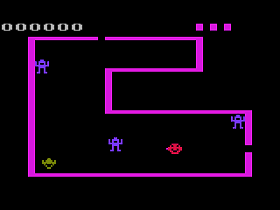 The Game: Trapped in a maze full of HallMonsters, you are adventurer Winky, on a mission to snatch incredible treasures from hazardous underground rooms inhabited by lesser beasts such as re-animated skeletons, goblins, serpents, and so on. Sometimes even the walls move, threatening to squish Winky or trap him, helpless to run from the HallMonsters. The deeper into the dungeons you go, the more treacherous the danger – and the greater the rewards. Just remember two things – the decomposing corpses of the smaller enemies are just as deadly as the live creatures. And there is no defense – and almost never any means of escape – from the HallMonsters. (Coleco, 1982)
 The Game: You’re the pilot of a lone fighter ship, screaming down the trench-like, heavily armed confines of a spaceborne fortress, on a mission to find and destroy the Zaxxon robot – the most heavily guarded of all – at the heart of the structure. (Coleco, 1982)
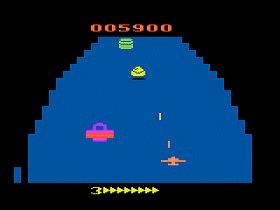 The Game: You’re the sole space fighter pilot penetrating a heavily-armed, mobile alien fortress. If you can survive wave after wave of fighters and ground defenses, you’ll have the opportunity to destroy the Zaxxon robot at the heart of the complex. (Coleco, 1982)
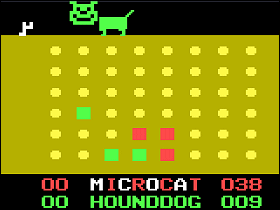 The Game: The constant struggle between cat and dog requires a great deal of concentration. Two players can play, or one player can control the dog while the CPU makes moves as the “Microcat.” Each animal drops a piece into the playing field, trying to line up four pieces horizontally, vertically or diagonally, or trying to keep the other animal from lining up his four pieces. Whoever lines up four pieces first wins the game. (Phillips, 1982)
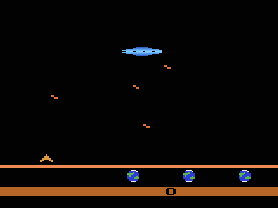 The Game: Players control a single laser cannon responsible for defending several planets who don’t seem to be able to look out for themselves. The cannon squares off against an alien mothership which deploys its own fleet of attack ships to destroy those planets. Good news: the planets are protected by a force field spanning the bottom of the screen. Bad news? The aliens can shoot through it, exposing the row of fragile planets as they scroll across the screen like shooting gallery targets. Worse news? You can’t defend all of them forever. (Games By Apollo, 1982)