It goes without saying that video games were big business in the 1970s, but sometimes getting a look at the players attempting to make their name on that particular field is a good indicator of just how big the business was. Take Fairchild Semiconductor, for example – a well-known player in the integrated circuit business already, Fairchild dipped its toes into the video game water. And why not? You could either have a lock on supplying the chips for another company’s machine, or you could build the whole system and put your name on it. Fairchild chose to go the latter route, and the chipmaker had an ace up its corporate sleeve – something they felt would change the video game industry permanently.
The sad one-two punch to this story is as follows:
- Fairchild’s new system did have something that would permanently change the video game industry, an industry-standard-setting new twist whose influence can still be felt today.
- Fairchild’s new system wouldn’t survive long enough in the market to really reap the benefit of that revolutionary new gimmick.
Fairchild’s Video Entertainment System came, as did most dedicated consoles of the day, with games built into the machine’s hardware: a simple game of hockey and a Pong-like tennis game. The VES’ two hard-wired controllers were an interesting new twist unto themselves, literally: players would hold the bulk of the controller in one hand and manipulate the control – a combination of multi-directional joystick, twisting paddle and “plunger” – with the other. And when hockey and tennis got old, you could buy extra cartridges and slide them into the slot provided on the front of the system’s main panel.
Fairchild’s system was the first home video game that could be programmed with additional games sold in cartridge form. These optional extra games were housed in their own ROM chips in the cartridges, and Fairchild promised that many future titles would be available. And in 1976, in a consumer world where the console wars, thus far, had been waged by systems that couldn’t be expanded or added onto, at least not since the Magnavox Odyssey with its add-on Shooting Gallery light gun, this was big news. So long as new cartridges were made available, and the games were fresh enough to keep the game-buying public entertained, Fairchild didn’t have to worry about churning out another machine in the next year. The VES simply wouldn’t get old. (At least that was the theory.)
Fairchild’s “Videocarts,” as they were called, were big, bright yellow, and covered with bold, day-glo label artwork that was certainly fancier than anything the machine could actually put on a TV screen. But when the first of these multi-game cartridges added not just one but several new games to the existing system, consumers saw the appeal immediately. Fairchild actually wound up backlogged, with more demand for the VES than they initially had a supply.
One year into the VES’s lifetime, however, another player emerged on the field, and its product had a similar name and operated on the same basic idea. And while Atari’s Video Computer System didn’t even have a built-in game going for it, it did have the marketing might of the makers of Pong behind it, and an established distribution network through Sears. Fairchild’s reaction would almost seem, in hindsight, to indicate that they knew they were up against a formidable foe: the VES was rechristened Channel F, to avoid confusion with Atari’s new cartridge-based system, and the games on Fairchild’s “Videocarts” grew a little more elaborate, now frequently taking up an entire cartridge’s memory with a single game.
Fairchild stayed behind the Channel F through 1978, but Atari’s gains in the home video game market by that time made Channel F look like an also-ran. Other systems – Magnavox’s Odyssey² and Mattel Electronics’ Intellivision among them – were also preparing to go on the market, trying to be the next Atari-sized success story. Fairchild didn’t feel it could compete, and found an unlikely buyer for the Channel F inventory and intellectual properties. Tool and instrument maker Zircon International took on the challenge, even going so far as to retool the console’s look (though not its internal hardware) and re-releasing it as the Zircon Channel F System II in 1982, at the height of video game mania – and on the eve of the crash. A few extra games were released through Zircon, and then they gave up the ghost as well. The first programmable cartridge-based system finally dead-ended.
Here, then, is a brief guide to the oft-overlooked Channel F and its games. And before you write off the influence of Fairchild’s wonder machine of the 1970s, ask yourself this: does your Game Boy Advance still run its games from pre-programmed cartridges? Players may have tuned out on Channel F over 25 years ago, but the system’s legacy still remains.
A Phosphor Dot Fossil examined by Earl Green

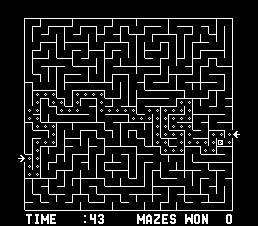 The Game: You control a dot making its way through a twisty maze with two exits – one right behind you and one across the screen from you. The computer also controls a dot which immediately begins working its way toward the exit behind you. The game is simple: you have to guide your dot through the maze to the opposite exit before the computer does the same. If the computer wins twice, the game is over. (Midway, 1976)
 The Game: Up to four players control markers that leave a solid “wall” in their wake. The object of the game is to trap the other players by building a wall around them that they can’t avoid crashing into – or forcing them to crash into their own walls. Run into a wall, either your own or someone else’s, ends your turn and erases your trail from the screen (potentially eliminating an obstacle for the remaining players). The player still standing at the end of the round wins. (Ramtek, 1976)
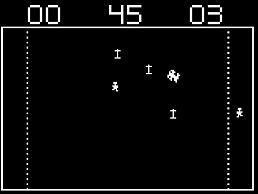 The Game: Two players control one car each, careening freely around an arena filled with zombies. Faced with zombie-fication at the pedestrian crossing of the undead, the drivers have only one option: run over their opponents! Each zombie that’s squashed leaves a grave marker behind that becomes an unmovable obstacle to zombies and cars alike. Whoever has run over the most zombies by the end of the timed game wins. (Exidy, 1976)
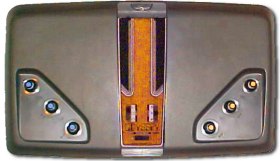 With the same trio of games as the Odyssey 400 – Tennis, Hockey/Soccer and Smash – the Odyssey 500, released in 1976 by Magnavox, would appear to not be much of an upgrade, but in fact, it’s an absolutely critical turning point for home video games: the Odyssey 500 did away with squares and rectangles to represent the player, and introduced character sprites – hardware-generated characters that roughly mimicked the shape of a human being.
 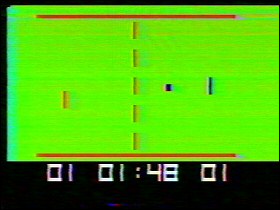 The Game: Activated by leaving a cartridge out of the slot, powering the system up and pressing one of the selector keys, Tennis and Hockey are built into the system. Timed games can be selected, and the traditional rules of each sport apply. (Fairchild, 1976)
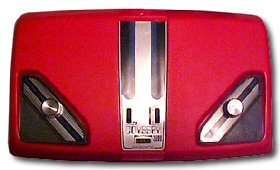 After the baffling backward step of the Odyssey 400, Magnavox’s Odyssey 2000 saw a return to the Pong-inspired, single-paddle control scheme, with digital scoring restored as well – Magnavox had decided to rest the Brown Box design (and the subsequent variations on it) permanently in favor of, once again, the General Instruments AY-3-8500 “Pong on a chip” processor. Packaged in a red casing, this would be the last anyone would see of the smoothly rounded-off, integrated Odyssey console. The next system to bear the name would return to its roots – with wired controllers that weren’t necessarily stuck to the main console – and look forward, with a futuristic new design that stands up even today.
 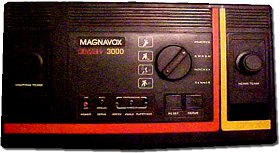 It adds nothing to the Odyssey 2000’s “four action-packed video games,” but the Odyssey 3000 is a quantum leap in the design aesthetic of the console itself. Finally breaking away from the basic casing design that had been in place since the Odyssey 100, Odyssey 3000 packs four games (well, really just three plus a Tennis “practice mode”) into a sleek, futuristic-looking black wedge with highlights that almost anticipate – believe it or not – the look of the computer screens in Star Trek: The Next Generation (though to be more realistic, it may have been influenced by the design line of Atari’s Fuji logo). The controllers are detachable but hardwired, and nestle snugly into the console itself.