 The unmanned Kosmos 1686 module, launched by the Soviet Union in September, successfully completes an automated docking with space station Salyut 7. This new module is a permanent addition to the final Salyut station, offering more habitable space for work and storage aboard the aging station. Kosmos 1686 arrives with nearly 10,000 pounds of supplies and consumables, and serves as a case study to help engineers plan the upcoming Mir space station, which is designed from the outset to consist of several add-on modules.

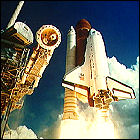 The inaugural flight of Space Shuttle Atlantis takes the newest orbiter on a four-day Defense Department mission (the specifics of which remain classified). Manning Atlantis for this flight are Commander Karol Bobko, Pilot Ronald Grabe, and mission specialists David Hilmers, Robert Stewart and William Pailes.
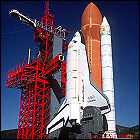 With $4 billion having been spent on upgrading and customizing a special launch facility since 1972 to handle (mostly military)
 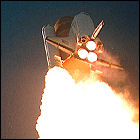 Space Shuttle Challenger lifts off on a one-week mission to carry the Spacelab module and an all-German crew to orbit. The “Spacelab D1” mission is flown by Commander Henry Hartsfield, Pilot Steven Nagel, mission specialists James Buchli, Guion Bluford, and Bonnie Dunbar, and payload specialists Reinhard Furrer, Ernst Messerschmid and Wubbo J. Ockels.
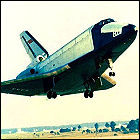 With its own jet engines freeing it from the need for a carrier aircraft, the Buran Analogue test vehicle – the Soviet equivalent of Space Shuttle Enterprise – makes its first approach and landing test, cutting off its jet engines at a predetermined altitude and gliding to an airstrip for a landing. The Buran Analogue will ultimately make more test flights than the Enterprise, continuing to conduct glider landings through 1988.
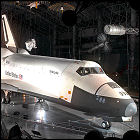 The Space Shuttle Enterprise arrives to begin its new life as a star exhibit at the Smithsonian Air & Space Museum in Washington D.C. Having used the Enterprise as a test shuttle for landings and engineering fit checks, and having dispatched it on a world tour of air shows and other public appearances, NASA donates Enterprise to the Smithsonian, as any plans to refit it into a spaceworthy orbiter have been nixed by this point.
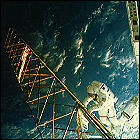 Space Shuttle Atlantis lifts off on a seven-day mission of crucial importance to plans for a future space station. In addition to launching three satellites (Mexico’s MORELOS-B, RCA’s SATCOM KU-2 and AUSSAT-2 for Australia), two spacewalks in excess of five hours each are conducted, each one testing a different method of erecting large truss structures in space. Atlantis’ crew for this mission consists of Commander Brewster Shaw, Pilot Bryan O’Connor, mission specialists Mary Cleave, Sherwood Spring, Jerry Ross and payload specialists Rodolfo Neri Vela and Charles Walker.
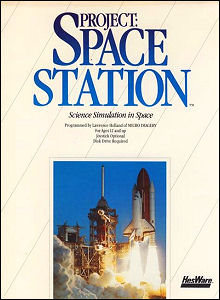 HESware releases the
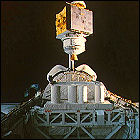 Space Shuttle Columbia lifts off on a six-day satellite deployment mission, and is also the first spaceflight to include a sitting member of the US Congress among its crew. The SATCOM KU-I satellite is launched, but another payload designed to observe Halley’s Comet (which is rapidly approaching its closest approach to Earth) malfunctions and collects no data. Columbia’s crew for this mission consists of Commander Robert Gibson, Pilot Charles Bolden, mission specialists Franklin Chang-Diaz, Steven Hawley, George Nelson, and payload specialists Robert Cenker and Congressman Bill Nelson.
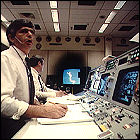 73 seconds after liftoff, Space Shuttle Challenger explodes when a rubber O-ring designed to be a tight seal between solid rocket booster segments allows flames from the booster to breach the shuttle’s external fuel tank, causing the tank’s highly flammable contents to ignite. The shuttle is destroyed with all hands aboard. Later analysis reveals that frigid cold temperatures in the nights leading up to the launch allowed the booster’s O-rings to become brittle enough to break – a possibility that NASA had been warned of by engineers at Morton-Thiokol, the contractor responsible for the solid rocket boosters.
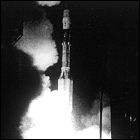 The Soviet Union launches the first module of its new Mir space station, a new modular station design building on the Soviets’ years of experience with the Salyut stations. One end of this “core” module is a six-sided structure, with docking ports on five sides; this design will allow new modules to be added onto Mir in all directions, and will potentially allow for several Soyuz or unmanned Progress cargo vehicles to be docked simultaneously, a design element which will later be carried forward to the International Space Station.
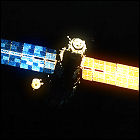 The Soviet Union launches Soyuz T-15 on an unprecedented mission into orbit. Cosmonauts Leonid Kizim and Vladimir Solovyov become the first occupants of the newly-launched Mir space station on March 15th, where they remain until early May, at which time they undock the Soyuz T-15 vehicle from Mir and visit the powered-down Salyut 7 space station, becoming its final occupants until they return to Mir in late June, bringing several pieces of equipment and experiments cannibalized from Salyut back with them. The crew spends a total of 125 days in space, at the end of which Kizim is the most-traveled man in space, having accumulated over a year of total space travel time. Soyut T-15 is the last second-generation Soyuz vehicle to fly, returning to Earth on July 16th.
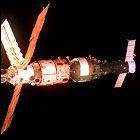 The Soviet Union launches Soyuz TM-2, the first manned launch of a newly uprated version of the Soyuz capsule. Cosmonauts Yuri Romanenko and Aleksandr Laveykin travel to the Mir space station, where Laveykin remains for 174 days before departing in July, but Romanenko sets a new space endurance record, remaining in orbit for 326 days. Romanenko’s return to Earth just before the end of 1987 marks the end of Expedition 2’s occupancy of Mir.
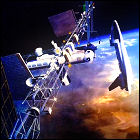 President Reagan approves a $10,000,000,000 budget for a redesigned, pared-down Space Station Freedom, to be constructed over sixteen Space Shuttle launches beginning in 1994, with Freedom not being fully operational until 1996. To the stern disapproval of the scientific community, almost all laboratory space has been removed from Freedom’s design proposal, leaving only Japan and the European Space Agency to provide lab space. Without the space for American astronauts to conduct scientific experiments, Space Station Freedom’s new primary mission is quite clearly stated to be to catch the American space program up with, or surpass, the Soviet Union’s long-duration space missions aboard the Mir space station. While the Preisdent approves of the slimmed-down station design, NASA must now run the gauntlet to get Congressional approval to proceed.
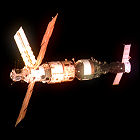 The Soviet Union launches Soyuz TM-3 on an eight-day mission into space which includes a visit to space station Mir. Cosmonauts Aleksandr Aleksandrov and Muhammed Faris (the latter of whom is the first Syrian space traveler) return to Earth at the end of the mission, along with Mir crew member Yuri Romanenko, while Alexander Viktorenko takes Romanenko’s slot on Mir. In order to leave the newer vehicle docked to Mir as an escape craft, the Soyuz TM-3 crew returns aboard Soyuz TM-2.
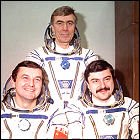 The Soyuz TM-4 mission is launched by the Soviet Union, en route to space station Mir. Cosmonauts Vladimir Titov and Musa Manarov take up residence as the new long-duration crew aboard Mir, formally known as Expedition 3, and they eventually break all previous space endurance records by staying aboard Mir for exactly one year and one day, returning to Earth on December 21st, 1988. Cosmonaut Anatoli Levchenko, after the week-long overlap with the Expedition 2 crew, returns to Earth with Expedition 2 crew members Yuri Romanenko and Aleksandr Aleksandrov aboard the Soyuz TM-3 vehicle.
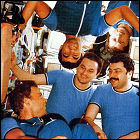 Cosmonauts Anatoly Solovyev, Viktor Savinykh and Aleksandr Aleksandrov lift off for a week-long visit to Soviet space station Mir aboard Soyuz TM-5. Numerous biological and astronomical experiments are conducted by the blended crew, and at the end of the week of joint activities, the Soyuz TM-5 crew use the older TM-4 capsule to return home, leaving the station crew with a newer vehicle.
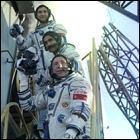 The Soviet Union launches the Soyuz TM-6 mission to the Mir space station, with cosmonauts Vladimir Lyakhov, Valeri Polyakov and Abdul Ahad Mohmand aboard. Lyakhov and Mohmand remain aboard Mir for only a week, participating in experiments involving both crews, but Polyakov, a medical doctor, remains on Mir to monitor the Expedition 3 crew in the final months of their unprecedented one-year stay in orbit. This crew exchanges spacecraft with the station crew, returning home in the Soyuz TM-5 vehicle after a week on Mir, but their return is plagued by problems both technical and otherwise.
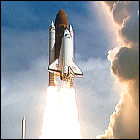 The first Space Shuttle launch in over two years since the Challenger accident, Discovery lifts off on a flight to test improved safety systems and procedures. The shuttle’s major payload is the second TDRS (Tracking & Data Relay Satellite) launched by NASA (an identical satellite was lost in the Challenger explosion in 1986), as well as numerous smaller experiments. Problems with Discovery’s environmental system cause the crew cabin to be warmer than usual. Discovery’s crew for this flight consists of Commander Fred Hauck, Pilot Richard Covey, and mission specialists John Lounge, George Nelson, and David Hilmers.
 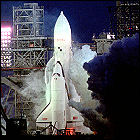 Modeled closely after the American Space Shuttle, the Soviet-built orbiter Buran lifts off for its first and only voyage into space. Still in the testing stages, Buran flies completely unmanned, with ground controllers at Baikonur Cosmodrome guiding the vehicle’s every move. With no large engines of its own (unlike NASA’s shuttle fleet), Buran is lifted into orbit solely by the giant Energia booster, makes two orbits, and returns home as a glider. A second flight is scheduled, but before it can take place, the Soviet Union collapses. Buran never flies again.
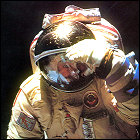 The Soviet Union launches Soyuz TM-7 to space station Mir, ferrying cosmonauts Alexander Volkov and Sergei Krikalev, and French spationaut Jean-Loup Chrétien to the station. Volkov and Krikalev will remain aboard Mir for 151 days, while Chrétien will remain for a shorter 24-day mission. Chrétien had visited the Salyut 7 space station on his previous spaceflight; his next flight, in 1997, will visit Mir again, this time by way of Space Shuttle Atlantis. Unusually, the return of this Mir crew will leave the station unoccupied for almost half a year.
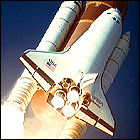 Space Shuttle Atlantis lifts off on the 27th shuttle flight, a four-day mission to launch a classified Defense Department payload. The crew aboard Atlantis for this flight consists of Commander Robert Gibson, Pilot Guy Gardner, and mission specialists Richard Mullane, Jerry Ross, and William Shepherd. All other information about this flight, including launch weight and even Atlantis’ orbital altitude, remain classified to this day.
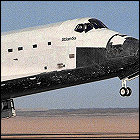 Space Shuttle Atlantis returns to Earth from a classified four-day mission to deploy a payload for the Department of Defense, and on only the second flight since the Challenger disaster, most of Atlantis’ crew are surprised to return to Earth at all. During the mission, they note that Atlantis is missing numerous heat shield tiles along the vehicle’s right side and its wing – a post-landing damage survey counts over 700 missing tiles, making Atlantis the most-damaged orbiter to return safely from space. The damage had been pointed out to ground controllers by the crew, but when NASA asks permission from the Defense Department to allow the crew to send a live TV signal to Earth so engineers can survey the damage in orbit, that permission is refused. A slow-scan encrypted video system is used instead, and its low resolution doesn’t reveal the extent of the damage. The damage is believed to have been caused by insulation vibrating loose from the solid rocket booster and the external fuel tank and striking the shuttle during launch, an almost identical cause of damage that proves catastrophic to another shuttle 15 years later.
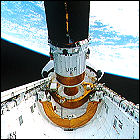 Space Shuttle Discovery lifts off on a nearly-five-day mission to take NASA’s third TDRS (Tracking & Data Relay Satellite) into orbit, among other smaller experiment packages, including IMAX filming. Aboard Discovery for the first shuttle flight of 1989 are Commander Michael Coats, Pilot John Blaha, and mission specialists James Bagian, James Buchli, and Robert Springer.
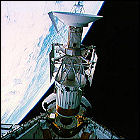 Space Shuttle Atlantis lifts off on a four-day mission to launch the long-delayed interplanetary probe Magellan, which is sent to Venus via an Interial Upper Stage booster module. For the first time, one of a shuttle’s five onboard computers fails and is replaced in an in-orbit repair procedure. Aboard Atlantis for this flight are Commander David Walker, Pilot Ronald Grabe, and mission specialists Norm Thagard, Mary Cleave and Mark Lee. The launch of Magellan, a mission originally conceived in 1972, marks the beginning of the first American interplanetary mission since 1977.
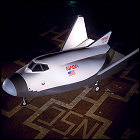 NASA begins intensive work, including the construction of a full-sized test article, on the HL-20, a vehicle being considered for “assured access” to the space station NASA plans to build in the 1990s. HL-20 is based upon the scale-model unmanned
 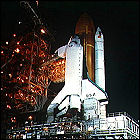 Lifting off on its first spaceflight since January 1986, Space Shuttle Columbia heads into orbit on a five-day classified Department of Defense mission. Columbia’s crew for this flight consists of Commander Brewster Shaw, Pilot Richard Richards, and mission specialists James Adamson, David Leestma and Mark Brown.
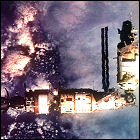 Cosmonauts Alexander Viktorenko and Aleksandr Serebrov lift off aboard the Soviet spacecraft Soyuz TM-8, bound for the presently unoccupied space station Mir (which had been left without a crew since April 1989). At a distance of only 4 meters to Mir’s docking hatch, Soyuz TM-8 suffers a breakdown of its automated docking system, and Viktorenko has no choice but to back the Soyuz away and carefully dock under manual control. The two-man crew remains aboard Mir for 166 days, returning to Earth in February 1990.