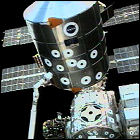
 Space Shuttle Discovery lifts off on the 106th shuttle flight, a mission to exchange crews aboard the International Space Station. The shuttle’s cargo bay carries a logistics module containing more equipment for the ISS laboratory module, as well as storage racks to be installed elsewhere in the station. Aboard Discovery for her 30th flight are Commander Scott Horowitz, Pilot Frederick Sturckow, missions specialists Daniel Barry and Patrick Forrester, and ISS Expedition 3 crewmembers Frank Culbertson, Mikhail Turin and Vladimir Dezhurov, who remain aboard the station. Returning to Earth via Discovery are ISS Expedition 2 crewmembers Yury Usachev, James Voss and Susan Helms.

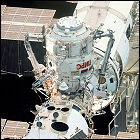
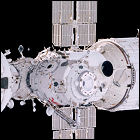 Russia launches the Pirs docking module into orbit, where automatic systems allow it to rendezvous with the International Space Station for docking to the existing Zvezda module. The Pirs module adds a docking port for Soyuz capsules, as well as an airlock for future spacewalks.
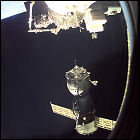 Russia launches Soyuz TM-33 on a mission to the International Space Station. Aboard the Soyuz are cosmonauts Viktor Afanasyev and Konstantin Kozeyev, and French spationaut Claudie Haigneré, making her second visit to a space station (she has previously visited Russia’s Mir space station). This is a short-term visiting crew, spending only eight days aboard Mir and then returning aboard the older Soyuz TM-32 spacecraft, leaving TM-33 as the return vehicle for the next visiting crew.
 Space Shuttle Endeavour lifts off on the 107th shuttle flight, a resupply and crew rotation mission to the International Space Station. Aboard Endeavour for her 17th flight are Commander Dominic Gorie, Pilot Mark Kelly, mission specialists Linda Godwin and Daniel Tani, and ISS Expedition 4 crewmembers Yuri Onufrienko, Carl Walz and Daniel Bursch. Returning to Earth via Endeavour are ISS Expedition 3 crewmembers Frank Culbertson, Mikhail Turin and Vladimir Dezhurov.
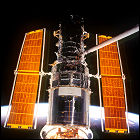 Space Shuttle Columbia lifts off on the 108th shuttle flight, the third Hubble Space Telescope servicing mission. Numerous enhancements are carried aboard the shuttle to replace existing parts on the decade-old orbiting telescope, including new cooling systems and a new set of solar power arrays. Aboard Columbia for her 27th flight are Commander Scott Altman, Pilot Duane Carey, Payload Commander John Grunsfeld, and mission specialists Nancy Currie, James Newman, Richard Linnehan and Michael Massimino.
 Space Shuttle Atlantis lifts off on the 109th shuttle flight, an 11-day mission to add the integrated truss “backbone” to the International Space Station. In addition to assembling and attaching this major part of the station, a mobile transport is added for the station’s remote manipulator arm, allowing the arm to roll from one end of the station to the other for whatever functions may be required. Aboard Atlantis for her 25th flight are Commander Michael Bloomfield, Pilot Stephen Frick, and mission specialists Jerry Ross, Steven Smith, Ellen Ochoa, Lee Morin and Rex Walheim.
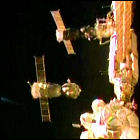 Russia launches a short-term visiting crew to the International Space Station aboard Soyuz TM-34. This is the last Soyuz TM class vehicle to fly, with a newer version of the capsule, Soyuz TMA, scheduled to launch later in 2002. Russian cosmonaut Yuri Gidzenko, Italian astronaut Roberto Vittori, and South African space tourist Mark Shuttleworth comprise Soyuz TM-34’s crew, staying at the ISS for eight days. Like Dennis Tito before him, multi-millionaire and Linux developer Shuttleworth has paid for his own ride into space. This crew leaves the Soyuz TM-34 vehicle at the ISS, returning home aboard Soyuz TM-33.
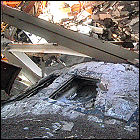 Stored in a hangar undergoing structural work at the Baikonur Cosmodrome in Kazakhstan, the Soviet-era
 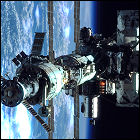 Space Shuttle Endeavour lifts off on the 110th shuttle flight, a mission to exchange the crew of the International Space Station. Scheduled supplies and other equipment are also transported to the station. Aboard Endeavour for her 18th flight are Commander Kenneth Cockrell, Pilot Paul Lockhart, mission specialists Franklin Chang-Diaz and Philippe Perrin, and ISS Expedition 5 crewmembers Valeri Korzun, Peggy Whitson and Sergei Treschev. Returning to Earth aboard the shuttle are ISS Expedition 4 crewmembers Yuri Onufriyenko, Carl Walz and Daniel Bursch.
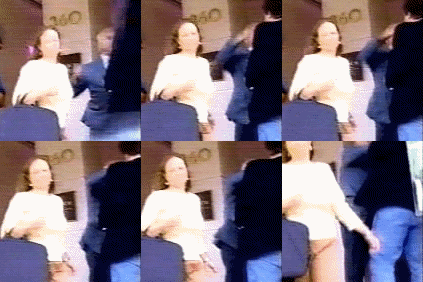 As Apollo 11 astronaut Buzz Aldrin leaves a speaking engagement in Beverly Hills, a self-proclaimed skeptic accosts him, demanding that the astronaut swear on the Bible that he actually went to the moon. With a Japanese news crew’s cameras rolling, Aldrin proceeds to punch the man in the face. The heckler and self-proclaimed “ambush journalist” tries to file assault charges, though police decide in Aldrin’s favor – especially since this is the third time the man has ambushed Aldrin with his theory that all of the Apollo flights to the moon were hoaxes.
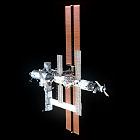 Space Shuttle Atlantis lifts off on the 111th shuttle flight, an 11-day construction mission to the International Space Station. Another major structural truss is assembled and attached, serving the primary function of radiating built-up waste heat away from the station and into space. Aboard Atlantis for her 26th flight are Commander Jeff Ashby, Pilot Pamela Melroy, and mission specialists David Wolf, Piers Sellers, Sandra Magnus and Fyodor Yurchikhin.
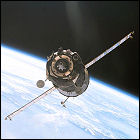 Russia launches a new variant of the venerable Soyuz spacecraft, Soyuz TMA-1, on a mission to the International Space Station. Cosmonauts Sergei Zalyotin and Yury Lonchakov and Belgian astronaut
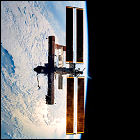 Space Shuttle Endeavour lifts off on the 112th shuttle flight, a two-week mission to resupply and exchange crews at the International Space Station. Another structural tress to dissipate excess heat into space is assembled and attached. Aboard Endeavour for her 19th flight are Commander James Wetherbee, Pilot Paul Lockhart, mission specialists Michael Lopez-Alegria and John Herrington, and ISS Expedition 6 crewmembers Kenneth Bowersox, Nikolai Budarin and Don Pettit. Returning to Earth aboard the shuttle are Expedition 5 crewmembers Valeri Korzun, Peggy Whitson and Sergei Treschev.
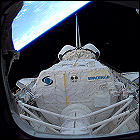 Space Shuttle Columbia lifts off for a scientific research mission with the SPACEHAB module – a successor to Spacelab – in its cargo bay, for a flight lasting almost 17 days. Columbia’s crew for this flight is Commander Rick Husband, Pilot Willie McCool, Payload Commander Michael Anderson, mission specialists Kalpana Chawla, David Brown and Laurel Clark, and payload specialist Ilan Ramon, the first Israeli astronaut. During liftoff, a piece of insulated foam is vibrated loose from the shuttle’s external fuel tank, causing critical damage to the leading edge of Columbia’s left wing. The foam collision is noticed and discussed internally at NASA, but is not deemed a threat by ground controllers.
 After nearly 17 days in orbit performing experiments in the SPACEHAB module its cargo bay, Space Shuttle Columbia deorbits to return to Earth for a planned landing at Kennedy Space Center in Florida. During reentry, a gaping hole in the leading edge of Columbia’s left wing – damage caused by a piece of foam shaken loose from the external fuel tank during liftoff – allows superheated plasma to leak into the shuttle’s superstructure, tearing the vehicle apart. The entire crew (Commander Rick Husband, Pilot Willie McCool, Payload Commander Michael Anderson, mission specialists Kalpana Chawla, David Brown and Laurel Clark, and payload specialist Ilan Ramon) is lost. At first, ground controllers are only aware of a series of sensor failures in the wing, followed by a loss of contact; ground-based cameras finally spot an expanding cloud of debris falling at supersonic speeds. As with the loss of Challenger in 1986, an extensive investigation and review of NASA procedures follows the loss of Columbia and her crew, resulting in a two-year grounding of the remaining shuttle fleet and a pause in construction of the International Space Station.
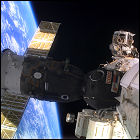 The seventh full-time crew of the International Space Station lifts off from Russia aboard Soyuz TMA-2, a drastic change from their original mission plan. Originally planned to be another short-term “ferry flight” to swap out the station’s Soyuz lifeboat vehicle, Soyuz became the only way to send full-time crews to the station during the post-Columbia-disaster grounding of the American shuttle fleet. Yuri Malenchenko and Ed Lu took up residence aboard the ISS for 184 days, returning in October 2003 with Spanish astronaut Pedro Duque. With the shuttle fleet landlocked, two-man ISS crews became the norm, as three-man crews relied on the greater resupply capacity of the shuttles.
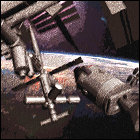 Last flown in the 1975 Apollo-Soyuz mission, the Apollo command/service module is – briefly – given strong consideration by NASA to serve as a “lifeboat” for the crew of the International Space Station, even to the point of conducting a study about un-mothballing the surviving unused Apollo hardware sitting in museums around the world. Part of the reason for this unusual study is that NASA’s budget has run out for finding a workable solution to keeping a “lifeboat” available to station astronauts in the anticipated long gap before the Space Shuttle’s return to service. Ultimately, even the seemingly unthinkable return of Apollo is nixed, since at least a Saturn IB booster would need to be similarly refitted – at huge expense – to lift a 30-year-old Apollo capsule into space.
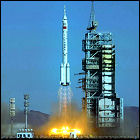 China becomes the third country to independently launch a crewed mission with the flight of Shenzhou 5, an orbital flight lasting almost 22 hours. Taikonaut Yang Liwei becomes the first Chinese citizen to leave Earth, though
 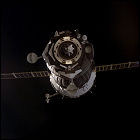 The eighth full-time crew of the International Space Station lifts off from Russia’s Baikonur Cosmodrome aboard Soyuz TMA-3. Alexander Kaleri and Michael Foale take up residence on the ISS for 194 days, both of them veterans of long-term stays aboard the Mir space station; arriving on the ISS with them for a ten-day stay is Spanish astronaut Pedro Duque, who returns to Earth aboard Soyuz TMA-2 with the Expedition 7 crew.
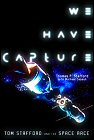 Smithsonian Books publishes General Thomas Stafford’s non-fictional memoir of his time in NASA, “
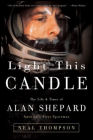 Crown Books publishes Neal Thompson’s non-fictional biography, “
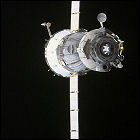 The ninth full-time crew of the International Space Station lifts off from Russia’s Baikonur Cosmodrome aboard Soyuz TMA-4. Gennady Padalka and Michael Fincke take up residence on the ISS for 187 days. Arriving with them on the ISS for a ten-day stay is Dutch astronaut Andre Kuipers, who returns to Earth aboard Soyuz TMA-3 with the Expedition 8 crew.
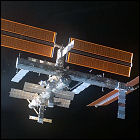 The three members of the Expedition 9 crew arrive on the International Space Station, and the station promptly loses one of its three gyroscopes, which keep the station aligned in orbit. According to NASA, the station can remain stable with only two of the gyroscopes operating, and even if a second one should fail, the thrusters of the newly-arrived Soyuz capsule can keep it aligned. Departing in their Soyuz vehicle will be Expedition 8 crewmembers Michael Foale and Alexander Kaleri, along with ESA astronaut Andrè Kuipers, who arrived with the Expedition 9 crew to perform a week’s worth of experiments. Manning the station for the next six months will be Commander Gennady Padalka and Flight Engineer Mike Fincke.
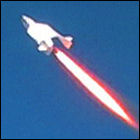 A joint venture between experimental aircraft designer Burt Rutan and investor/Microsoft co-founder Paul Allen, SpaceShip One becomes the first privately owned vehicle to cross the 100-kilometer boundary into space. It is one of several vehicles vying for the Ansari X Prize, a $10,000,000 competition to launch the first privately funded (in other words, not government-funded) space vehicle, even though this is considered one of its test flights and not a qualifying flight for the X Prize. Launched from an airplane “mothership” and dropped off seconds before its own rocket engine takes it into suborbital space, SpaceShip One nearly reaches Mach 3, and is already the first private aircraft to reach Mach 2. Pilot Mike Melvill becomes the first recipient of the Federal Aviation Administration’s commercial astronaut wings upon landing.
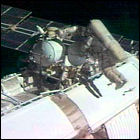 A risky spacewalk at the International Space Station is called off hurriedly, with astronaut Mike Fincke already through the open hatch. The oxygen container on Fincke’s spacesuit is the cause for concern, as mission controllers in Russia note that its pressure is rapidly dropping. Fincke and mission commander Gennady Padalka were en route to replace a circuit breaker, but due to a variety of other problems aboard the station they were exiting the station via the Russian-built airlock at the opposite end of the station from the breaker’s destination, requiring a 45-minute journey from one end of the station to the other. The spacewalk, rescheduled for a later date, will leave the station unoccupied with its entire crew outside for only the second time since the station became operational.
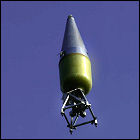 A team of Ansari X Prize hopefuls suffers a major setback when their vehicle, the Rubicon 1, explodes after liftoff in an unmanned test flight. According to Eric Meier, one of the designers of the Rubicon 1, the $20,000 vehicle cannot be recovered or repaired, but must be completely rebuilt. Meier and his team intend to build a new craft and continue vying for the X Prize, whose deadline is the end of 2004. Two other teams, one Canadian and one American, have already announced dates for their qualifying flights.
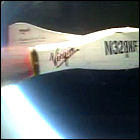 The first qualifying flight for the Ansari X Prize becomes a dangerous one for pilot Mike Melvill, as the experimental spacecraft SpaceShip One begins a rapid roll after its rocket engine ignites, sending the vehicle on a twisty trajectory into suborbital space. The vehicle reaches just under Mach 3, and still passes the altitude of 100 kilometers necessary to be considered a space flight (and to be considered a contender for the X Prize), but SpaceShip One must repeat the feat to win the $10,000,000 prize for launching the first privately funded spacecraft.
 Privately-owned experimental space vehicle SpaceShip One makes its second qualifying flight into suborbital space, exceeding Mach 3 (the first privately owned vehicle to do so) and reaching an altitude of 112 kilometers. Brian Binnie pilots SpaceShip One for its third trip into space and earns the second set of FAA commercial astronaut wings as a result. A fourth trip is considered, but then cancelled to avoid any damage to the history-making vehicle. By this point, Virgin has already hired SpaceShip One designer Burt Rutan to build SpaceShip Two, a suborbtial passenger spacecraft which will take paying customers into space as part of the company’s “Virgin Galactic” service, based on the design of SpaceShip One. Rutan and investor (and Microsoft co-founder) Paul Allen also claim the $10,000,000 Ansari X Prize.
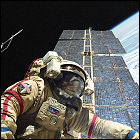 The tenth full-time crew of the International Space Station lifts off from Russia’s Baikonur Cosmodrome aboard Soyuz TMA-5. Salizhan Sharipov and Leroy Chiao take up residence on the ISS for 192 days. Arriving with them on the ISS for a nine-day stay is cosmonaut Yuri Shargin, who returns to Earth aboard Soyuz TMA-4 with the Expedition 9 crew.
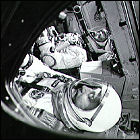 A veteran of the Gemini, Apollo and shuttle programs, 74-year-old astronaut John Young retires from NASA, capping off a 42-year career with the space agency. Young joined NASA in 1962 after hearing President Kennedy’s historic directive to launch a manned mission to the moon, and only three years later Young flew with Mercury veteran Gus Grissom on Gemini 3, the first manned two-person NASA mission. Young commanded Gemini 10 in 1966, was the command module pilot for the moon-orbiting Apollo 10 mission, and in 1972, Young commanded Apollo 16, landing in the moon’s mountainous Descartes region. Young commanded the first space shuttle mission, the maiden flight of Columbia in 1981, and commanded the ninth shuttle flight in 1983. Young had also served as the Chief Astronaut, determining crew assignments and making personnel decisions. In the wake of the Challenger disaster in 1986, Young became one of NASA’s most outspoken critics, and was reassigned to the position of special assistant for engineering, operations and safety – a move he regarded as a political one.