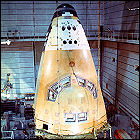
 Fearing that the relatively sleek, aerodynamic design of the still-unflown American Space Shuttle is a hint that the vehicle could see use as an orbital bomber, the Kremlin orders the creation of the Soviet Space Shuttle program, though work on the vehicle, codenamed Buran (“Snowflake”), is primarily a crash program within the country’s defense department rather than the civilian branch of its space program. Within months, it is concluded that Buran will closely copy the American shuttle design due to the soundness of its aerodynamic design.

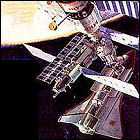 With work having started mere days earlier on Buran, a Soviet version of the American space shuttle design, the Soviet Union’s space agency is given new marching orders to create a new generation of space station hardware, based on the experience gained thus far with the four Salyut space stations and their associated Almaz military space hardware. A modular design is chosen, with multiple docking ports and multiple station components launched over a period of time, concepts which will be tested with yet-to-be-launched Salyut stations. Frequently fighting with the Buran shuttle development program for money and resources (despite the fact that the two spacecraft are expected to be compatible), this new station will not be launched until 1986, almost exactly ten years later, at which time it will be known as Mir.
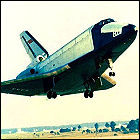 With its own jet engines freeing it from the need for a carrier aircraft, the Buran Analogue test vehicle – the Soviet equivalent of Space Shuttle Enterprise – makes its first approach and landing test, cutting off its jet engines at a predetermined altitude and gliding to an airstrip for a landing. The Buran Analogue will ultimately make more test flights than the Enterprise, continuing to conduct glider landings through 1988.
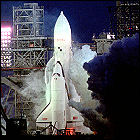 Modeled closely after the American Space Shuttle, the Soviet-built orbiter Buran lifts off for its first and only voyage into space. Still in the testing stages, Buran flies completely unmanned, with ground controllers at Baikonur Cosmodrome guiding the vehicle’s every move. With no large engines of its own (unlike NASA’s shuttle fleet), Buran is lifted into orbit solely by the giant Energia booster, makes two orbits, and returns home as a glider. A second flight is scheduled, but before it can take place, the Soviet Union collapses. Buran never flies again.
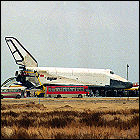 Russian President Boris Yeltsin brings an end to the secretive Soviet-era
 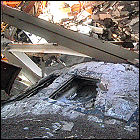 Stored in a hangar undergoing structural work at the Baikonur Cosmodrome in Kazakhstan, the Soviet-era
 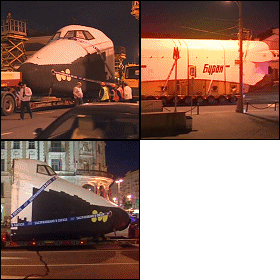 One of the last remaining prototypes of the Soviet-era Buran space shuttle is transported over land (and in pieces) from Gorky Park to an exhibition center in the center of Moscow to become part of an exhibit of Russian technological accomplishments. The unfinished Buran spaceframe had served numerous uses during its 30+ stay in Gorky Park, ranging from an impressive display piece to a diner (!).