
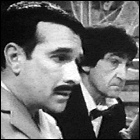
 The 223rd episode of Doctor Who airs on the BBC. Kevin Stoney guest stars as Tobias Vaughn, and Nicholas Courtney returns as the freshly-promoted Brigadier Lethbridge-Stewart, head of the newly created UNIT. This is the last Cybermen story until 1975.
This episode aired on the fifth anniversary of Doctor Who’s first broadcast.
This timeline entry leads to an entry covering this entire Doctor Who serial; there are plans to write new episodic entries in the future. You can support this effort!
Order Earl Green’s book VWORP!1 from theLogBook.com Store
 ABC airs the eighth episode of Irwin Allen’s sci-fi series Land Of The Giants, starring Gary Conway, Don Matheson, Deanna Lund, and Don Marshall.
  The
The 
 ABC broadcasts the 12th episode of the Filmation animated series Fantastic Voyage, based on the
  The
The 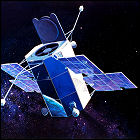 NASA launches the second Orbiting Astronomical Observatory satellite, given the nickname “Stargazer” after it successfully enters service. OAO-2 will remain in service for over four years, making significant contributions to the scientific understanding of comets and supernovae. Two separate experiments, including one designed and overseen by Dr. Fred Whipple, observe the sky in ultraviolet light from Earth orbit.
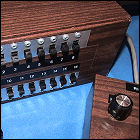 At Sanders Associates, Ralph Baer completes the sixth iteration of his recently-patented Television Gaming & Training Apparatus, now covered in brown woodgrain and called “The Brown Box.” Utilizing logic circuits and spot generators rather than a computer chip, the Brown Box is capable of playing video ping pong and other simple games. This is the prototype of the first mass-marketed home video game system. Sanders begins courting prospective licensees, including RCA, Zenith, General Electric, Motorola and Magnavox; companies already manufacturing television sets will be the corporate entites most likely to show an interest. RCA declines, but one of its executives, having seen the Brown Box demonstrated, later defects to Magnavox, which eventually licenses the Brown Box technology from Sanders. The result will be the Magnavox Odyssey, the first-ever home video game console.
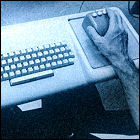 At the Fall Joint Computer Conference held at the San Francisco Convention Center, computer visionary Douglas Englebart demonstrates a collaborative computer system loaded down with groundbreaking technologies: the first computer mouse, driving a point-and-click object-oriented graphical user interface, bitmapped graphics, hypertext, real-time video conferencing, and a live networked collaborative space. Decades later, computer historians give this event – billed in the conference program as “a research center for augmenting human intellect” – a new name: the mother of all demos.
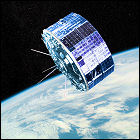 The recently-rechristened Environmental Sciences Service Administration launches, with the help of NASA, ESSA-8, the latest in a constellation of weather satellites operated by the former U.S. Weather Bureau. ESSA-8 is the first satellite in the ESSA constellation to boast a significant operational life span, watching Earth’s cloud patterns until it is shut down in 1976.
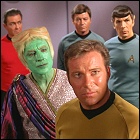 The
The 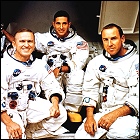 Moved ahead in the schedule due to ongoing difficulties with the construction of the lunar module, Apollo 8 lifts off from Cape Canaveral on a mission that represents NASA’s biggest gamble yet in the race for the moon: on only the second manned Apollo flight, astronauts Frank Borman, Jim Lovell and Bill Anders will go to the moon, orbit it in their command/service module, and return to Earth (the lunar module is still in the late stages of development). Mission planners plot out a free return trajectory – ensuring that without engines, Apollo 8 could loop around behind the moon and swing back toward home.
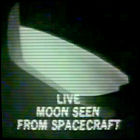 Broadcasting live black & white television pictures from lunar orbit on Christmas Eve, the crew of Apollo 8 delivers one of the most-watched broadcasts of 1968. As the surface of the moon rolls silently outside the windows of their command/service module, the astronauts take turns reading the first chapter of Genesis, dedicating it to “all of you on the good Earth.” After ten orbits of the moon, Apollo 8 fires its engine, putting it on a return trajectory to Earth; it splashes down safely three days later.
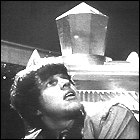 The
The 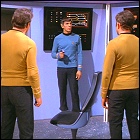 The
The  BBC2 airs the 26th episode of science fiction anthology series Out Of The Unknown. Adapted by Jack Pulman from a story by Robert Sheckley, the story stars Peter Copley. This episode, which opens the series’ third season and the tenure of incoming producer Alan Bromly, no longer exists in the BBC’s archives.