
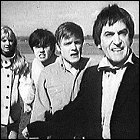
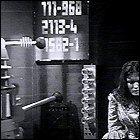
 British broadcaster ABC airs the 116th episode of the spy-fi series The Avengers, starring Patrick Macnee and Diana Rigg. Brian Blessed (Flash Gordon) and Charlotte Rampling (Zardoz) guest star.
More about The Avengers in the LogBook and theLogBook.com Store
 The
The 
 The 14th episode of Larry Cohen’s science fiction series The Invaders, starring Roy Thinnes and produced by Quinn Martin’s QM Productions, premieres on ABC. Robert Walker Jr. (Star Trek) guest stars.
 The 58th episode of Irwin Allen’s science fiction series Lost In Space premieres on CBS, starring Guy Williams, June Lockhart, and Jonathan Harris.
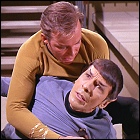 The
The 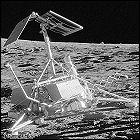 NASA’s robotic explorer
 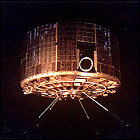 The recently-rechristened Environmental Sciences Service Administration launches, with the help of NASA, ESSA-5, the latest in a constellation of weather satellites operated by the former U.S. Weather Bureau. Though suffering from a few technical glitches and system failures, ESSA-5 remains in service until late 1968.
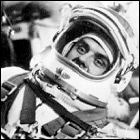 The first flight of the Soviet Union’s new manned space vehicle, Soyuz 1, lifts off from the Baikonur Cosmodrome. Though designed to accomodate a crew of three – and intended to be the answer to NASA’s Apollo command/service module in the ongoing race to reach the moon – the first Soyuz is flown by test pilot (and close friend of Yuri Gagarin) Vladimir Komarov. Though early plans for the mission involve a rendezvous and docking with a second Soyuz, only one vehicle is available for the mission, and it suffers a series of technical problems. Though aware of the faults in the Soyuz design, engineers have been pressured to put a manned Soyuz in orbit for political reasons.
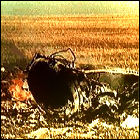 After a day in space aboard a spacecraft crawling with technical glitches, cosmonaut Vladimir Komarov orients the Soyuz 1 capsule for return to Earth. Though the vehicle survives reentry through Earth’s atmosphere, the main parachute fails to open, and the first Soyuz capsule returns to Earth at a speed of well over 100 miles per hour, killing Komarov instantly. The Soviet Union’s space program is stalled – much like the American Apollo program, postponed after the fatal Apollo 1 fire – well into 1968 as a result of the need to redesign Soyuz from the inside out.
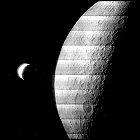 NASA’s fourth Lunar Orbiter satellite lifts off for its one-week trek to the moon. Placed into an orbit that takes it over the moon’s poles instead of its equator,
  The
The 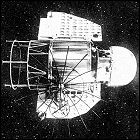 The Soviet Union launches Venera 4, a space probe dispatched to the planet Venus. Venera 4 is equipped with a landing probe which it deposits into the planet’s dense atmosphere in October, and the probe’s findings stun scientists on Earth who had long considered Venus a near-twin of Earth: the atmosphere is predominantly carbon dioxide, with minimal oxygen and a pressure nearly 100 times Earth’s atmospheric pressure at sea level. The temperature within the Venusian atmosphere is found to soar past 800 degrees Fahrenheit, presenting a challenge for designers of the next round of vehicles to visit the planet. The Venera 4 landing probe is not equipped with cameras, and contact is lost with it before contact is made with the ground.
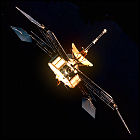 A near-identical twin of NASA/JPL’s unmanned Mariner 4 Mars probe, Mariner 5 lifts off en route to the planet Venus. Though the space probe’s architecture is similar to that of Mariner 4, Mariner 5 is modified to include solar shades to keep parts of the spacecraft cool, a problem which doesn’t exist at Mars. Mariner 5 takes almost exactly four months to reach Venus.
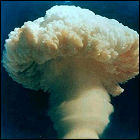 The People’s Republic of China conducts a nuclear weapons test under the nondescript code name Test No. 6, which is in fact China’s first thermonuclear (hydrogen) bomb test. Dropped by an aircraft, Test No. 6 has a yield of 3.3 megatons. For context, China had conducted its first nuclear test barely three years earlier.