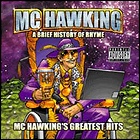
 The “MC Hawking” album A Brief History Of Rhyme is released.

Earl Green is the creator, curator, and head writer of theLogBook.com.
The “MC Hawking” album A Brief History Of Rhyme is released.
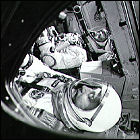 A veteran of the Gemini, Apollo and shuttle programs, 74-year-old astronaut John Young retires from NASA, capping off a 42-year career with the space agency. Young joined NASA in 1962 after hearing President Kennedy’s historic directive to launch a manned mission to the moon, and only three years later Young flew with Mercury veteran Gus Grissom on Gemini 3, the first manned two-person NASA mission. Young commanded Gemini 10 in 1966, was the command module pilot for the moon-orbiting Apollo 10 mission, and in 1972, Young commanded Apollo 16, landing in the moon’s mountainous Descartes region. Young commanded the first space shuttle mission, the maiden flight of Columbia in 1981, and commanded the ninth shuttle flight in 1983. Young had also served as the Chief Astronaut, determining crew assignments and making personnel decisions. In the wake of the Challenger disaster in 1986, Young became one of NASA’s most outspoken critics, and was reassigned to the position of special assistant for engineering, operations and safety – a move he regarded as a political one.
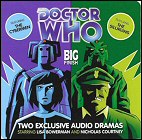 Big Finish releases a free CD with two audio dramas, one of them a stand-alone Bernice Summerfield adventure and the other a prelude to the upcoming UNIT audio series featuring Nicholas Courtney as the Brigadier, attached to the cover of Doctor Who Magazine issue #351. Both audio stories are later made available on the Big Finish website.
Big Finish releases a free CD with two audio dramas, one of them a prelude to the upcoming UNIT audio series and the other a stand-alone Bernice Summerfield adventure featuring the Cybermen, attached to the cover of Doctor Who Magazine issue #351. Both audio stories are later made available on the Big Finish website.
 Big Finish Productions releases a bonus Doctor Who audio drama starring Colin Baker. (This title was initially exclusive to Big Finish’s subscription program, as an incentive for those whose subscriptions included The Next Life.)
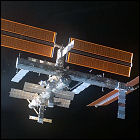 NASA orders the crew of the International Space Station to cut back on meals. Without the Space Shuttle delivering supplies to the station, resupply missions have been flown only by Russia’s much smaller unmanned Progress capsules, but the station was never designed to be restocked by Progress alone. Astronaut Leroy Chiao and cosmonaut Salizhan Sharipov are ordered to cut back on calories – with a reduction in workload to match – until more food arrives on a Progress capsule scheduled for liftoff on Christmas Eve. A failure of that flight could lead to an order to abandon the station.
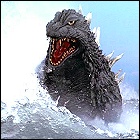 Toho releases the 29th Godzilla movie, Godzilla: Tokyo S.O.S..
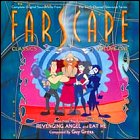 La-La Land Records releases the first soundtrack CD in the Farscape Classics series. The limited edition CD contains Guy Gross’ music from the episodes Revenging Angel and Eat Me.
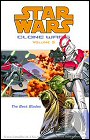 Dark Horse Comics publishes the fifth trade paperback collection of its Star Wars: Clone Wars comics, The Best Blades.
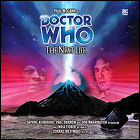 Big Finish Productions releases the 64th Doctor Who audio drama in its main monthly range, starring Paul McGann and India Fisher.
 MJTV releases The Actor Speaks: Paul Darrow, a CD featuring interviews with the former Blake’s 7 star, dramatic readings, and a new short audio play in the universe of the Kaldor City audio dramas.
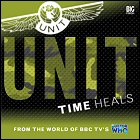 Big Finish Productions releases the first U.N.I.T. audio drama, a Doctor Who audio spinoff featuring Nicholas Courtney as Brigadier Lethbridge-Stewart leading a new cast of characters.
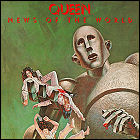 Renowned SF artist (and 11-time Hugo winner) Frank Kelly Freas dies at the age of 82. Perhaps best known to the general public for his painted cover art that adorned Mad Magazine from 1955 through 1962, “Kelly” Freas painted the cover art for such pulp SF magazines as Planet Stories, Science Fiction Quarterly, Weird Tales and especially Analog, to which he contributed cover art many times over five decades. He painted book covers for the works of Arthur C. Clarke, Joe Haldeman, A.E. Van Vogt, Isaac Asimov, Robert Heinlein, Ray Bradbury, Frederik Pohl, Poul Anderson and Ursula Le Guin, among others. He was commissioned by the crew of the first Skylab mission to design their mission patch, and painted the cover of the hit album News Of The World for the rock group Queen.
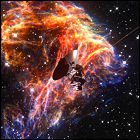 Launched ahead of its identical twin, Voyager 1, in 1977, NASA’s Voyager 2 spacecraft surpasses its 10,000th day in deep space. At 11 billion miles from Earth, Voyager 2 is one of the most distant human-made objects in space, surpassed only by Voyager 1. Both Voyagers are expected to function well into the 2020s, and are expected to have left the solar system to enter interstellar space by then.
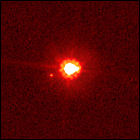 Astronomers at Palomar Observatory discover a body beyond Neptune’s orbit that initial observations show is larger than Pluto. Eris is quickly dubbed the tenth planet by the media and the scientific community, and it is later found to have a small moon of its own in a close orbit, which is later named Dysnomia. But events overtake Eris and Dysnomia before the science textbooks have a chance to be rewritten to include a tenth planet: Eris becomes a case study in an ongoing debate within the International Astronomical Union about the definition of a planet. In 2006, the IAU will establish a set of parameters which determine that Eris isn’t a planet – and then rewrites the history books by deciding that Pluto isn’t either.
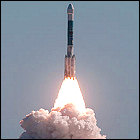 After months of delays in development of its elaborate guidance software system, NASA’s Deep Impact unmanned space probe is launched on a mission to intercept, and fire an impactor into, Comet Tempel 1 half a year later. In order to catch up with the comet, Deep Impact is lofted into orbit by a Delta II rocket, which puts the spacecraft on a precise course at a speed of roughly 64,000mph. Deep Impact will fire the impactor into the comet in July to study the distribution and composition of the debris scattered by the resulting impact.
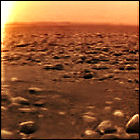 The European Space Agency’s Huygens probe successfully lands on Saturn’s largest moon, Titan, gathering measurements and taking mind-boggling images from the sky all the way down to the surface. Perhaps the biggest discovery of the initial pictures is an aerial view of what appear to be tributaries leading to a large body of liquid – an almost delta-like region as viewed from the sky. (Thanks to Titan’s thick atmospheric haze, its surface has never before been seen.) Huygens itself manages to touch down on dry land, on a plain scattered with chunks of ice, slowed to only 15 miles per hour by parachutes during its descent (despite upper-level winds estimated at around 300mph). Even if Huygens had splashed down in a body of liquid, the probe is designed to stay afloat.
 The 84th episode of the prequel spinoff Star Trek: Enterprise airs on UPN.
 Sci-Fi channel airs the second episode of Ronald D. Moore’s re-imagining of Battlestar Galactica.
 The 164th episode of Stargate SG-1 airs on the Sci-Fi Channel, starring Richard Dean Anderson, Amanda Tapping, Michael Shanks, and Christopher Judge.
 Sci-Fi Channel airs the tenth episode of Stargate Atlantis. Robert Davi guest stars in the second half of a two-part story.
 The 85th episode of the prequel spinoff Star Trek: Enterprise airs on UPN.
 Sci-Fi channel airs the third episode of Ronald D. Moore’s re-imagining of Battlestar Galactica. Richard Hatch, who played Apollo in the original series, makes his first appearance as political agitator Tom Zarek (and plays most of his scenes against Jamie Bamber, the new series’ Apollo). Brent Stait (Andromeda) also guest stars.
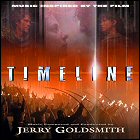 Varese Sarabande releases Jerry Goldsmith‘s rejected score for the movie Timeline, a movie that ultimately hit theaters with a score by Brian Tyler.
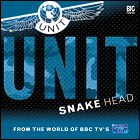 Big Finish Productions releases the second U.N.I.T. audio drama, a Doctor Who audio spinoff.
The 165th episode of Stargate SG-1 airs on the Sci-Fi Channel, starring Richard Dean Anderson, Amanda Tapping, Michael Shanks, and Christopher Judge. Claudia Black (Farscape) guest stars.
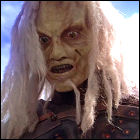 Sci-Fi Channel airs the 11th episode of Stargate Atlantis.
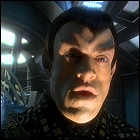 The 86th episode of the prequel spinoff Star Trek: Enterprise airs on UPN. Jeffrey Combs guest stars.
 Sci-Fi channel airs the fourth episode of Ronald D. Moore’s re-imagining of Battlestar Galactica.
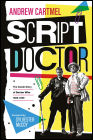 Former Doctor Who script editor Andrew Cartmel’s memoir, Script Doctor: The Inside Story of Doctor Who, 1986-1989, is published.