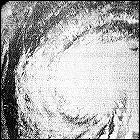
 NASA and the United States Weather Bureau launch the third experimental TIROS weather satellite, TIROS-3. Further refinements to the basic TIROS satellite system are made, but one of the satellite’s two television cameras fails within days of going into service. TIROS-3 proves the future life-saving potential of weather satellites by giving Earthbound meteorologists advance warning of the formation and strengthening of Hurricane Esther well before it makes landfall on the east coast of the United States. TIROS-3 is operational for less than a year.

 CBS broadcasts the 14th and final episode of the anthology series ‘Way Out, hosted by author Roald Dahl. With ratings steadily falling, and network production shifting from New York to Hollywood, the series has reached its end.
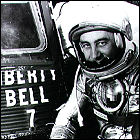 The second American in space is Virgil “Gus” Grissom, pilot of the Mercury 4 capsule Liberty Bell 7. Like Alan Shepard’s flight, Grissom’s launch reaches an altitute of 118 miles and splashes down 15 minutes later, but mechanical problems with the explosive bolts to release the capsule’s hatch allow water into the vehicle. Grissom has to bail out at sea, wearing a spacesuit that’s rapidly taking on water, while Liberty Bell 7 sinks to the bottom of the Atlantic. Grissom weathers repeated accusations that he manually blew the hatch and caused his vehicle to sink, a claim which is later disproven.
 The 19th episode of Sydney Newman’s spy series The Avengers, starring Ian Hendry and Patrick Macnee, airs on UK broadcaster ABC. This episode is now missing from the archives, but will be recreated in audio form in the 21st century by Big Finish Productions.
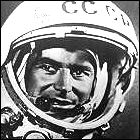 The Soviet Union launches its second manned spacecraft, Vostok 2, with cosmonaut Gherman Titov aboard. This mission sets a new space endurance record, with Titov spending just over one day in orbit, circling Earth 17 times in the process. Later accounts show that it’s not a pleasant day in orbit: Titov is reportedly the first sufferer of space sickness, vomiting in the cabin of his Vostok capsule.
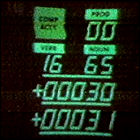 The first government contract is issued in the Apollo lunar landing program, as MIT lands the contract to develop the guidance and navigation computer at the heart of the Apollo vehicles. For its day, MIT designed one of the most robust computers that early ’60s technology could squeeze into such a small space; modern digital watches are far more powerful than that computer. The same computer system will be installed in both the command module and the lunar module.
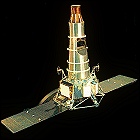 NASA launches the Ranger 1 lunar probe, designed to test a new vehicle configuration to reach the moon, transmitting pictures back to Earth as it falls toward impact on the lunar surface. The Agena second stage rocket designed to push Ranger 1 into a much higher orbit to escape Earth’s gravity fails, and Ranger 1 falls back into Earth’s atmosphere, disintegrating eight days after launch. This is the first of a series of setbacks for the troubled Ranger program.
 The 66th episode of Rod Serling’s The Twilight Zone airs on CBS. Elizabeth Montgomery and Charles Bronson star in the third season premiere.
 The first episode of the British science fiction series A For Andromeda, created and written by John Elliot and astronomer Fred Hoyle, premieres on the BBC, starring Esmond Knight and Julie Christie. Despite being considered a seminal early British science fiction series, much of A For Andromeda, including this episode, no longer exists in the BBC’s archives.
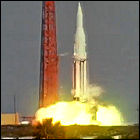 An unmanned Saturn I rocket is launched, the first practical demonstration of the multiple-engine design which has already been earmarked for future Apollo missions to the moon. Designed by expatriate German rocket engineer Werhner von Braun, the Saturn I is the first iteration of a family of heavy-lift rockets that will include the Saturn IB and the Saturn V; in this configuration, the Saturn I is the first stage of a Saturn V with no second stage.
 The Soviet Union detonates the most powerful thermonuclear weapon built to date, code-named AN602, or, more informally, “Tsar Bomba”. Though it’s designed to deliver a yield of 100 megatons, the 27-ton device is only fueled enough to produce a 50-megaton explosion, still enough to be detected by other nations. (A U.S. reconnaissance aircraft is close enough to witness the detonation, so the test is hardly a secret to the western world.) The detonation registers on seismic sensors, and interferes with radio transmissions nearby for nearly an hour; the explosion is visible as far away as Norway and Alaska. Due to modifications made to avoid endangering the Soviet population, fallout is minimal, though that might not be the case were the weapon to be deployed offensively.