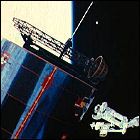
 Space Shuttle Discovery lifts off on a mission to deliver three communications satellites to orbit. The triple payload includes SYNCOM IV-4, the Australian AUSSAT-1 satellite, and American Satellite Company’s ASC-1. Discovery is manned on this mission by Commander Joe Engle, Pilot Richard Covey, and mission specialists James van Hoften, John Lounge and William Fisher. The mission lasts one week, and Discovery is able to return home a day early after achieving mission objectives ahead of time.

 MCA Records releases the
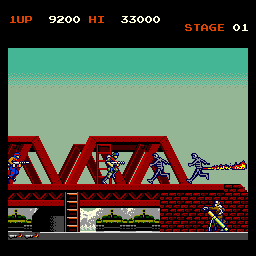 Konami introduces the arcade game
  ABC broadcasts the
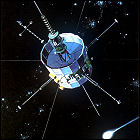 The International Cometary Explorer satellite – originally launched as International Sun-Earth Explorer 3 in 1978 – reaches the culmination of a series of complex orbital changes: a flyby of Comet Giacobini-Zinner, within 5,000 miles of the nucleus, primarily to sample and study the comet’s plasma tail and the interaction between that and the solar wind. ISEE-3 was not equipped with cameras at launch, so no imagery of the comet is obtained. The success of this flyby emboldens mission planners who hope to send it onward to study Halley’s Comet early in 1986, as part of a backup plan to use existing NASA spacecraft to study Halley in lieu of a specialized vehicle that would’ve been launched by space shuttle in 1986 (cancelled in the wake of the Challenger disaster).
 ABC broadcasts the
  Origin Systems releases the
  Warner Bros. Records releases the
 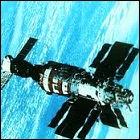 The Soviet Union launches the Soyuz T-14 mission, carrying a crew of three cosmonauts intended to become the next long-term occupants of space station Salyut 7. The crew consists of Vladimir Vasyutin, Georgi Grechko and Alexander Volkov, though Grechko only remains until September 26th, returning to Earth with the Soyuz T-13 crew. Two months into the crew’s stay on Salyut, however, Vasyutin becomes seriously ill. Communications between the station and ground controllers are carried out on a scrambled frequency for a week, at which point the crew is recalled to Earth, ending an occupancy that was meant to last for half a year. Soyuz T-14 returns to Earth, carring Vasyutin, Volkov and Soyuz T-13 crew member Viktor Savinykh home on November 21st, once again leaving Salyut 7 unoccupied for several months.
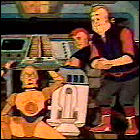 ABC broadcasts the
 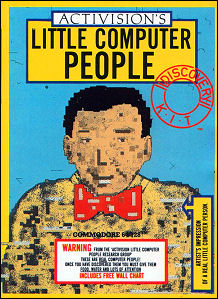 Electronic Arts releases
 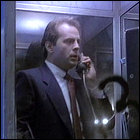 CBS airs the
 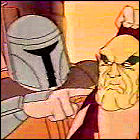 ABC broadcasts the
  The
The  The Minnesota Educational Computing Corporation releases
  The unmanned Kosmos 1686 module, launched by the Soviet Union in September, successfully completes an automated docking with space station Salyut 7. This new module is a permanent addition to the final Salyut station, offering more habitable space for work and storage aboard the aging station. Kosmos 1686 arrives with nearly 10,000 pounds of supplies and consumables, and serves as a case study to help engineers plan the upcoming Mir space station, which is designed from the outset to consist of several add-on modules.
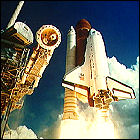 The inaugural flight of Space Shuttle Atlantis takes the newest orbiter on a four-day Defense Department mission (the specifics of which remain classified). Manning Atlantis for this flight are Commander Karol Bobko, Pilot Ronald Grabe, and mission specialists David Hilmers, Robert Stewart and William Pailes.
 The first episode of James D. Parriott’s lighthearted sci-fi series, Misfits Of Science, premieres on NBC, starring Dean Paul Martin, Kevin Peter Hall (Predator, Harry And The Hendersons), and Courteney Cox (Friends, Scream, Cougar Town). Larry Linville (M*A*S*H) guest stars.
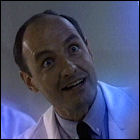 CBS airs the
 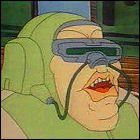 ABC broadcasts the
 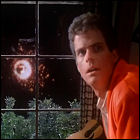 The
The  CBS airs the third episode of a revival of Rod Serling’s The Twilight Zone. Eric Bogosian, Lorna Luft, and Jeffrey DeMunn star in three short stories.
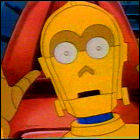 ABC broadcasts the
 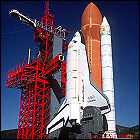 With $4 billion having been spent on upgrading and customizing a special launch facility since 1972 to handle (mostly military)
 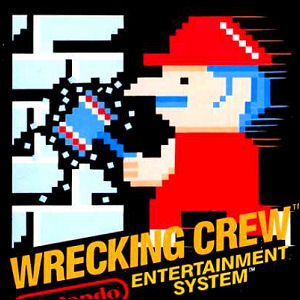 Nintendo releases
 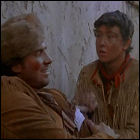 The
The