 No sooner has Paramount’s movie arm axed Star Trek‘s big screen comeback than the studio’s television division announces the unthinkable: Paramount will form its own network, to premiere in February 1978, taking on ABC, CBS, and NBC in prime time. Leading off the new network’s first night will be a two-hour, made-for-TV Star Trek movie starring William Shatner and most of the original cast (with Leonard Nimoy notable by his absence), who will then go on to star in a weekly series chronicling the further adventure of the Enterprise. Gene Roddenberry will return as the creator of the new series. But within just a few weeks, it becomes apparent that the “big three” networks are ready to play hardball to keep Paramount’s network off the air, from leaning on their advertisers to avoid buying ad time on the new network, to quietly threatening to stop picking up Paramount-produced series for their own fall schedules.

 The sixth episode of children’s fantasy series King Of The Castle is broasdcast on HTV. The series is created by Bristol-based writers Bob Baker and Dave Martin (Sky, Doctor Who), and stars Philip Da Costa. Talfryn Thomas (Survivors) and Milton Johns (Doctor Who, The Empire Strikes Back) also star.
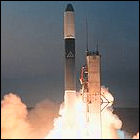 The second in a new generation of geosynchronous weather satellites is launched for the National Oceanic & Atmospheric Administration, GOES-2. An acronym for Geostationary Operational Environmental Satellite, GOES-2 is initially positioned at a point over 60 degrees west longitude on Earth, though it will be repositioned several times in its career as a weather satellite. In 1993, it will cease weather monitoring operations and will act chiefly as a communications satellite serving islands in the Pacific Ocean, as well as manned research facilities in Antarctica. GOES-2 will serve that function through 2001.
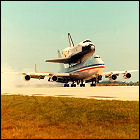 Mounted on the back of Boeing 747, the Space Shuttle Enterprise takes off on its first crewed flight, the first of three “captive-active” flights which see Enterprise remain in place on its carrier aircraft. For the first time, Enterprise’s computers, avionics and other flight systems are powered up in a full-up, hour-long dress rehearsal of an eventual free-flight landing test at 15,000 feet. The first crew of the Space Shuttle Enterprise consists of astronauts Fred Haise and Gordon Fullerton.
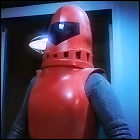 NBC premieres the two-hour TV movie

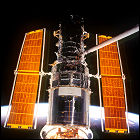 Congress approves the largest NASA budget in ten years, including authorization and funding for two major unmanned spacecraft: a Space Telescope to be deployed into Earth orbit via Space Shuttle, and a yet-to-be-named Jupiter orbiter and atmospheric probe, originally proposed in the late 1960s as part of the outer planets Grand Tour mission plan. The Jupiter probe, which must be ready to launch in 1982 to take advantage of a planetary configuration providing the shortest distance between Earth and Jupiter, is the subject of a fierce budget fight in Congress. (This spacecraft will go on to be named Galileo.)
 UK broadcaster Anglia TV (later part of ITV) premieres the TV movie
  The
The 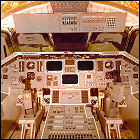 Riding the back of a modified Boeing 747, Space Shuttle Enterprise ascends to 22,000 feet for her second “active-captive” test flight, with all systems powered up and a crew aboard (astronauts Joe Engle and Richard Truly). The combined vehicle reaches speeds of over 300 miles per hour, and angles for “dropoff” – for upcoming test flights in which the Enterprise will actually separate from the 747 and glide to its landing strip – are studied for future reference.
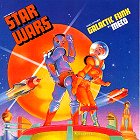 Casblanca Records releases
 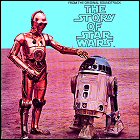 20th Century Fox Records releases
 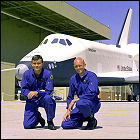 Space Shuttle Enterprise takes off – on the back of a Boeing 747 – for the last of its “active-captive” flights, with a crew aboard and all systems powered up. For this final test flight prior to the first free-flight landing test mere weeks away, Enterprise is again crewed by astronauts Fred Haise and Gordon Fullerton, and reaches an altitude of 30,000 feet.
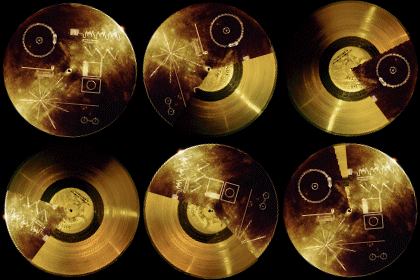 With less than a month to go before the launch of the first of two Voyager unmanned spacecraft, NASA attaches copper phonograph records, encased in lightweight, protective golden casings, to each of the Voyager probes. With participation from Carl Sagan (who led the effort to mount a plaque on the Pioneer probes consisting only of visual information), SETI pioneer Frank Drake, Jon Lomberg and others, the 12″ LP consists of not only sound recordings, but photos and diagrams depicting the diversity and composition of life on Earth. The sounds include various kinds of Earth wildlife, spoken messages from President Jimmy Carter and United Nations Secretary-General Kurt Waldheim, music from Beethoven and Bach to Chuck Berry (the Beatles decline permission to include “Here Comes The Sun”), and Carl Sagan’s young son Nick delcaring “Greetings from the children of planet Earth.” The outer casing includes a playback mechanism and diagrams for how to use it.
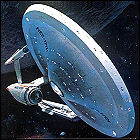 At a meeting at Paramount, studio head Michael Eisner formally cancels plans for a
  The
The 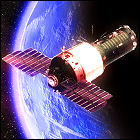 The Soviet-launched Salyut 5 military space station tumbles out of its orbit, having exhausted the fuel needed to keep it in a controlled orbit of the Earth. The two-ton space station burns up on re-entry, having been visited by only two crews; another mission to Salyut 5 had been planned, but its fuel depletion made that flight too risky to undertake.
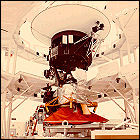 Mere weeks before the launch of the first Voyager spacecraft, NASA swaps Voyager 2 and Voyager 1. Repeated failures have plagued the attitude and articulation control and flight data subsystems in the spacecraft designated VGR77-2, leaving mission planners with doubt about its flightworthiness. VGR77-3 thus becomes Voyager 2, and VGR77-2 undergoes repairs to correct its problems before being designated Voyager 1. The two vehicles’ thermonuclear power sources are swapped, as whichever one is Voyager 2 will require a longer-lasting power source to power all instruments for possible visits to Uranus and Neptune following the 1981 Saturn encounter. (A third vehicle, VGR77-1, is an engineering test spare which eventually goes on display at the JPL campus in Pasadena.)
 The
The 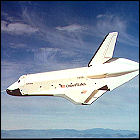 Released from its 747 Shuttle Carrier Aircraft in mid-air for the first time, and airborne on its own for the first time, the Space Shuttle Enterprise takes wing over the dry lake bed at Edwards Air Force Base for a test landing. With no engines on board (a test shuttle that will never go into orbit, Enterprise isn’t equipped with them) and only one shot at a safe landing, Enterprise successfully touches down on the runway after a flight lasting only a few minutes, validating the unpowered approach method of landing a shuttle just returned from space.
 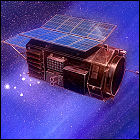 NASA launches the first High Energy Astronomy Observatory satellite in Earth orbit, continuing the survey of the sky with sensitive detectors designed to find gamma ray and X-ray sources. HEAO-1 will remain in service through January 1979, and will re-enter Earth’s atmosphere in March 1979.
 Mercury Records releases
 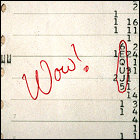 Radio astronomers at Ohio State University observe a signal from the direction of the constellation Sagittarius that seems to jump out from the usual cosmic background noise. The 72-second signal is quickly dubbed the “Wow Signal” (thanks to a hastily scribbled note), and is considered by some to be a strong candidate for a message from an extraterrestrial civilization since its frequency falls almost exactly on the hydrogen line of the electromagnetic spectrum, a wavelength closely watched by the SETI program. But more powerful telescopes listening in on the same region of space in the years and decades to come pick up no further signals. Scientists involved in the initial analysis later admit that the “message” may be of Earthly origin, reflected back from an object in space.
 NBC airs the seventh episode of Quinn Martin’s horror/sci-fi anthology Tales Of The Unexpected. (This series is not to be confused with the longer-lived British series of the same name, created by acclaimed author Roald Dahl.) Joanna Pettet and Gary Collins (The Sixth Sense) guest star. (The series has already been cancelled at this point; NBC is burning off the remaining episodes into off-season time slots.)
 The
The 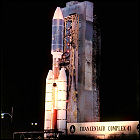 NASA launches Voyager 2 (weeks ahead of Voyager 1), giving the unmanned space probe the best shot of taking advantage of a favorable planetary alignment known as the “Grand Tour”. Using a series of carefully calculated gravity assists, Voyager has the potential to visit all four of the major outer gas planets – Jupiter, Saturn, Uranus and Neptune – in under 15 years without having to expend fuel to make the trip. If Voyager 2 survives long enough to visit Uranus or Neptune, it will become the first man-made spacecraft to visit either planet.
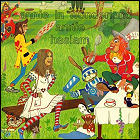 Sire Records releases
 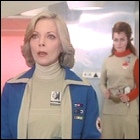 The
The 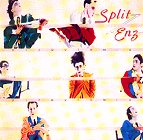 Mushroom Records releases the third Split Enz album,