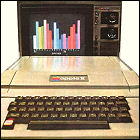
 Apple Computer introduces the Apple II home computer system, a pre-built 4K computer (with an optional upgrade to 48K) capable of displaying color graphics on a TV or monitor, and storing programs on either cassette or floppy disk. The computer ships with an implementation of BASIC written by Steve Wozniak, with an optional pair of paddle controllers for games. The system also has an open architecture, with space for expansion cards (and no restriction on what cards can be developed, or by whom).

 The fifth episode of children’s fantasy series King Of The Castle is broasdcast on HTV. The series is created by Bristol-based writers Bob Baker and Dave Martin (Sky, Doctor Who), and stars Philip Da Costa. Talfryn Thomas (Survivors) also stars.
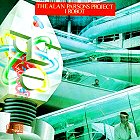 The Alan Parsons Project releases its second album,
 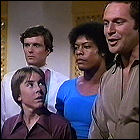 The
The 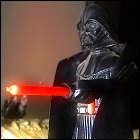 The unexpected runaway success of a dark horse in the summer movie race makes for a mad dash for the toy rights. The winner of that race is Kenner Products, the toy division of cereal maker General Mills, and the prize is the exclusive license to market toys and other products based on Star Wars. Prior to the movie’s release, however, George Lucas has convinced 20th Century Fox to allow him to keep all toy licensing rights, meaning that ongoing licensing payments are made directly to Lucas, providing him with the lion’s share of his future wealth. Kenner executive Bernard Loomis finds himself fighting to convince his own sales team that this movie will attract more than a momentary audience. With the late start and the long lead time on design, tooling and manufacture, Loomis concocts an audacious marketing scheme involving an “empty box” available by Christmas.
 No sooner has Paramount’s movie arm axed
 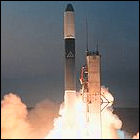 The second in a new generation of geosynchronous weather satellites is launched for the National Oceanic & Atmospheric Administration, GOES-2. An acronym for Geostationary Operational Environmental Satellite, GOES-2 is initially positioned at a point over 60 degrees west longitude on Earth, though it will be repositioned several times in its career as a weather satellite. In 1993, it will cease weather monitoring operations and will act chiefly as a communications satellite serving islands in the Pacific Ocean, as well as manned research facilities in Antarctica. GOES-2 will serve that function through 2001.
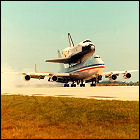 Mounted on the back of Boeing 747, the Space Shuttle Enterprise takes off on its first crewed flight, the first of three “captive-active” flights which see Enterprise remain in place on its carrier aircraft. For the first time, Enterprise’s computers, avionics and other flight systems are powered up in a full-up, hour-long dress rehearsal of an eventual free-flight landing test at 15,000 feet. The first crew of the Space Shuttle Enterprise consists of astronauts Fred Haise and Gordon Fullerton.
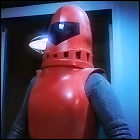 NBC premieres the two-hour TV movie
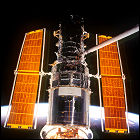 Congress approves the largest NASA budget in ten years, including authorization and funding for two major unmanned spacecraft: a Space Telescope to be deployed into Earth orbit via Space Shuttle, and a yet-to-be-named Jupiter orbiter and atmospheric probe, originally proposed in the late 1960s as part of the outer planets Grand Tour mission plan. The Jupiter probe, which must be ready to launch in 1982 to take advantage of a planetary configuration providing the shortest distance between Earth and Jupiter, is the subject of a fierce budget fight in Congress. (This spacecraft will go on to be named Galileo.)
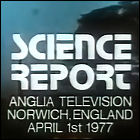 UK broadcaster Anglia TV (later part of ITV) premieres the TV movie
 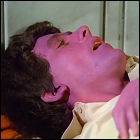 The
The 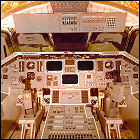 Riding the back of a modified Boeing 747, Space Shuttle Enterprise ascends to 22,000 feet for her second “active-captive” test flight, with all systems powered up and a crew aboard (astronauts Joe Engle and Richard Truly). The combined vehicle reaches speeds of over 300 miles per hour, and angles for “dropoff” – for upcoming test flights in which the Enterprise will actually separate from the 747 and glide to its landing strip – are studied for future reference.