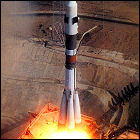
 The Soviet Union launches cosmonauts Boris Volynov and Vitaly Zholobov aboard Soyuz 21, the first mission to the newly-orbited Salyut 5 military space station. Though a few scientific experiments are conducted, most of the crew’s activities involve military surveillance of Earth. The crew’s stay is intended to last as long as two months, though an emergency aboard the station will cut that stay short.

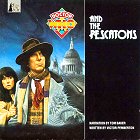 Argo Records
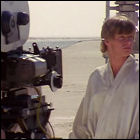 After grueling location shooting in Tunisia and lengthy studio filming at Elstree Studios in England, principal photography wraps up on George Lucas’
 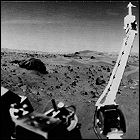 Viking 1 makes a soft landing on Mars, the first spacecraft to do so intact (the Soviet space program had been attempting to put landers on Mars, some of them including rudimentary rovers, since 1962). It successfully transmits the first picture from the Martian surface back to Earth within seconds, and successfully gathers soil samples for analysis. Viking 1’s orbiter mothership will later shut down in 1980, but the lander itself functions until 1982. Viking 1’s landing takes place on the seventh anniversary of the first manned moon landing.
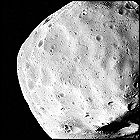 The Viking 1 orbiter, observing Mars from orbit while relaying data from the Viking 1 lander to Earth, snaps a close-up view of the Martian moon Phobos from within 5,000 miles. Though more distant from Phobos than Mariner 9’s closest pass in 1972, the Viking cameras are vastly superior, revealing greater detail even at greater distances; craters as small as 13 miles across can be seen in the images. JPL scientists and mission planners are already developing ideas for future Mars missions, including unmanned landers with wheeled rovers.
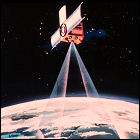 NASA and the National Oceanic & Atmospheric Administration launch NOAA-5, a weather satellite intended to operate in a near-polar low Earth orbit. Within two weeks of its launch, NOAA-5 proves instrumental in tracking Hurricane Belle, a category 1 hurricane, as it approaches and makes landfall in the northeastern United States. NOAA-5 will operate without any major malfunctions through July 1979.