
 Midway releases the arcade video game Pac-Land, a game placing Pac-Man in a side-scrolling 2-D world similar to that of Super Mario Bros.
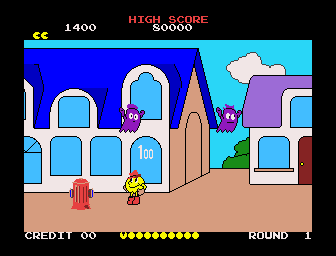 The Game: In a total break with any and all previous Pac-Man games, Pac-Land puts the yellow one onscreen as a very good homage to the Hanna-Barbera Saturday morning cartoon based on the original game, complete with the show’s bubbly theme song. You wander down the streets of Pac-Land, avoiding those nasty Ghost Monsters and hoping to find Power
  Pellets, all before your time runs out for that phase of your journey. Ghost Monsters may attack from the ground, or try to bomb you from the air; either way, chomping a Power Pellet will relieve them of their altitude and put them on the run. You may have to jump over them or duck under them until then – and be very careful in the forest, where Ghost Monsters may lurk behind trees. (Bally/Midway [under license from Namco], 1984)
Memories: It may have been well-drawn and animated, but Pac-Land really stuck out like a sore thumb to me – in hindsight, it was more like Super Mario Bros. than Pac-Man. Still, for those few of us who initially liked the Saturday morning cartoon, this game was a lovingly crafted valentine to the TV version of Pac-Man – a very roundabout example of a video game inspired by a licensing spin-off inspired by a video game.
 Humorously enough, at the end of each phase, Pac-Man stopped and panted near a “Break Time” sign on the outskirts of town, apparently unleashing a Tinkerbell-ish fairy from underneath his hat. In the background, a church can be seen. Perhaps this means that Pac-Man must adhere to the same rules as Highlander’s Immortals – no combat on holy ground!
A Phosphor Dot Fossil examined by Earl Green