
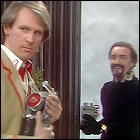
 The 576th episode of Doctor Who airs on BBC1. Anthony Ainley appears as the Master; Nigel Stock also guest stars in a story shot in and around a real Concorde supersonic jetliner.
 The authorities at Heathrow Airport are suspicious when a Police Box appears in their terminal within moments of the disappearance of a Concorde aircraft in mid-air. The Doctor drops the name of U.N.I.T. and is allowed to help in the search for the whereabouts – or, he suspects, the whenabouts – of the missing plane. The Doctor, with Nyssa, Tegan and the TARDIS in tow, takes the next Concorde flight on an identical vector, and soon finds himself on prehistoric Earth, along with the passengers and crew of the other plane. A strange being called Kalid has hijacked the two planes into Earth’s past to use their passengers and crew as slave labor for a sinister task – and Kalid is also very interested in the Doctor’s TARDIS.
written by Peter Grimwade
directed by Ron Jones
music by Roger LimbCast: Peter Davison (The Doctor), Matthew Waterhouse (Adric), Sarah Sutton (Nyssa), Janet Fielding (Tegan), Anthony Ainley (The Master/Kalid), Nigel Stock (Professor Hayter), Richard Easton (Captain Stapley), Keith Drinkel (Flight Engineer Scobie), Michael Cashman (First Officer Bilton), Peter Dahlsen (Horton), Brian McDermott (Sheard), John Flint (Captain Urquhart), Judith Blyfield (Angela Clifford/Tannoy voice), Peter Cellier (Andrews), Hugh Hayes (Anithon), Andre Winterton (Zarak), Matthew Waterhouse (Adric illusion), Graham Cole (Melkur illusion), Chris Bradshaw (Terileptil illusion), Tommy Winward (Security man), Barney Lawrence (Dave Culshaw)
Broadcast from March 22 through 30, 1982
LogBook entry & review by Earl Green
Review: Despite a perfectly good first episode, this four-parter quickly takes a nose-dive and crahes, to coin a phrase. The Master’s elaborate charade is an utterly pointless one, and there’s no need for him to even bother with his disguise until the Doctor arrives…and there’s not much more point in continuing it even after he arrives. A common problem with the writing for the Master during the 80s also rears its head here, with his motivation for his evil activities shifting almost randomly in the second half of the story.
Some of the guest characters are endearing, and they almost make up for the lack of cohesive plotting later on. Time-Flight also sees one of the only instances of Nyssa ever being treated as an alien, exhibiting what seems to be a receptivity to telepathic influence. It’s a story that could have been interesting, but instead merely became an immense mess.