
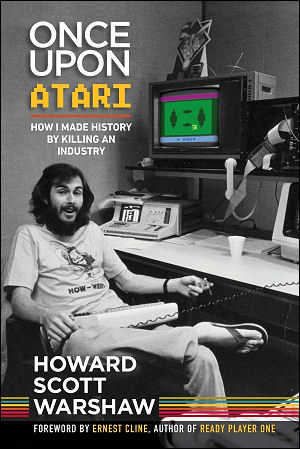
 Former Atari game designer and programmer Howard Scott Warshaw self-publishes his memoir, Once Upon Atari: How I Made History By Killing An Industry.
 Story: Howard Scott Warshaw, designer and programmer of such classic Atari 2600 games as Yars’ Revenge, Raiders Of The Lost Ark, and E.T.: The Extra-Terrestrial, looks back on his career and digs down into the claims that he’s responsible for one of the system’s best games ever (Yars’) and one of its worst (E.T.), the latter of which is credited with killing the American video game industry. But did E.T., or Warshaw, really do that?
Review: Howard Scott Warshaw is a really interesting guy. I say this having met him on a couple of occasions, but I also say it because I found it fascinating that someone who had to put up with years of being (unjustly) blamed for a game he created somehow single-handedly causing the fall of the early video game industry…would change careers and become a therapist, who counts other creatives in that industry among his clients. What better career trajectory could anyone embark on, if not that one? I was hoping that his memoir would cover that transition, and I was not disappointed in the slightest.
To put my own biases on the table: the Atari 2600 E.T. cartridge is far from the worst game ever made for that hardware platform – have the people making that claim ever even laid eyes on the Mythicon games? – nor did it topple the industry. But because it had the very high visibility of a heavily-promoted first-party title from Atari itself, it had an outsized target painted on its back. And a lot of the blame was retrospectively assigned by a generation of commentators who felt that, if this game caused the video game industry crash, this game brought a beloved part of their childhood to an end. Clearly this game, and its author, can never be forgiven for that. Unless, of course, you’re thinking clearly.
As Warshaw lays out in the book, due to a time crunch caused by lengthy haggling over the coveted E.T. game license, and when a game would have to be delivered in time for mass-production to have it in store shelves by Christmas 1982, he had five weeks to do the game. Five weeks for one person to conceptualize it, program it, do what little play testing he’s able to do himself, and send the code off for production. I’d dare anyone to have done better with that kind of schedule. (And here’s a hard truth for some of you reading this to swallow: it’s still not the worst-in-class gaming experience that some reviewers would have you believe it is.)
The author also details the academic life that led him to computer programming, and how that led to Atari, as well as far happier stories surrounding the creation of Raiders Of The Lost Ark and Yars’ Revenge for Atari. The stories are a bit crazy. Drugs were involved. So were decent sums of money, executives way out of their depth in industries they couldn’t comprehend, and rivalries within the company. It’s worthy of a movie. But the real meat happens when the video game industry does slam on the brakes, leaving the author in what I felt was an all-too-familiar relatable position of having to figure out his next move on the fly.
The pivot into therapy is really where the heart of the book is – that, and the fact that the urban legends of E.T. destroying an industry and kicking everyone’s puppy simply not going away until evidence to the contrary is literally dug up at an Alamagordo landfill with Warshaw in attendance. But those two stories are intertwined. After years of having that disproportionate level of blame heaped on you, most of us would wind up in therapy as a patient. The author took it a step further and became a practitioner – one who almost certainly has a truly unique viewpoint. The combination of those two stories means this book is chock full of really good advice for anyone in a creative field. That advice may, in fact, be the real value that lies in these pages. The fact that the advice sneaks in between anecdotes in a heartfelt, humorously-told memoir is even better. Once Upon Atari is top-tier, absolutely one of the best video game designer memoirs in an increasingly crowded genre.
Year: December 14, 2020
Author: Howard Scott Warshaw
Publisher: Scott West Productions
Pages: 328
Book review by Earl Green