
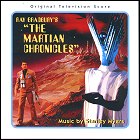
 Stanley Myers’ soundtrack from the 1979 miniseries The Martian Chronicles is released on CD.
 I barely remember the lavish 1979 British/U.S. co-production of Ray Bradbury’s The Martian Chronicles. I seem to remember being hyped up about it (as I was about most anything that had to do with space), seeing a little bit of it, and then my mom deciding unilaterally that this miniseries was Not For Me. And oddly enough, I haven’t seen it in its entirety since, despite it being on DVD these days. (That’s a gap in my SF TV knowledge I need to correct one of these days, come to think of it.) But boy, do I remember the music. I had already seen Battlestar Galactica and Buck Rogers (and, of course, Star Wars) by this point, but The Martian Chronicles clearly had Music From The Future. With its futuristic synth sweeps giving it a foothold in the new wave sound while its orchestral components were firmly tied to the disco-fied ’70s, The Martian Chronicles’ music is bold, brassy, memorable, and that spacey element pushes it just far enough across the line to make it sound, musically, a bit like a science fiction version of Dallas.
Anchoring the entire theme as a heavily-used (and very adaptable) leitmotif is the “Space March”, which appears in its full form several times during the album. (The fullest expression of it is in the track “The Silver Locusts”; the track actually titled “Space March” is much more brief.) Elements of this theme eventually split off on their own and become a brooding, serious theme that recurs in many of the later scenes, as heard in such cues as “Million Year Picnic”. The action and suspense cues turn out to be the bits that haven’t aged gracefully, instantly dating themselves to the 1970s with disco-style guitar work and percussion.
 And yet, for all of these things that should be fatal blows, the music from The Martian Chronicles works quite well in its own little continuum. The late British composer Stanley Myers (who composed, among a great many other things, a very early Doctor Who adventure) did a great job of devising very adaptable themes and motifs, and then developing those fully. It may come across as a bit cheesy according to modern sensibilities, but it’s a musical time capsule of sorts, and one that I enjoy returning to quite a bit.
The Expeditions
- Prologue (2:19)
- The Martian Chronicles Theme (2:03)
- Space March (0:59)
- Ylla’s Dream (1:39)
- Mask Of Conflict (2:19)
- Mr. K Returns (1:22)
- Concern For The Future (0:44)
- Mrs. Black’s Piano (1:13)
- Realization (0:11)
- Saying Goodbye (1:24)
- Col. Wilder’s Promise (3:14)
- Spender’s Anger / One Of Our Own (2:26)
- Martian City (2:37)
- Hunting Spender / Is This How It Will Be? (3:43)
The Settlers
- The Silver Locusts (2:39)
- Lustig’s Visitor (4:03)
- Return To The Dead City (2:01)
- David Is Confused (1:18)
- Chase In First Town (1:25)
- Father Peregrine’s Vision (4:55)
- Col. Wilder’s Thoughts / Rumors Of War (1:32)
- The Martian Appears (0:18)
- Parkhill Sees Earth Destroyed (0:40)
- Dead Earth (0:37)
The Martians
- Final Conflict (1:56)
- Hathaway’s Last Chance (0:52)
- Lights In The Sky (2:06)
- Ben And Genevieve (2:41)
- Never Give Up Hope (0:59)
- Hathaway Dies (1:03)
- Martian Highway (0:46)
- Memories (1:07)
- Placing The Explosives / Canal Journey (2:36)
- Setting Up Camp (1:13)
- The Million Year Picnic (2:53)
- End Titles / bonus track: Source Music (4:52)
Released by: Airstrip One Company
Release date: 2002
Total running time: 68:45
2007 music review by Earl Green