
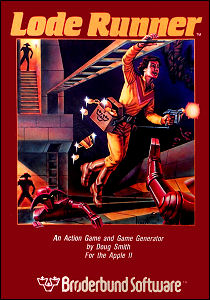
 Broderbund Software introduces the earliest versions of Doug Smith’s computer game Lode Runner, including the Atari Home Computer version. Inspired by the obscure arcade game Space Panic, Lode Runner gives players a weapon that digs rather than directly disabling enemies. A game franchise spanning multiple platforms and decades is spawned.
The Game: Cavernous rooms are loaded with gold, just ripe for the picking. But before you celebrate hitting the mother lode, look again – there are other gold-diggers homing in on the treasure. What do you have that they don’t? A drill gun that can blast a hole in the floors, into which your opponents will jump blindly. Eventually, the holes will reseal themselves, and that process will swallow your enemies (and you, if you happen to be clumsy enough to wander into the hole yourself). Grabbing all of the gold will reveal a passage to the next level of the game. (Broderbund, 1983)
Memories: Originally designed and programmed on the Apple II, Lode Runner impressed Broderbund enough that ports to other systems were a high priority. But a major difference in the control scheme for the Apple and Atari computers caused Lode Runner to lose something in translation.
 The controller ports on the original Apple II series computers were designed for a pair of paddles sharing a common connector cord: two single-axis controllers, each with a single action button. When the first joysticks were put on the market for the Apple II, they used the same control ports, using the two analog axes for a single controller, and giving the player two separate buttons on the same controller. Atari’s home computers used the controllers already designed for the Atari VCS, and this becomes a game-changer for Lode Runner.
If one had played the Apple version first, it was easy to be spoiled by those two buttons: one to dig left and one to dig right. (Future versions of the game also used this as the default control scheme: well into the reign of the NES and Game Boy, the two-button system was the only way to fly… or, in this case, dig.) The version of Lode Runner released for the Atari 8-bit machines forced the player to face the direction he wished to dig, leaving his back exposed.
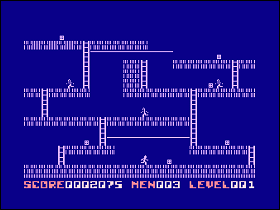
Players who hadn’t experienced Lode Runner with two action buttons probably just thought the game was tough to the point of being unfair. Additionally, while the Apple version had to deal with a limited color palette in that machine’s notoriously finicky hi-res graphics mode, the Atari edition had fewer restrictions – and still favored a graphical look that appeared to be made for a monochrome monitor.
 Lode Runner is the same game on the Atari home computers that it was elsewhere, but the changed control scheme and the watered-down graphics make it less like the game that debuted on the Apple II – and inferior to future editions on platforms that weren’t limited to a single fire button.
A Phosphor Dot Fossil examined by Earl Green